
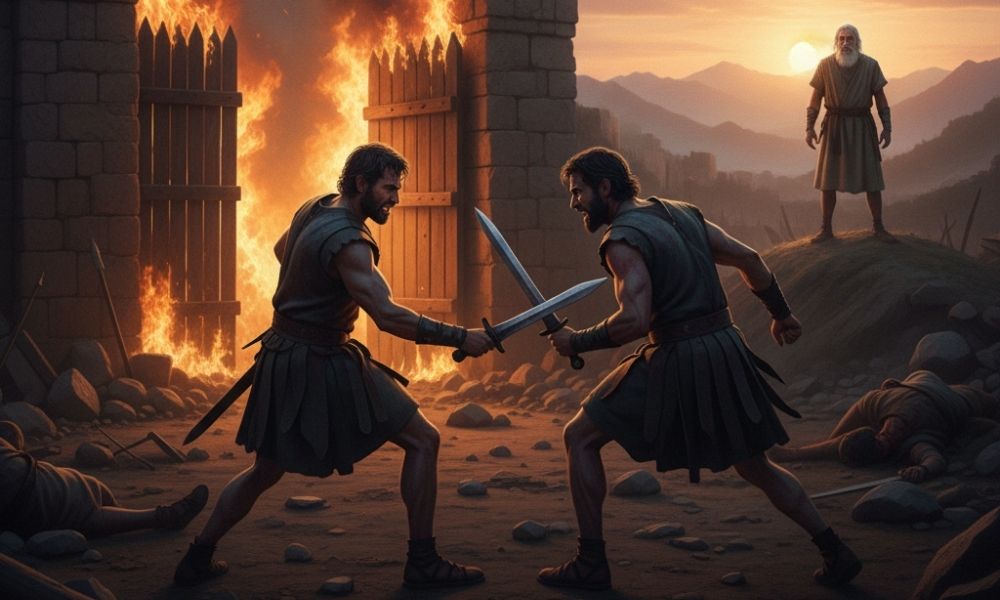
Simeon was the second son of Jacob and Leah — a man of fierce zeal, passion, and strength. Alongside his brother Levi, he acted boldly to defend family honor but also brought judgment upon himself through violence. His life illustrates how unchecked anger can destroy blessing, yet God’s covenant faithfulness endures through mercy and discipline.
Name: Simeon (Hebrew: Shim‘on, meaning “Heard” or “One who hears”)
Tribe/Nation: Israel (Tribe of Simeon)
Era: Patriarchal Period (~19th century BCE)
Father: Jacob (Israel)
Mother: Leah
Brothers: Reuben, Levi, Judah, Issachar, Zebulun, and six others
Home: Canaan → Egypt (during the famine)
Book: Genesis (Chapters 29–49)
Key Virtues: Zeal, loyalty to family
Key Flaws: Anger, cruelty, impulsiveness
Legacy: Ancestor of the Tribe of Simeon; remembered for zeal that lacked restraint
Symbol: Sword — representing both vengeance and judgment
Name Meaning
Simeon means “Heard,” from Leah’s words when he was born: “Because the LORD has heard that I am unloved, He has given me this son also” (Genesis 29:33). His name reflects God’s compassion toward Leah and His attentiveness to human sorrow.
Lineage / Family Background
Simeon was the second son of Jacob and Leah, born after Reuben. He grew up during the years Jacob served Laban in Haran and became one of the twelve patriarchs whose descendants formed the nation of Israel.
- Grandfather: Isaac
- Great-grandfather: Abraham
- Father: Jacob
- Mother: Leah
- Brothers: Reuben (older), Levi (younger), Judah, and others
- Half-Brothers: Joseph and Benjamin (sons of Rachel)
Major Roles / Identity
- Second son of Jacob and Leah
- Avenger of family honor after the violation of Dinah
- Co-leader (with Levi) of the attack on Shechem
- Patriarch of the Tribe of Simeon
Key Character Traits
- Fierce and Passionate: Quick to act in anger and vengeance.
- Loyal: Deeply protective of family honor.
- Impulsive: Allowed emotion to overrule wisdom.
- Fearless: Displayed boldness in battle and justice, even if misguided.
Main Life Events
- Birth and Naming: Leah named him Simeon, saying, “Because the LORD has heard that I am unloved” (Genesis 29:33).
- Revenge on Shechem: When their sister Dinah was violated by Shechem, Simeon and Levi deceived the men of the city and killed them all in vengeance (Genesis 34:25–26).
- Jacob’s Displeasure: Jacob rebuked Simeon and Levi for their violence: “You have brought trouble on me by making me obnoxious to the inhabitants of the land” (Genesis 34:30).
- Joseph’s Captivity Plot: Simeon joined his brothers in selling Joseph into slavery (Genesis 37:19–28).
- Imprisonment in Egypt: Years later, Joseph (disguised as Egypt’s governor) detained Simeon as a hostage while testing his brothers’ repentance (Genesis 42:24).
- Jacob’s Final Blessing: Before dying, Jacob prophesied,
“Simeon and Levi are brothers;
their swords are weapons of violence…
I will scatter them in Jacob
and disperse them in Israel” (Genesis 49:5–7).
Major Relationships
- Jacob: His father, who loved him but condemned his violent actions.
- Leah: His mother, who named him in hope of God’s compassion.
- Levi: His closest ally and partner in vengeance at Shechem.
- Joseph: His younger half-brother, whose enslavement he helped orchestrate and later suffered guilt for.
- Brothers: United in family struggles but divided in character and destiny.
Notable Passages
- Genesis 29:33: “Because the LORD has heard that I am unloved, He has given me this son also.”
- Genesis 34:25–26: “Simeon and Levi, Dinah’s brothers, took their swords and attacked the unsuspecting city, killing every male.”
- Genesis 49:5–7: “Cursed be their anger, so fierce, and their fury, so cruel! I will scatter them in Jacob and disperse them in Israel.”
- Genesis 42:24: “Then Joseph took Simeon from them and bound him before their eyes.”
Legacy & Impact
Simeon’s descendants formed one of the twelve tribes of Israel, but as Jacob prophesied, the Tribe of Simeon was later scattered among the territory of Judah (Joshua 19:1–9). Despite this, they remained part of God’s covenant people.
- Known for courage and battle skill
- Their dispersion fulfilled Jacob’s prophecy but also allowed them to integrate within Judah’s blessing
- A reminder that zeal must be guided by righteousness
Symbolism / Typology
- Sword: Represents zeal without restraint — passion that must be purified by God’s Spirit.
- Scattering: Symbol of divine discipline and restoration through integration into Judah.
- Leah’s Hope: Through Simeon, God showed He “hears” — even those who feel unloved or overlooked.
Extra-Biblical References
- Jewish tradition sees Simeon as impulsive but loyal, a man of deep feeling whose zeal needed refining.
- Rabbinic writings associate his tribe with fierce warriors and defenders of justice.
- Some Christian commentators see in Simeon a warning that uncontrolled zeal can destroy one’s inheritance, yet also hope that divine mercy redeems even the passionate and flawed.







Leave a Reply