
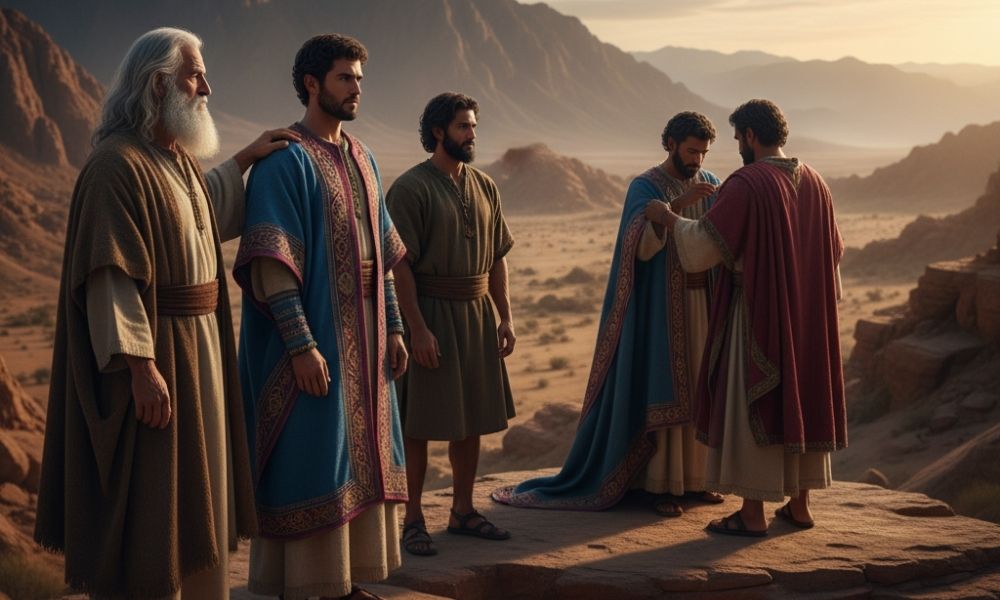
Eleazar was a prominent priest in ancient Israel, known for his faithfulness, leadership, and dedication to God’s service. As the third son of Aaron and nephew of Moses, Eleazar played a vital role in maintaining the priestly line and guiding Israel during its journey through the wilderness and into the Promised Land. His life symbolizes obedience, sacred duty, and the preservation of divine order among God’s people.
Quick Facts
Name: Eleazar (Hebrew: אֶלְעָזָר, Elʿazar — “God has helped”)
Tribe: Levi (descendant of Aaron)
Father: Aaron (the first high priest of Israel)
Mother: Elisheba, daughter of Amminadab
Brothers: Nadab, Abihu, and Ithamar
Spouse: One of the daughters of Putiel (Exodus 6:25)
Children: Phinehas (his successor)
Era: Exodus and Conquest (13th–12th century BCE)
Role: High Priest of Israel after Aaron’s death
Symbol: Priestly garments and the Urim and Thummim — representing divine guidance
Name Meaning
“Eleazar” means “God has helped.” The name reflects his life’s testimony — that divine aid and faithfulness sustain those who serve God with integrity and devotion.
Lineage and Role
As the third son of Aaron, Eleazar was consecrated to serve as a priest alongside his father and brothers. After the deaths of his elder brothers Nadab and Abihu (for offering unauthorized fire before the Lord, Leviticus 10:1–2), Eleazar succeeded Aaron as High Priest. He became the chief mediator between God and Israel, carrying the sacred duties of worship, sacrifice, and guidance.
Major Life Events
- Servant of the Tabernacle: Assisted Aaron in maintaining sacred duties and offerings (Numbers 3:32).
- Custodian of Holy Objects: Oversaw the holy vessels and the anointing oil (Numbers 4:16).
- Succeeded Aaron as High Priest: After Aaron’s death on Mount Hor, Eleazar received the priestly garments and continued his father’s sacred office (Numbers 20:26–28).
- Guided Israel during Joshua’s Leadership: Worked alongside Joshua during the conquest and division of Canaan (Joshua 14:1; 19:51).
- Father of Phinehas: His son zealously defended God’s holiness and later became High Priest.
Character and Virtues
- Faithfulness: Obeyed God’s commands without compromise.
- Steadfast Leadership: Ensured continuity of the priesthood and stability among Israel’s tribes.
- Holiness: Upheld purity in worship and sacred rituals.
- Wisdom: Served as a counselor and spiritual guide in Israel’s transition into the Promised Land.
Legacy and Impact
Eleazar’s priesthood bridged the era of Moses and Joshua, ensuring that God’s covenant and worship remained central to Israel’s national life. His faithfulness preserved the line of Aaron and prepared the way for future priests and prophets. Through his lineage came Phinehas, whose zeal and righteousness earned an “everlasting covenant of priesthood” (Numbers 25:10–13).
Notable Passages
- Numbers 3:32: Eleazar is appointed chief over the leaders of the Levites.
- Numbers 20:25–28: Aaron’s garments are transferred to Eleazar on Mount Hor.
- Joshua 14:1: Eleazar helps Joshua distribute the Promised Land among the tribes.
Symbolism and Typology
- Eleazar — symbolizes faithful priesthood and divine guidance through obedience.
- Aaron’s Vestments — represent the sacred transfer of God’s covenantal authority.
- His Son Phinehas — foreshadows God’s reward for zeal and righteousness.







Leave a Reply