
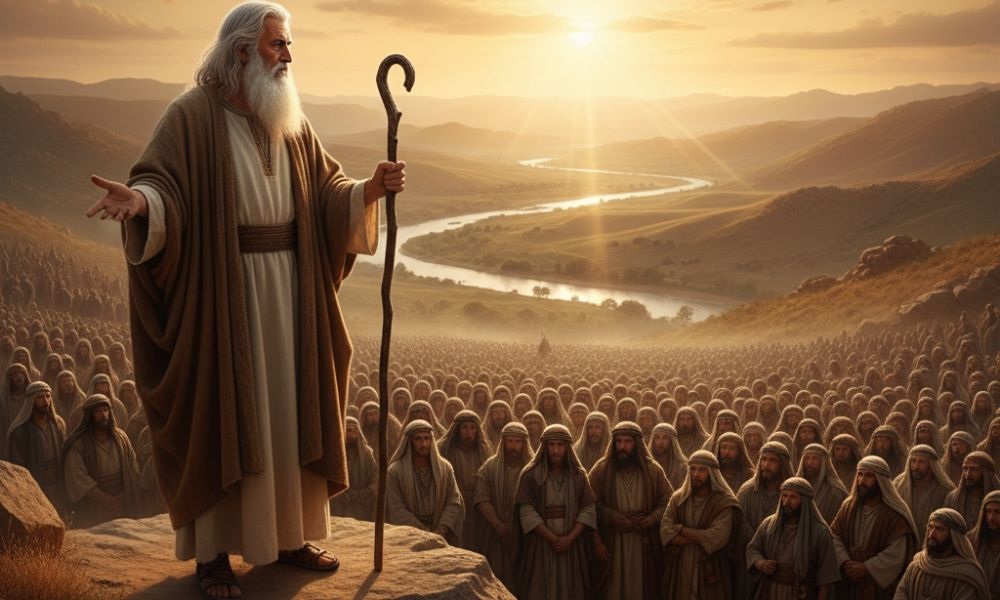
The Book of Deuteronomy is the fifth and final book of the Torah (or Pentateuch), traditionally attributed to Moses. It serves as a profound conclusion to the first five books of the Bible, summarizing God’s covenant with Israel and calling His people to renewed faithfulness before entering the Promised Land. The title “Deuteronomy” means “Second Law”, derived from the Greek Deuteronomion, as it repeats and reinforces the laws given earlier in Exodus, Leviticus, and Numbers.
Deuteronomy is both a theological reflection and a farewell address from Moses, urging Israel to remember God’s faithfulness, obey His commands, and remain loyal to Him alone.
Quick Facts
Hebrew Name: Devarim (“Words”)
Meaning of Title: “Second Law” or “Repetition of the Law”
Author: Traditionally Moses
Era: End of Israel’s 40 years in the wilderness (~1406 BCE)
Setting: Plains of Moab, east of the Jordan River
Audience: The new generation of Israelites before entering Canaan
Chapters: 34
Main Theme: Covenant renewal and obedience to God’s law
Key Verse: Deuteronomy 6:5 — “Love the LORD your God with all your heart and with all your soul and with all your strength.”
Overview and Structure
Deuteronomy consists primarily of three speeches delivered by Moses before his death:
- First Discourse (Chs. 1–4):
A historical review of Israel’s journey from Egypt to the edge of Canaan, emphasizing God’s guidance and Israel’s failures. - Second Discourse (Chs. 5–26):
The heart of the book — a restatement of the Law (including the Ten Commandments) and detailed instructions for worship, justice, and community life. - Third Discourse (Chs. 27–30):
Covenant renewal — blessings for obedience, curses for disobedience, and a call to choose life by loving and obeying God.
The book concludes (Chs. 31–34) with Moses’ final blessings, the commissioning of Joshua, and the death of Moses on Mount Nebo.
Major Themes
- Covenant Renewal:
God reaffirms His covenant with the new generation entering the Promised Land. - Obedience and Blessing:
Obedience brings life and blessing; disobedience brings curse and exile. - Love for God:
The central command is wholehearted love and devotion to God (Deut. 6:4–5 — the Shema). - Social Justice and Compassion:
Emphasis on caring for the poor, widows, orphans, and foreigners (Deut. 10:18–19; 24:17–22). - God’s Sovereignty and Faithfulness:
The Lord alone is God — faithful to His promises and deserving of Israel’s exclusive worship.
Key Passages
- Deuteronomy 5: Repetition of the Ten Commandments.
- Deuteronomy 6:4–9: The Shema — “Hear, O Israel: The LORD our God, the LORD is one.”
- Deuteronomy 8: Warning not to forget God amid prosperity.
- Deuteronomy 28: Blessings and curses — consequences of obedience or disobedience.
- Deuteronomy 30:19–20: “I have set before you life and death, blessings and curses. Now choose life…”
Theological Significance
Deuteronomy is foundational for understanding biblical covenant theology. It teaches that true worship involves both love and obedience, not ritual alone. It also sets the moral and spiritual tone for Israel’s national life and becomes a key influence on later prophets and on Jesus Himself.
Jesus quoted Deuteronomy frequently — especially during His temptation (Matthew 4:1–11) — showing its central place in the life of faith.
Legacy and Influence
- Forms the theological foundation for Joshua–Kings, known as the Deuteronomistic History.
- Shapes Israel’s understanding of covenant, law, and obedience.
- The Shema remains a central declaration of faith in Judaism.
- In Christianity, it points forward to the new covenant in Christ, who fulfills the law perfectly.







Leave a Reply