
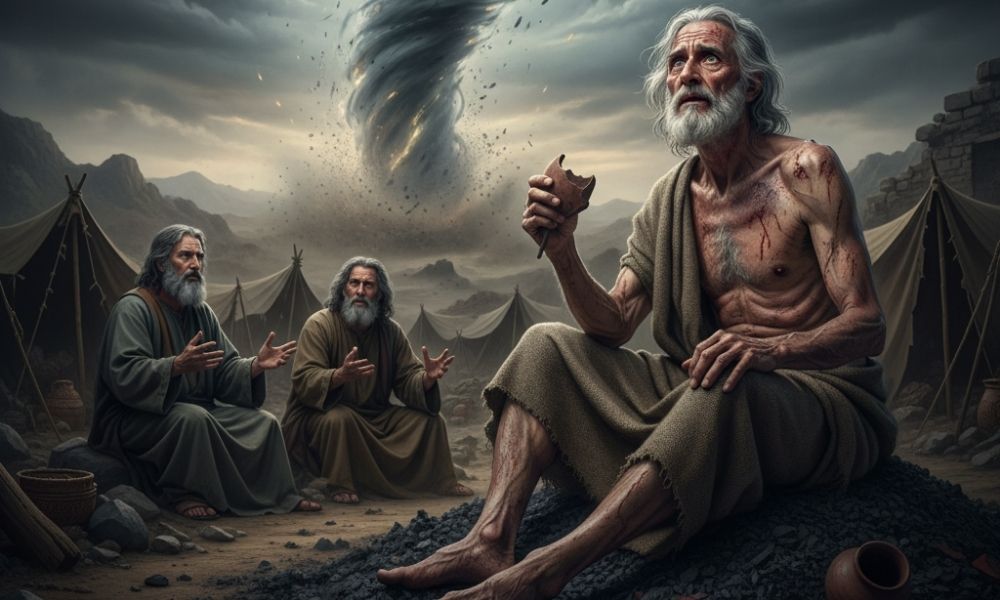
Job is the central figure of the Book of Job, renowned for his unwavering faithfulness to God amidst catastrophic suffering. His story explores the deep mysteries of pain, righteousness, and divine sovereignty. Though tested by Satan with the loss of his family, wealth, and health, Job’s agonizing spiritual journey ultimately leads him to a profound, personal encounter with God, demonstrating the limits of human understanding and the ultimate goodness of the Creator.
- Name: Job (Hebrew: Iyyov, meaning “Persecuted,” “Hated,” or “Object of Enmity”)
- Tribe/Nation: From the land of Uz (location uncertain, likely east or southeast of Palestine)
- Era: Patriarchal period (content suggests a time contemporary with or before Moses, possibly around the time of Abraham)
- Occupation/Role: Wealthy landowner, patriarch, “blameless and upright” man
- Family: Wife (unnamed), seven sons, and three daughters (all died, later restored with seven new sons and three new daughters)
- Home: The land of Uz
- Book: The Book of Job (42 chapters)
- Key Virtues: Faithfulness, integrity, righteousness, perseverance
- Legacy: The foremost biblical example of undeserved suffering and steadfast faith; a model of wrestling with God in pain.
- Symbol: A potsherd (for scraping his sores) or a whirlwind (from which God speaks)
Name Meaning
“Job” (Hebrew: Iyyov) is often translated as “persecuted” or “hated.” This name poignantly reflects his story, as he becomes the target of Satan’s accusations and endures immense, seemingly hostile suffering, feeling abandoned by God and man.
Lineage / Family Background
- Origin: A non-Israelite man from the land of Uz. His piety exists outside the Abrahamic covenant, highlighting universal wisdom and faith.
- Wife: Unnamed in the text; famously tells Job to “curse God and die” (Job 2:9).
- First Family: Seven sons and three daughters, all killed simultaneously in a disaster (Job 1:18–19).
- Restored Family: After his trial, God blesses him with seven sons and three new daughters (Job 42:13).
- Friends: Eliphaz, Bildad, and Zophar, who come to “comfort” him but instead offer flawed theological arguments. A fourth man, Elihu, speaks later.
Biblical Era / Context
- Time: The setting feels ancient, likely during the Patriarchal Era (c. 2000–1500 BCE). The lack of reference to the Mosaic Law, Job’s role as family priest, and his long life support this.
- Setting: Begins in the land of Uz, then moves to a place of suffering (an ash heap outside the city). The narrative also includes scenes in the heavenly court.
- Cultural Context: The book grapples with the dominant “retributive justice” theology (the righteous prosper, the wicked suffer), which Job’s suffering directly challenges.
Major Roles / Identity
- A “blameless and upright” man who feared God (Job 1:1)
- A symbol of innocent human suffering
- A defendant of his own integrity against his accusers
- A theological wrestler, questioning God’s justice
- A restored patriarch
Key Character Traits
- Integrity: “In all this, Job did not sin by charging God with wrongdoing” (Job 1:22); “I will not deny my integrity” (Job 27:5).
- Perseverance: Endured immense loss without cursing God, though he cursed the day of his birth (Job 3).
- Honesty: Expressed his raw anguish, grief, and confusion directly to God.
- Righteousness: Described by God Himself as “blameless and upright” (Job 1:8).
- Humility: Ultimately humbles himself when confronted by God’s sovereignty and wisdom (Job 42:1–6).
Main Life Events
- The Heavenly Challenge: Satan challenges God about Job’s faithfulness (Job 1:6–12).
- First Test: Loses his livestock, servants, and all ten children in one day (Job 1:13–19).
- Second Test: Afflicted with painful sores from head to toe (Job 2:7).
- The Debate: Engages in a long, agonizing debate with his friends (Eliphaz, Bildad, and Zophar) about the cause of his suffering (Job 3–31).
- Elihu’s Speech: A younger man, Elihu, rebukes both Job and his friends (Job 32–37).
- God Speaks: God finally answers Job from a whirlwind, challenging Job’s understanding and revealing His own sovereignty and wisdom (Job 38–41).
- Job’s Repentance: Job acknowledges God’s power and his own ignorance (Job 42:1–6).
- Restoration: God rebukes Job’s friends, restores Job’s fortunes twofold, and blesses him with a new family (Job 42:7–17).
Major Relationships
- God (Yahweh): The central relationship of the book. Job’s faith is tested, and he wrestles directly with God’s silence and perceived injustice, ultimately finding deeper intimacy.
- Satan: The “accuser” who initiates the test of Job’s faith.
- Job’s Wife: Encapsulates despair, goading him to abandon his faith (Job 2:9).
- Eliphaz, Bildad, and Zophar: His “miserable comforters” (Job 16:2) who represent rigid, conventional theology, arguing that Job must have sinned to deserve his suffering.
Notable Passages
- Job 1:21: His initial response to loss — “Naked I came from my mother’s womb, and naked I will depart. The LORD gave and the LORD has taken away; may the name of the LORD be praised.”
- Job 13:15: His declaration of faith amidst despair — “Though he slay me, yet will I hope in him; I will surely defend my own ways to his face.”
- Job 19:25–26: His famous cry of hope — “I know that my Redeemer lives, and that in the end he will stand on the earth. And after my skin has been destroyed, yet in my flesh I will see God.”
- Job 42:5: His final understanding — “My ears had heard of you, but now my eyes have seen you.”
Legacy & Impact
- Job’s story challenges simplistic “prosperity gospel” or “retributive justice” theologies.
- Provides a profound model for how to (and how not to) comfort those who are suffering.
- Demonstrates that it is possible to maintain faith in God while simultaneously questioning, lamenting, and expressing honest doubt and anger.
- His name is synonymous with extreme patience and perseverance (James 5:11).
Symbolism / Typology
- Job: A figure of innocent suffering, sometimes seen as a prefigurement of Christ, the perfectly righteous one who suffered unjustly for a divine purpose.
- The Whirlwind: Represents God’s awesome power and majestic mystery, a force that is untamable and beyond human comprehension.
- The Ash Heap: Symbolizes utter desolation, mourning, and repentance.
- Behemoth & Leviathan: Symbols of God’s sovereign control over all creation, including forces of chaos that humans cannot tame.
Extra-Biblical References
- Job is mentioned in the New Testament as an example of perseverance: “You have heard of Job’s perseverance and have seen what the Lord finally brought about” (James 5:11).
- He is mentioned alongside Noah and Daniel as a great righteous figure in the Old Testament (Ezekiel 14:14, 20).
- Job’s story is a foundational text in Christian and Jewish theodicy (the defense of God’s goodness in the face of evil).







Leave a Reply