
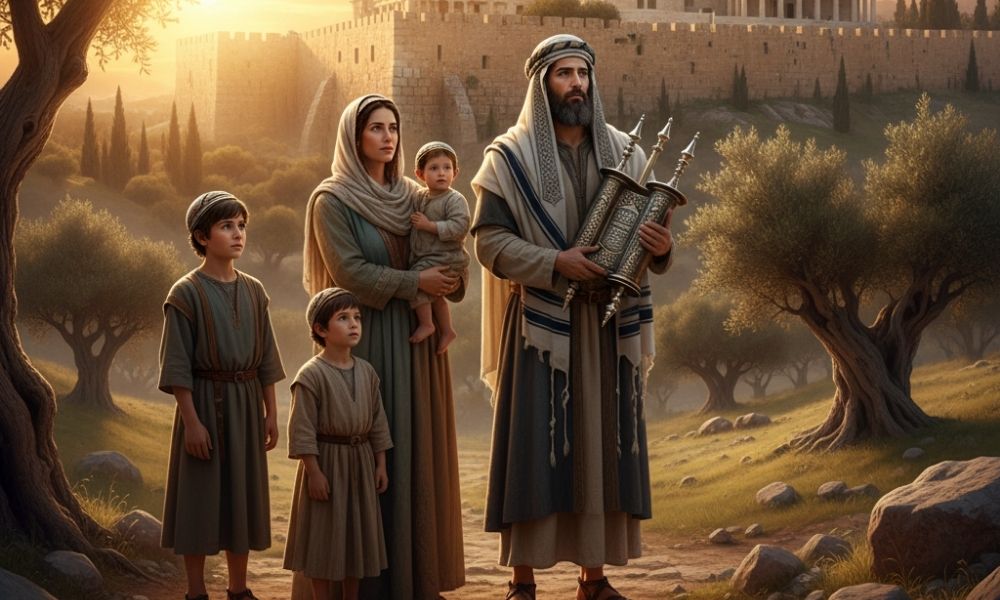
The Jews are the descendants of Abraham, Isaac, and Jacob (Israel) — the covenant people chosen by God to bear His law, preserve His Word, and bring forth the Messiah. Their history, rooted in God’s promises, reveals a story of faith, covenant, exile, restoration, and enduring hope. The Jewish people have played a central role in the unfolding of God’s redemptive plan throughout Scripture and history.
Quick Facts
Name: Jews (from “Judah,” one of the twelve tribes of Israel)
Ancestry: Descendants of Abraham, Isaac, and Jacob
Language: Hebrew (ancient and modern)
Homeland: The Land of Israel (Canaan / Palestine)
Religion: Judaism — belief in one God (Yahweh) and observance of the Torah
Key Books: Genesis–Malachi (Old Testament / Hebrew Bible)
Symbol: The Star of David (modern), the Menorah (biblical and temple symbol)
Origins and Covenant
The Jewish people trace their origin to Abraham, whom God called from Ur and made a covenant with, promising him:
- A land (Canaan)
- A nation (his descendants)
- A blessing to all nations (Genesis 12:1–3)
Through Isaac and Jacob, the covenant continued. Jacob, renamed Israel, had twelve sons who became the twelve tribes of Israel, the foundation of the Jewish nation.
Formation as a Nation
Under Moses, the descendants of Israel were delivered from slavery in Egypt and received the Law (Torah) at Mount Sinai — establishing them as God’s covenant people (Exodus 19–20).
Key events include:
- Exodus from Egypt
- Wilderness wandering
- Conquest of Canaan under Joshua
- The Kingdoms of David and Solomon
- The Babylonian exile and return
Their covenant relationship centered on worship, obedience, and holiness before God.
Faith and Identity
The Jewish faith, Judaism, is one of the world’s oldest monotheistic religions, emphasizing:
- Belief in one God (Deuteronomy 6:4 — “Hear, O Israel: The LORD our God is one LORD”)
- Observance of the Torah (Law of Moses)
- Sabbath and festivals (Passover, Shavuot, Yom Kippur, etc.)
- Hope for the Messiah and God’s kingdom
Historical Journey
The Jews experienced both triumph and tragedy:
- Exile and Return: From Babylon back to Jerusalem under Ezra and Nehemiah
- Second Temple Period: Rebuilding of faith and identity
- Roman Occupation: The era into which Jesus was born
- Dispersion (Diaspora): Scattering across nations after the destruction of Jerusalem in AD 70
- Modern Israel (1948): The reestablishment of the Jewish homeland
Throughout history, they preserved their language, faith, and customs despite persecution — a testimony to God’s covenant faithfulness.
Theological Significance
The Jews are central to God’s redemptive plan:
- Through them came the Law, the Prophets, and the Messiah — Jesus Christ (Romans 9:4–5).
- God’s promises to Israel remain part of His eternal purpose.
- In Christ, the covenant blessing extends to all nations (Galatians 3:8).







Leave a Reply