
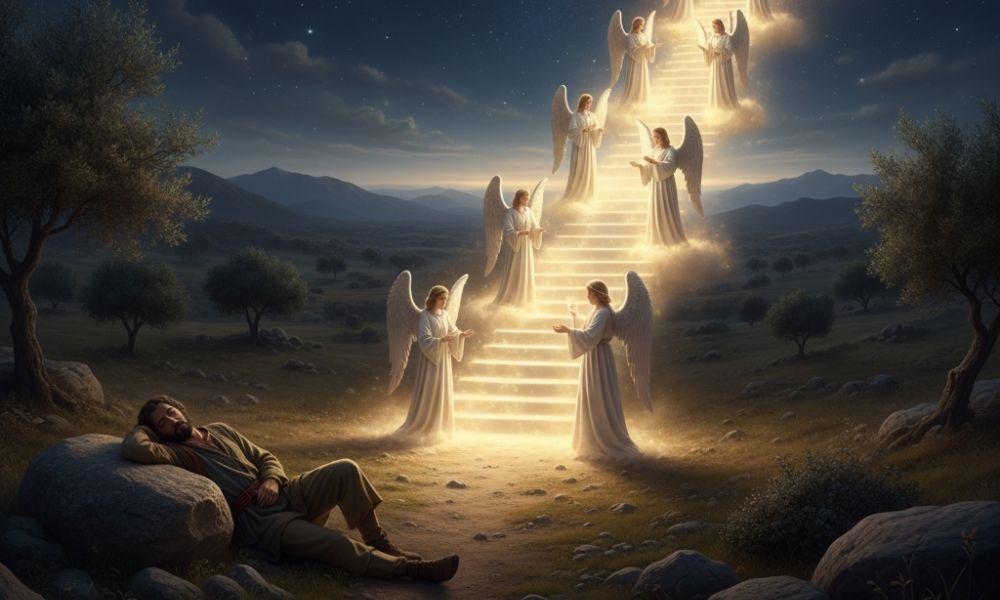
Jacob’s dream of the ladder at Bethel marks one of the most profound spiritual moments in Genesis. It takes place as he flees from his brother Esau after deceiving their father, Isaac. Alone and afraid, Jacob encounters God in a dream that reaffirms the covenant promise made to Abraham and Isaac. This vision transforms Jacob’s understanding of God—from a distant family deity to his personal protector and provider.
Quick Facts
Event: Jacob’s dream of the heavenly ladder at Bethel
Key Figures: Jacob and God
Primary Source: Genesis 28:10–22
Era: Patriarchal Age
Location: Bethel (formerly called Luz), in Canaan
Symbol: A stairway or ladder reaching from earth to heaven, with angels ascending and descending
Consequence: Jacob receives divine assurance, names the place “Bethel” (“House of God”), and vows his allegiance to God
Context of the Event
After deceiving Isaac and stealing Esau’s blessing, Jacob fled from Beersheba toward Haran to escape his brother’s wrath. It was a long and uncertain journey, and as night fell, he stopped to rest in the open wilderness. Using a stone as a pillow, Jacob lay down to sleep, burdened by fear and guilt but unaware that he was about to encounter God personally.
The Dream and the Vision
During the night, Jacob dreamed of a ladder—or stairway—set up on the earth, reaching to heaven, with angels ascending and descending upon it. Above the ladder stood the Lord, who spoke directly to Jacob, reaffirming the covenant given to Abraham and Isaac.
God said:
“I am the Lord, the God of your father Abraham and the God of Isaac.
I will give you and your descendants the land on which you are lying.
Your descendants will be like the dust of the earth…
All peoples on earth will be blessed through you and your offspring.
I am with you and will watch over you wherever you go.” (Genesis 28:13–15, NIV)
This was God’s promise of land, descendants, blessing, and divine presence—assuring Jacob that the covenant continued through him, despite his failures.
Jacob’s Awakening and Response
When Jacob awoke, he was filled with awe and said:
“Surely the Lord is in this place, and I was not aware of it.” (Genesis 28:16, NIV)
Frightened yet amazed, he exclaimed, “How awesome is this place! This is none other than the house of God; this is the gate of heaven.”
The next morning, Jacob set up the stone he had used as a pillow, poured oil on it, and named the place Bethel, meaning “House of God.” He made a vow that if God protected and provided for him, the Lord would be his God, and he would return to honor Him with a tenth of all he received.
Key Characters
- Jacob: The fugitive son, burdened by guilt yet chosen by God, who experiences a personal revelation of divine presence.
- God: The covenant-keeping Lord who assures Jacob of His promises, protection, and presence.
Major Themes
- Divine Presence: God is not limited to places or people—He meets Jacob in exile, proving His nearness even in times of isolation.
- Grace and Renewal: Despite Jacob’s deceitful past, God reaffirms His covenant, revealing mercy and grace.
- Heaven and Earth United: The ladder symbolizes the connection between the divine and human realms, foreshadowing Christ as the true bridge between God and humanity (John 1:51).
- Faith Awakening: Jacob’s encounter marks his spiritual beginning—his faith shifts from inherited tradition to personal commitment.
- Covenant Continuity: God’s promises to Abraham and Isaac are passed on to Jacob, ensuring the unbroken line of the covenant family.
Key Passages
- Genesis 28:12 (NIV):
“He had a dream in which he saw a stairway resting on the earth, with its top reaching to heaven, and the angels of God were ascending and descending on it.” - Genesis 28:15 (NIV):
“I am with you and will watch over you wherever you go, and I will bring you back to this land.” - Genesis 28:16–17 (NIV):
“Surely the Lord is in this place, and I was not aware of it… How awesome is this place! This is none other than the house of God; this is the gate of heaven.”
Theological Significance
Jacob’s dream at Bethel reveals the faithfulness of God despite human failure. Though Jacob was fleeing because of his deceit, God graciously met him in mercy, not judgment. The vision of the ladder signifies that heaven is open, and God’s messengers are active on earth. In Christian theology, this image finds fulfillment in Jesus Christ, who connects heaven and earth, offering reconciliation and access to God (John 1:51).







Leave a Reply