
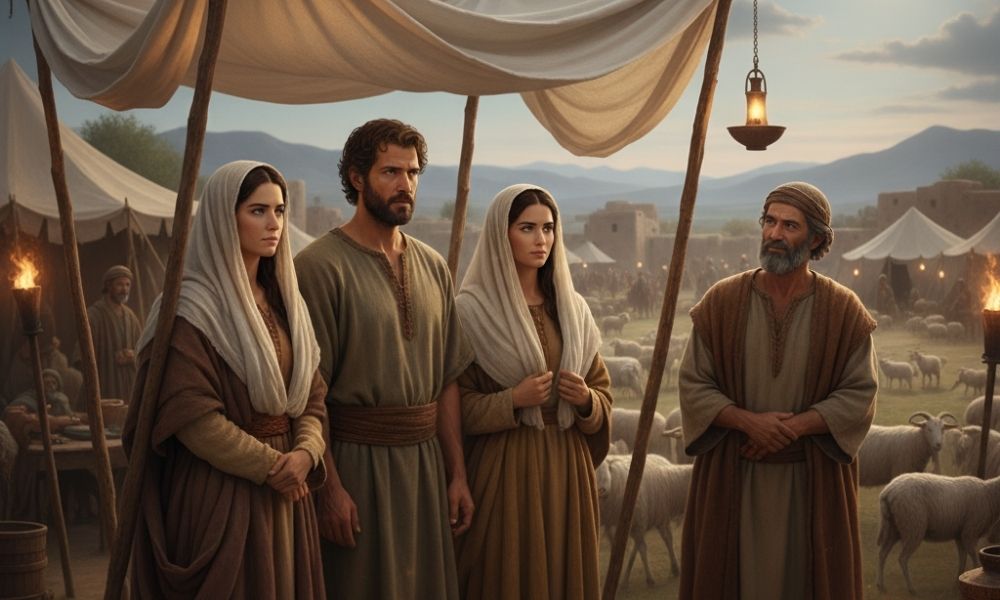
Jacob’s marriages to Leah and Rachel form one of the most dramatic and emotionally complex stories in Genesis. While seeking refuge from his brother Esau, Jacob arrives in Haran and meets Rachel, the daughter of his uncle Laban. Deeply in love, he agrees to work seven years to marry her. But on the wedding night, Laban deceives him, giving him Leah instead. Jacob later marries Rachel too, beginning a life of rivalry, heartache, and divine blessing that shapes the twelve tribes of Israel.
Quick Facts
Event: Jacob marries Leah and Rachel
Key Figures: Jacob, Laban, Leah, Rachel
Primary Source: Genesis 29:1–30
Era: Patriarchal Age
Location: Haran (in Mesopotamia)
Method: Jacob serves Laban for fourteen years in exchange for Rachel and Leah
Consequence: Family rivalry, divine blessing of children, and the founding of Israel’s twelve tribes
Context of the Event
After deceiving his father and stealing Esau’s blessing, Jacob fled to Haran, where his mother’s family lived. His journey was both an escape and a turning point—a chance for renewal and a new beginning. Upon arrival, Jacob encountered shepherds at a well and soon met Rachel, Laban’s younger daughter, tending her father’s sheep. Captivated by her beauty and kindness, Jacob helped water the flock and introduced himself as Rebekah’s son.
Jacob’s Love and Labor for Rachel
Jacob quickly fell in love with Rachel and agreed to serve Laban seven years to earn her hand in marriage. Scripture beautifully notes,
“Jacob served seven years to get Rachel, but they seemed like only a few days to him because of his love for her.” (Genesis 29:20, NIV)
However, when the time came, Laban deceived him. On the wedding night, he secretly substituted Leah, Rachel’s older sister, who was described as having “weak eyes” but a gentle spirit. In the dim light and under veils of custom, Jacob did not realize the deception until morning.
The Deception and Second Marriage
When Jacob confronted Laban, the older man justified his actions, saying, “It is not our custom here to give the younger daughter in marriage before the older one.” Laban offered Rachel as well—but only if Jacob agreed to work another seven years.
Jacob accepted. He completed Leah’s bridal week, then married Rachel, the one he loved, and began another seven years of service. Though Jacob loved Rachel more than Leah, both women would bear children (and through their maidservants) who would become the twelve tribes of Israel.
Leah and Rachel: Sisters in Rivalry
The household soon became a battleground of jealousy and sorrow.
- Leah, unloved by Jacob, was blessed by God with children—Reuben, Simeon, Levi, and Judah.
- Rachel, though deeply loved, was barren for many years and struggled with envy. She eventually bore Joseph and later Benjamin, but died giving birth to him.
Through this rivalry, God worked out His divine plan—bringing forth the ancestors of His covenant people.
Key Characters
- Jacob: A man of passion and persistence, who experiences in Haran the same kind of deceit he once practiced on others.
- Laban: The cunning uncle who exploits Jacob’s love for personal gain.
- Leah: The unloved but faithful wife, chosen by God to bear the tribe of Judah—the line of the Messiah.
- Rachel: The beloved wife, remembered for her beauty, sorrow, and the birth of Joseph, who would later save Israel from famine.
Major Themes
- Deception and Justice: Jacob, once a deceiver, becomes the deceived—God’s moral justice working quietly in his life.
- Love and Jealousy: Genuine love for Rachel contrasts with the pain of Leah’s rejection, highlighting the consequences of favoritism.
- God’s Sovereignty: Despite human flaws, God’s plan continues, bringing blessing through imperfect relationships.
- Fertility and Favor: God opens and closes wombs according to His purpose, showing that blessings come by His will, not by human effort.
- Formation of Israel: The marriages and children of Jacob form the foundation of the twelve tribes of Israel, fulfilling God’s covenant promise.
Key Passages
- Genesis 29:18 (NIV):
“Jacob was in love with Rachel and said, ‘I’ll work for you seven years in return for your younger daughter Rachel.’” - Genesis 29:25 (NIV):
“When morning came, there was Leah! So Jacob said to Laban, ‘What is this you have done to me?’” - Genesis 29:31 (NIV):
“When the Lord saw that Leah was not loved, he enabled her to conceive, but Rachel remained childless.”
Theological Significance
Jacob’s marriages to Leah and Rachel reveal how God’s purposes triumph through human imperfection. The deceit Jacob suffered mirrors his own earlier deception of Isaac, showing divine justice at work. Yet, through these flawed relationships, God fulfills His covenant—multiplying Jacob’s descendants into a great nation. From Leah’s line would come Judah, ancestor of King David and Jesus Christ, proving that God often works through the overlooked and unloved to accomplish His redemptive plan.







Leave a Reply