
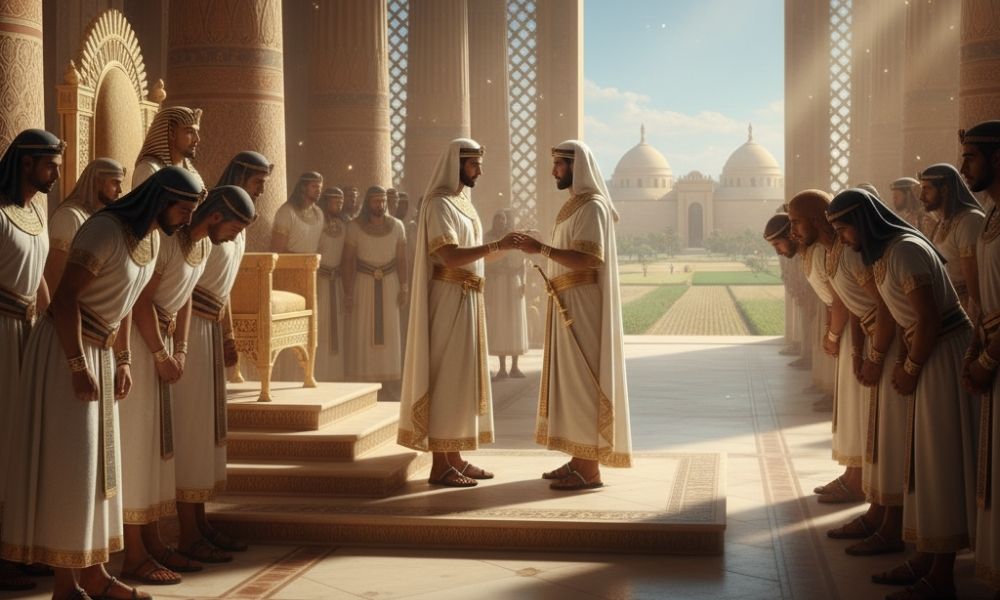
Joseph’s rise to power in Egypt is one of the most remarkable reversals in Scripture—a story of divine providence transforming a forgotten prisoner into a national leader. After interpreting Pharaoh’s troubling dreams with God-given wisdom, Joseph is elevated from captivity to command, entrusted with preparing Egypt for years of famine. His promotion fulfills God’s purpose not only for his life but for the preservation of Israel and surrounding nations.
Quick Facts
Event: Joseph is appointed governor of Egypt
Key Figures: Joseph, Pharaoh, Egyptian officials
Primary Source: Genesis 41:37–57
Era: Patriarchal Age
Location: Egypt, Pharaoh’s royal court
Symbol: Pharaoh’s signet ring, fine linen garments, and gold chain signifying authority
Consequence: Joseph governs Egypt wisely, stores grain for the famine, and becomes the instrument of God’s salvation
Context of the Event
After interpreting Pharaoh’s dreams—predicting seven years of plenty followed by seven years of severe famine—Joseph recommended a national plan of preparation. His proposal impressed Pharaoh and his counselors. Recognizing divine wisdom in Joseph, Pharaoh declared,
“Can we find anyone like this man, one in whom is the spirit of God?” (Genesis 41:38, NIV)
Pharaoh then elevated Joseph to the highest office in Egypt, second only to himself.
Joseph’s Appointment and Honors
Pharaoh formally installed Joseph as governor over all Egypt, granting him royal authority and honor:
- Signet Ring: Placed on Joseph’s hand, symbolizing royal power to make decrees in Pharaoh’s name.
- Fine Linen Robes and Gold Chain: Signs of dignity, status, and favor.
- Second Chariot: Pharaoh paraded Joseph through the streets as heralds cried, “Make way!”
Pharaoh renamed him Zaphenath-Paneah, meaning “God speaks and lives,” and gave him Asenath, daughter of Potiphera, priest of On, as his wife. Joseph was thirty years old when he began his service, fulfilling the dreams God had shown him as a youth.
Joseph’s Leadership During Prosperity
During the seven years of abundance, Joseph traveled throughout Egypt organizing massive grain collection. He stored grain in every city, gathering so much that “it was beyond measure.” His administrative skill and foresight ensured Egypt’s stability and prosperity.
“Joseph stored up huge quantities of grain, like the sand of the sea; it was so much that he stopped keeping records because it was beyond measure.” (Genesis 41:49, NIV)
During this time, Joseph’s household also grew. He and Asenath had two sons:
- Manasseh (“God has made me forget all my trouble”)
- Ephraim (“God has made me fruitful in the land of my suffering”)
Joseph’s Wisdom in Famine
When the seven years of famine arrived, the entire land suffered hunger. But in Egypt, there was bread—because God had given Joseph foresight. As famine spread beyond Egypt’s borders, people from other nations came to buy grain from Joseph. Thus, Joseph became the channel of God’s provision to the known world.
“And all the world came to Egypt to buy grain from Joseph, because the famine was severe everywhere.” (Genesis 41:57, NIV)
Key Characters
- Joseph: The faithful servant elevated to ruler, embodying wisdom, humility, and God’s favor.
- Pharaoh: The king who recognized divine presence in Joseph and trusted him completely.
- Asenath: Joseph’s Egyptian wife, through whom he had two sons who would later become tribes of Israel.
Major Themes
- Divine Providence: God orchestrates Joseph’s rise from slavery and imprisonment to leadership, fulfilling His promises.
- Wisdom and Stewardship: Joseph’s success rests on spiritual insight and practical management.
- Faith Rewarded: Years of patience, integrity, and faith in adversity lead to divine exaltation.
- God’s Redemptive Plan: Through Joseph, God preserves the covenant family that will one day bring forth the Messiah.
- Cultural Integration and Faithfulness: Joseph serves faithfully in a foreign land while remaining devoted to God.
Key Passages
- Genesis 41:39–40 (NIV):
“Then Pharaoh said to Joseph, ‘Since God has made all this known to you, there is no one so discerning and wise as you. You shall be in charge of my palace, and all my people are to submit to your orders.’” - Genesis 41:42–43 (NIV):
“Then Pharaoh took his signet ring from his finger and put it on Joseph’s finger. He dressed him in robes of fine linen and put a gold chain around his neck.” - Genesis 41:46 (NIV):
“Joseph was thirty years old when he entered the service of Pharaoh king of Egypt.” - Genesis 41:57 (NIV):
“All the world came to Egypt to buy grain from Joseph, because the famine was severe everywhere.”
Theological Significance
Joseph’s promotion from prisoner to ruler reveals that God exalts the humble in His time. What others intended for evil, God turned for good (Genesis 50:20). Joseph’s leadership demonstrates that divine wisdom, integrity, and faith can influence entire nations. His rule prefigures Christ’s greater redemptive role—the suffering servant who becomes the savior of the world.







Leave a Reply