
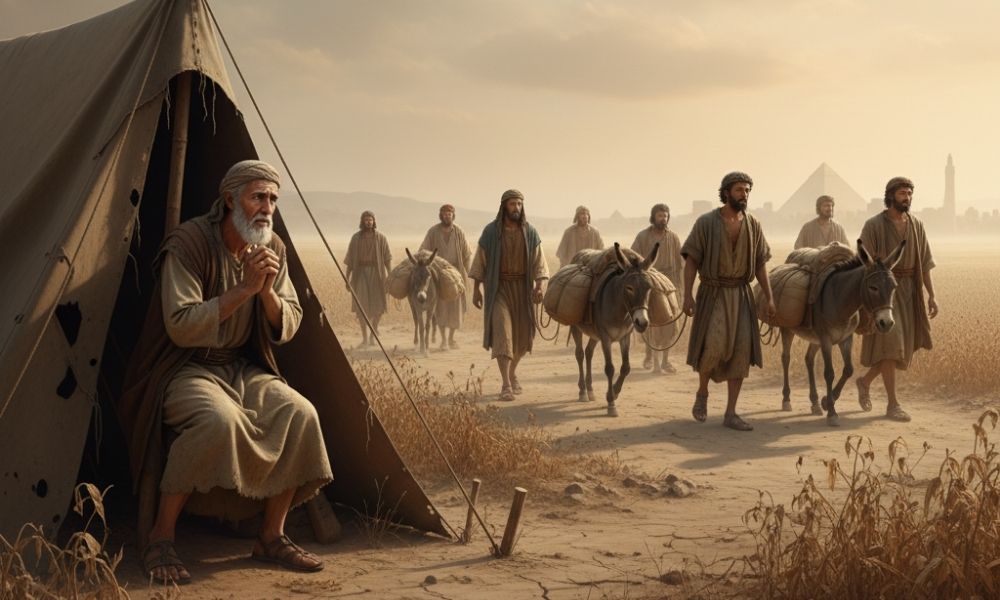
The famine that struck Canaan was a defining moment in the story of Joseph and his family. It fulfilled the prophecy revealed through Pharaoh’s dreams and became the means by which God reunited Joseph with his brothers. What began as a devastating crisis in Canaan turned into the unfolding of God’s redemptive plan—drawing Jacob’s family to Egypt, where the nation of Israel would be established.
Quick Facts
Event: A severe famine strikes Canaan, forcing Jacob’s sons to go to Egypt for food
Key Figures: Joseph, Jacob (Israel), Joseph’s brothers
Primary Source: Genesis 42:1–5; 43:1–15
Era: Patriarchal Age
Location: Canaan and Egypt
Consequence: Jacob sends his sons to Egypt, unknowingly into the hands of Joseph, whom they had sold years earlier
Context of the Event
The famine came exactly as Joseph had foretold when he interpreted Pharaoh’s dreams—seven years of abundance followed by seven years of severe famine. Egypt, under Joseph’s wise leadership, had stored grain during the prosperous years and became the center of food distribution for the entire region.
In contrast, Canaan and the surrounding lands were struck by scarcity. Jacob and his family soon ran out of food. Hearing that grain was available in Egypt, Jacob said to his sons,
“I have heard that there is grain in Egypt. Go down there and buy some for us, so that we may live and not die.” (Genesis 42:2, NIV)
Thus began the journey that would reunite the family after decades of separation.
The Brothers’ Journey to Egypt
- Jacob’s Decision: Jacob sent ten of his sons to Egypt to buy grain but kept Benjamin, Joseph’s youngest brother, at home, fearing harm might befall him.
- Arrival in Egypt: The brothers appeared before Joseph—now the powerful governor of Egypt—without recognizing him.
- Joseph’s Recognition: Joseph recognized them immediately, but he concealed his identity, speaking harshly and testing their integrity.
This famine-driven encounter set in motion a series of divine tests, confessions, and reconciliations that would heal years of guilt and restore broken relationships.
The Severity of the Famine
The famine was not limited to Egypt or Canaan—it affected the entire Near East.
“When the famine had spread over the whole country, Joseph opened all the storehouses and sold grain to the Egyptians.” (Genesis 41:56, NIV)
The crisis demonstrated both human vulnerability and divine foresight. Egypt’s survival and prosperity under Joseph’s leadership contrasted sharply with the desperation elsewhere, highlighting God’s provision through His servant.
Jacob’s Family in Distress
At home, Jacob’s family faced growing hunger. Each meal reminded them of their dependence on God’s unseen hand. Their decision to seek food in Egypt—though practical—was also prophetic. It fulfilled the divine plan announced generations earlier: that Abraham’s descendants would sojourn in a foreign land (Genesis 15:13).
The famine was therefore not merely a natural disaster; it was the instrument of God’s providence—guiding Jacob’s household into Egypt, where the nation of Israel would take root.
Key Characters
- Joseph: Now ruler of Egypt, he manages grain distribution and becomes the means of God’s provision.
- Jacob (Israel): The aging patriarch, struggling with fear and faith as he sends his sons to Egypt.
- Joseph’s Brothers: The same men who sold Joseph years before, now humbled by need and unaware of God’s unfolding plan.
Major Themes
- Divine Providence: God uses famine—a seeming tragedy—to fulfill His redemptive plan.
- Judgment and Mercy: The famine humbles proud hearts and paves the way for forgiveness and restoration.
- Faith in Crisis: Jacob’s decision to send his sons to Egypt reflects trust amid desperation.
- Reversal of Destiny: The brothers who betrayed Joseph are now dependent on him for survival.
- God’s Sovereign Timing: What seems like disaster is God’s chosen path to deliverance and the next chapter of Israel’s story.
Key Passages
- Genesis 41:54 (NIV):
“There was famine in all the other lands, but in the whole land of Egypt there was food.” - Genesis 42:2 (NIV):
“I have heard that there is grain in Egypt. Go down there and buy some for us, so that we may live and not die.” - Genesis 42:5 (NIV):
“So Israel’s sons were among those who went to buy grain, for there was famine in the land of Canaan also.”
Theological Significance
The famine that struck Canaan reveals how God’s purposes often unfold through crisis. What seemed like a calamity became the catalyst for reconciliation and national destiny. God’s provision through Joseph illustrates His faithfulness to the covenant promises—preserving Abraham’s descendants and positioning them for the next stage of His redemptive plan. The famine reminds believers that even in scarcity, God’s sovereignty ensures survival and fulfillment of His word.







Leave a Reply