
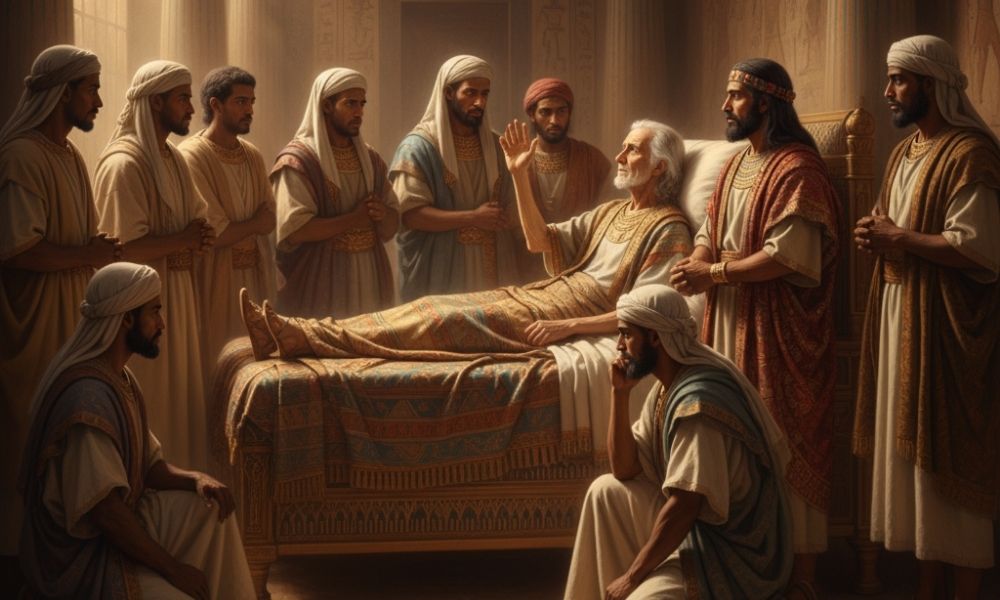
Jacob’s blessing of his twelve sons marks the final chapter of the patriarch’s life and the prophetic foundation of the twelve tribes of Israel. As he neared death in Egypt, Jacob gathered his sons around him to pronounce blessings, warnings, and destinies shaped by their character and role in God’s covenant plan. These words, both tender and truthful, reveal how God would work through each son to form the nation of Israel.
Quick Facts
Event: Jacob blesses and prophesies over his twelve sons
Key Figures: Jacob (Israel), Reuben, Simeon, Levi, Judah, Zebulun, Issachar, Dan, Gad, Asher, Naphtali, Joseph, Benjamin
Primary Source: Genesis 49:1–28
Era: Patriarchal Age
Location: Egypt, near Jacob’s deathbed
Consequence: Jacob’s sons receive blessings that define the destiny of the tribes of Israel
Context of the Event
After reuniting with Joseph in Egypt and living there for seventeen years, Jacob grew old and weak. Knowing his time was near, he called his twelve sons together to bless them.
“Gather around so I can tell you what will happen to you in days to come.” (Genesis 49:1, NIV)
These were not mere farewell words—they were prophetic declarations inspired by the Spirit of God, shaping the future of the twelve tribes and their roles in Israel’s history.
Summary of the Blessings
1. Reuben – The Firstborn Who Lost His Honor
“Turbulent as the waters, you will no longer excel.” (Genesis 49:4, NIV)
Reuben, Jacob’s firstborn, forfeited his birthright through moral failure (Genesis 35:22). Though he had strength and dignity, his instability cost him leadership.
2–3. Simeon and Levi – Brothers in Violence
“Cursed be their anger, so fierce… I will scatter them in Jacob.” (Genesis 49:7, NIV)
Because of their cruelty in avenging their sister Dinah, their descendants would be dispersed. Levi’s tribe, however, later redeemed itself through priestly service.
4. Judah – The Line of Kings
“The scepter will not depart from Judah… until he to whom it belongs shall come.” (Genesis 49:10, NIV)
Judah receives the greatest blessing—a promise of royal authority and Messianic lineage. From Judah’s line would come King David and, ultimately, Jesus Christ, the Lion of Judah.
5. Zebulun – The Merchant Tribe
“Zebulun will live by the seashore and become a haven for ships.” (Genesis 49:13, NIV)
Zebulun’s inheritance near the coast would make it a center for trade and commerce.
6. Issachar – The Servant of Strength
“Issachar is a rawboned donkey… He bent his shoulder to the burden.” (Genesis 49:14–15, NIV)
Issachar would be known for hard work and servitude, representing industriousness and endurance.
7. Dan – The Judge and Defender
“Dan will provide justice for his people.” (Genesis 49:16, NIV)
Dan’s name means “judge.” His tribe would produce judges like Samson, though also prone to idolatry.
8. Gad – The Warrior Tribe
“Gad will be attacked by a band of raiders, but he will attack them at their heels.” (Genesis 49:19, NIV)
Gad would live east of the Jordan and often face invasion but would prove courageous in battle.
9. Asher – The Tribe of Abundance
“Asher’s food will be rich; he will provide delicacies fit for a king.” (Genesis 49:20, NIV)
Asher’s fertile territory in the north would bring prosperity and abundance.
10. Naphtali – The Swift and Free
“Naphtali is a doe set free that bears beautiful fawns.” (Genesis 49:21, NIV)
Naphtali’s descendants would be known for agility, freedom, and eloquence—symbolizing fruitfulness and beauty.
11. Joseph – The Fruitful and Faithful One
“Joseph is a fruitful vine… because of the Mighty One of Jacob.” (Genesis 49:22–24, NIV)
Jacob gave Joseph the richest blessing—strength, fertility, and divine favor. His two sons, Ephraim and Manasseh, received separate tribal inheritance, giving Joseph a double portion.
12. Benjamin – The Fierce Warrior
“Benjamin is a ravenous wolf; in the morning he devours the prey.” (Genesis 49:27, NIV)
Benjamin’s descendants would be bold warriors. From his tribe came King Saul and the Apostle Paul, both strong yet complex figures.
Jacob’s Final Words
After blessing his sons, Jacob commanded them to bury him with his ancestors in the cave of Machpelah, near Hebron—the burial place of Abraham and Isaac. When he finished speaking,
“He drew his feet up into the bed, breathed his last, and was gathered to his people.” (Genesis 49:33, NIV)
Thus ended the life of the patriarch who had wrestled with God, raised the twelve tribes, and witnessed the beginnings of God’s covenant nation in Egypt.
Key Characters
- Jacob (Israel): The patriarch and prophet, delivering blessings that shape Israel’s destiny.
- The Twelve Sons: Founders of the twelve tribes, each reflecting distinct traits and roles in Israel’s history.
Major Themes
- Prophecy and Destiny: Jacob’s words reveal God’s long-term plan for Israel.
- Consequences of Character: Each blessing reflects the moral and spiritual legacy of the sons.
- Grace and Redemption: Even flawed men are used by God to fulfill His covenant.
- Messianic Promise: Judah’s line points forward to the coming of Christ.
- Unity in Diversity: Each tribe contributes uniquely to the nation’s future.
Key Passages
- Genesis 49:1 (NIV):
“Gather around so I can tell you what will happen to you in days to come.” - Genesis 49:10 (NIV):
“The scepter will not depart from Judah… until he to whom it belongs shall come.” - Genesis 49:28 (NIV):
“All these are the twelve tribes of Israel, and this is what their father said to them when he blessed them.”
Theological Significance
Jacob’s blessings show how God’s purposes work through both human weakness and divine promise. His words form the prophetic foundation of Israel’s future, pointing to the coming of a greater King from Judah’s line—Jesus Christ. In this moment, faith, prophecy, and history converge as God’s covenant continues through Jacob’s descendants.







Leave a Reply