
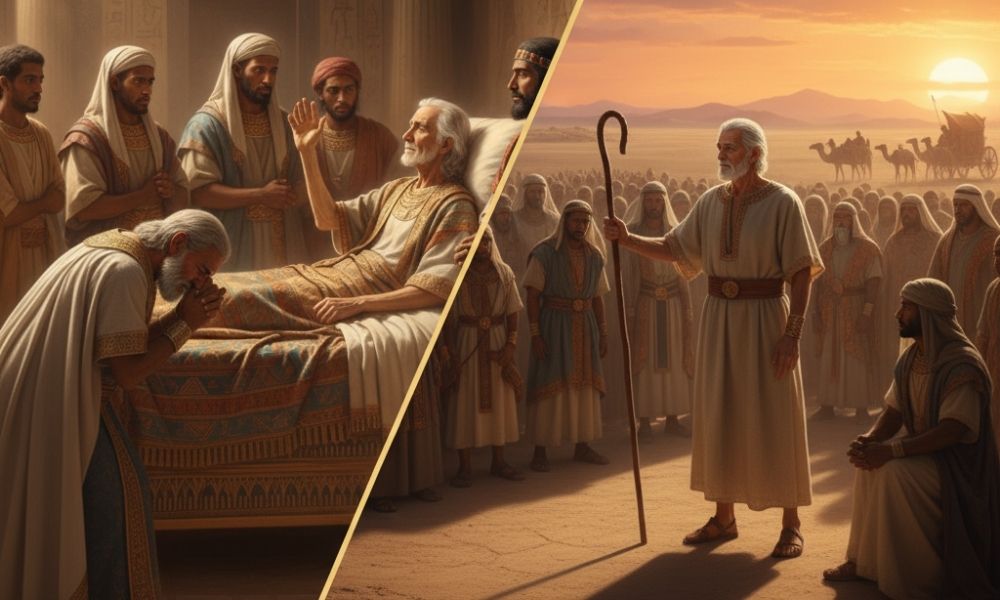
The deaths of Jacob and Joseph mark the closing of Genesis and the end of the patriarchal era. These two monumental figures—Jacob, the father of Israel’s tribes, and Joseph, the preserver of God’s covenant family—both died in faith, trusting God’s promises of a future beyond Egypt. Their deaths remind us that God’s covenant plan continues even after His servants pass away.
Quick Facts
Event: The deaths of Jacob and Joseph in Egypt
Key Figures: Jacob (Israel), Joseph, Pharaoh, Joseph’s brothers
Primary Source: Genesis 49:29–33; 50:1–26
Era: Patriarchal Age
Location: Egypt (Jacob later buried in Canaan)
Consequence: Jacob is buried in the Promised Land; Joseph dies in Egypt, leaving instructions for his bones to be carried home when God delivers Israel
Jacob’s Death and Burial (Genesis 49:29–33; 50:1–14)
Jacob’s Final Request
As Jacob neared death, he gathered his sons and made them swear to bury him in the land of Canaan, in the cave of Machpelah—the family tomb of Abraham and Isaac.
“Bury me with my fathers in the cave in the field of Ephron the Hittite.” (Genesis 49:29–30, NIV)
He died peacefully after blessing his sons and drawing his last breath, “gathered to his people,” a Hebrew expression signifying reunion with his ancestors.
Joseph’s Mourning and Pharaoh’s Honor
Joseph wept over his father, embraced him, and ordered embalming—a common Egyptian custom—so Jacob could be transported respectfully. The Egyptians mourned Jacob for seventy days, showing the great respect Joseph had earned in Egypt.
Pharaoh then permitted Joseph to fulfill his father’s wishes. Joseph led a grand funeral procession to Canaan, accompanied by Egyptian dignitaries, chariots, and horsemen—a royal tribute to Israel’s patriarch.
Jacob was buried in the Cave of Machpelah near Mamre, where Abraham and Isaac were laid to rest. Afterward, Joseph and his brothers returned to Egypt, marking the completion of one chapter and the beginning of another in God’s unfolding story.
Joseph’s Death and Final Testament (Genesis 50:15–26)
Reassurance to His Brothers
After Jacob’s burial, Joseph’s brothers feared that he might finally take revenge for their past betrayal. But Joseph’s response revealed his spiritual maturity and deep trust in God’s sovereignty:
“You intended to harm me, but God intended it for good to accomplish what is now being done, the saving of many lives.” (Genesis 50:20, NIV)
He comforted them and promised to care for them and their children, showing forgiveness and peace until the end of his days.
Joseph’s Faith and Death
Joseph lived to the age of 110 years, witnessing his children and grandchildren. Before dying, he reminded the Israelites that God would surely bring them back to the Promised Land. He made them swear an oath:
“God will surely come to your aid, and then you must carry my bones up from this place.” (Genesis 50:25, NIV)
Joseph’s body was embalmed and placed in a coffin in Egypt, where it remained until Moses carried his bones out during the Exodus (Exodus 13:19). His faith linked the end of Genesis to the beginning of Israel’s national story—turning promise into hope.
Key Characters
- Jacob (Israel): The aged patriarch who died in faith, longing for the Promised Land.
- Joseph: The faithful son who forgave his brothers, led Egypt wisely, and trusted God’s future deliverance.
- Pharaoh: Honored Jacob’s death, showing Egypt’s respect for Joseph’s God-given wisdom.
Major Themes
- Faith in God’s Promises: Both Jacob and Joseph died believing that God would fulfill His word to Abraham.
- Legacy and Covenant: Their final words pass on the hope of God’s covenant to future generations.
- Forgiveness and Peace: Joseph’s final act of mercy mirrors divine grace.
- Hope Beyond Death: Both men saw death not as an end, but as a continuation of God’s plan.
- Continuity of God’s Plan: Genesis ends not with despair, but with expectation—God’s people awaiting deliverance.
Key Passages
- Genesis 49:33 (NIV):
“When Jacob had finished giving instructions to his sons, he drew his feet up into the bed, breathed his last, and was gathered to his people.” - Genesis 50:20 (NIV):
“You intended to harm me, but God intended it for good to accomplish what is now being done, the saving of many lives.” - Genesis 50:25 (NIV):
“God will surely come to your aid, and then you must carry my bones up from this place.”
Theological Significance
The deaths of Jacob and Joseph demonstrate enduring faith in God’s covenant promise. Even in foreign lands, both patriarchs looked forward to God’s redemption and the return to Canaan. Joseph’s forgiveness mirrors God’s redemptive grace, while his dying words anticipate the Exodus, showing that death cannot halt the progress of divine promise.
Genesis, which began with creation and sin, closes with faith, forgiveness, and future hope—a reminder that God’s plan of salvation never ends with the grave.







Leave a Reply