
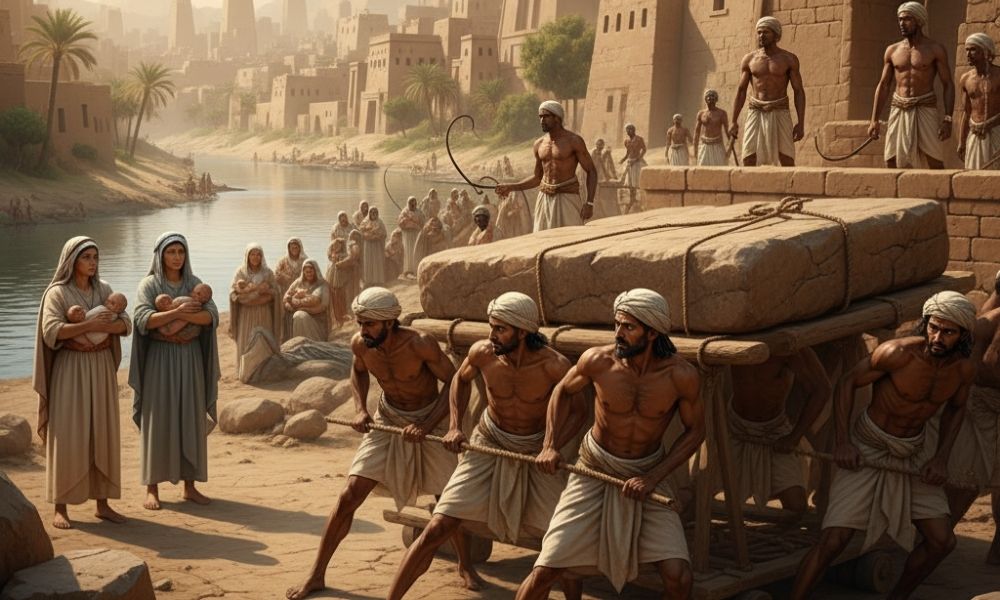
The enslavement of Israel in Egypt marks the transition from the age of the patriarchs to the birth of a nation. What began as a season of safety during Joseph’s leadership turned into centuries of oppression after a new Pharaoh arose who did not remember Joseph. Yet even in bondage, God’s promise to Abraham—to make his descendants into a great nation—continued to unfold. The suffering of Israel set the stage for one of the greatest acts of deliverance in history: the Exodus.
Quick Facts
Event: The Israelites become enslaved in Egypt
Key Figures: Pharaoh (the new king of Egypt), the Israelites, the midwives Shiphrah and Puah, Moses (later born during this time)
Primary Source: Exodus 1:1–22
Era: The period between Joseph’s death and the birth of Moses
Location: Egypt, especially the land of Goshen
Consequence: The Israelites were forced into harsh labor, yet multiplied greatly, leading Pharaoh to attempt population control through oppression and infanticide
Context of the Event
After Joseph’s death, generations passed, and the Israelites continued to grow and prosper in Egypt. They had come initially as guests under Joseph’s protection during the famine, settling in the land of Goshen. But over time, the memory of Joseph’s leadership faded.
“Then a new king, to whom Joseph meant nothing, came to power in Egypt.” (Exodus 1:8, NIV)
Fearing the growing strength and numbers of the Israelites, this new Pharaoh saw them as a potential threat to national security.
Pharaoh’s Oppression
In an attempt to weaken and control Israel, Pharaoh imposed harsh measures:
- Forced Labor:
The Israelites were enslaved and forced to build Egypt’s store cities, Pithom and Rameses. “They put slave masters over them to oppress them with forced labor.” (Exodus 1:11, NIV) - Harsh Treatment:
The Egyptians “worked them ruthlessly,” subjecting them to backbreaking labor in the fields and construction sites. - Population Control:
Despite the oppression, the Israelites continued to multiply. Frustrated, Pharaoh commanded the Hebrew midwives, Shiphrah and Puah, to kill every newborn Hebrew boy. But the midwives feared God and refused to obey, allowing the boys to live. “Because the midwives feared God, He gave them families of their own.” (Exodus 1:21, NIV) - Genocidal Decree:
Pharaoh escalated his cruelty, ordering all Egyptians to throw every male Hebrew baby into the Nile River—a brutal attempt to destroy Israel’s future.
Israel’s Growth Despite Slavery
Even under relentless oppression, Israel thrived because God’s blessing could not be stopped.
“But the more they were oppressed, the more they multiplied and spread; so the Egyptians came to dread the Israelites.” (Exodus 1:12, NIV)
What Pharaoh saw as a threat was actually the fulfillment of God’s promise to Abraham:
“I will make you into a great nation… and all peoples on earth will be blessed through you.” (Genesis 12:2–3)
Israel’s suffering was not the end but the beginning of their identity as God’s chosen people, preparing them for redemption.
Key Characters
- Pharaoh: The new Egyptian king who enslaved the Israelites out of fear and pride.
- Shiphrah and Puah: The courageous Hebrew midwives who disobeyed Pharaoh’s command and preserved life.
- The Israelites: Once honored guests, now enslaved laborers, awaiting God’s deliverance.
Major Themes
- Fulfillment of God’s Promise: Even in oppression, God’s covenant with Abraham continues to advance.
- Faith Under Pressure: The midwives’ courage shows that obedience to God outweighs fear of human authority.
- Oppression and Deliverance: Israel’s suffering becomes the backdrop for God’s mighty act of salvation.
- Providence Through Pain: What appears as defeat is preparation for divine redemption.
- Faithfulness of God: Though silent for a time, God never forgets His people or His covenant.
Key Passages
- Exodus 1:8 (NIV):
“Then a new king, to whom Joseph meant nothing, came to power in Egypt.” - Exodus 1:11–12 (NIV):
“They put slave masters over them to oppress them with forced labor… But the more they were oppressed, the more they multiplied and spread.” - Exodus 1:17 (NIV):
“The midwives, however, feared God and did not do what the king of Egypt had told them to do; they let the boys live.”
Theological Significance
The enslavement of Israel reveals that God’s silence is not absence. Even when His people suffer, His plan continues to move forward. The oppression in Egypt sets the stage for redemption through Moses, foreshadowing the greater deliverance through Christ. God’s faithfulness shines brightest in dark times—showing that no human power can thwart His covenant purposes.







Leave a Reply