
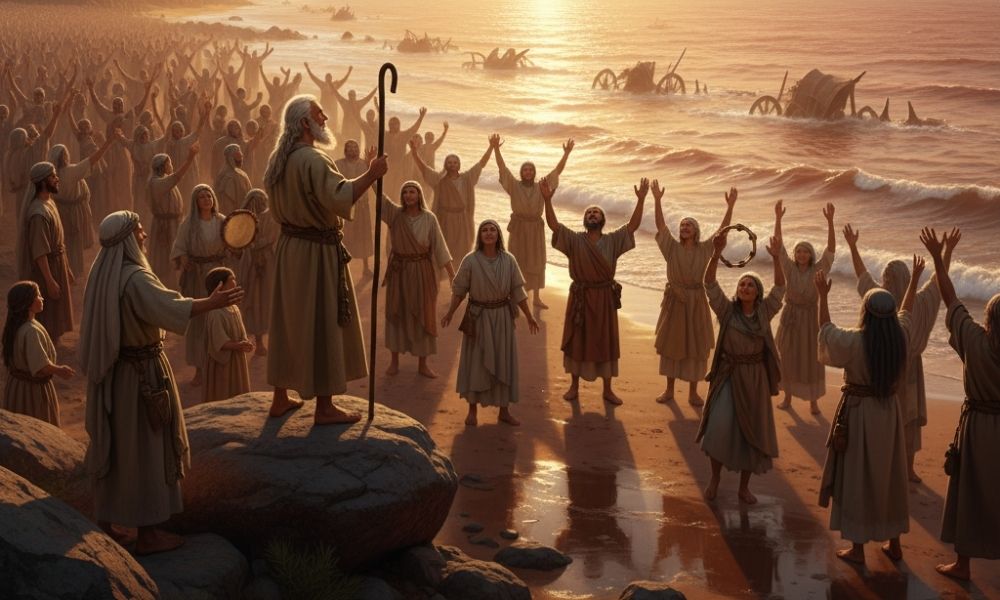
The Song of Deliverance, also known as The Song of Moses, is one of the most triumphant hymns in the Bible. Sung by Moses and the Israelites after crossing the Red Sea, it celebrates God’s miraculous victory over Pharaoh’s army and the liberation of His people from slavery in Egypt. This song marks the birth of Israel as a free nation under God, expressing awe, gratitude, and faith in His power and faithfulness.
Quick Facts
Event: Israel sings a song of praise after crossing the Red Sea
Key Figures: Moses, Miriam, the Israelites
Primary Source: Exodus 15:1–21
Era: The Exodus (c. 15th–13th century BCE)
Location: Shore of the Red Sea
Consequence: The Israelites publicly worship God for His deliverance and declare their trust in Him as their warrior and redeemer
Context of the Event
After centuries of bondage in Egypt, God delivered Israel through a series of mighty acts, culminating in the parting of the Red Sea. Pursued by Pharaoh’s army, the Israelites crossed safely on dry ground, while the waters closed upon their enemies, destroying them completely.
Standing on the eastern shore of freedom, Moses and the people broke into song—the first recorded hymn of praise in Scripture—declaring God’s power, justice, and steadfast love.
“Then Moses and the Israelites sang this song to the Lord:
‘I will sing to the Lord, for He is highly exalted.
Both horse and driver He has hurled into the sea.’” (Exodus 15:1, NIV)
Themes and Structure of the Song
The song in Exodus 15 is both poetic and prophetic, blending worship, testimony, and future hope. It unfolds in three main parts:
1. Praise for God’s Mighty Victory (Exodus 15:1–12)
- God is portrayed as a Divine Warrior who fights for His people.
- His power overwhelms Egypt’s pride and military strength.
“The Lord is a warrior; the Lord is His name.” (Exodus 15:3, NIV)
- The sea itself becomes an instrument of judgment.
2. Praise for God’s Covenant Faithfulness (Exodus 15:13–18)
- God not only delivered Israel but guided them toward His holy dwelling, fulfilling His covenant with Abraham.
- The nations will hear of His deeds and tremble.
“In Your unfailing love You will lead the people You have redeemed.” (Exodus 15:13, NIV)
- The song ends with a declaration of God’s eternal reign:
“The Lord reigns for ever and ever.” (Exodus 15:18, NIV)
3. Miriam’s Chorus of Praise (Exodus 15:20–21)
Miriam, the sister of Moses and Aaron, led the women in response with tambourines and dancing:
“Sing to the Lord, for He is highly exalted.
Both horse and driver He has hurled into the sea.” (Exodus 15:21, NIV)
Her refrain echoes the joy of the entire nation, celebrating the God who saves.
Spiritual Meaning
The Song of Deliverance is not just a victory chant—it is a confession of faith. It celebrates God’s:
- Power: He overthrows mighty enemies with a single breath.
- Justice: He defends the oppressed and brings down the proud.
- Presence: He leads His people as their shepherd and king.
- Faithfulness: He fulfills His promises through His mighty acts.
- Kingship: It is the first explicit proclamation that “The Lord reigns forever.”
Key Characters
- Moses: The prophet and leader who gives voice to Israel’s collective praise.
- Miriam: The prophetess who leads the women in song and dance, celebrating freedom.
- The Israelites: A redeemed nation, witnessing God’s power and responding in worship.
Major Themes
- Deliverance: God’s salvation is complete and powerful—He rescues beyond human ability.
- Worship: True worship flows from experiencing God’s saving grace.
- Faith: Israel moves from fear to faith, trusting the God who fights for them.
- Divine Kingship: God is revealed as King over creation and history.
- Covenant Fulfillment: The Exodus confirms God’s promises to Abraham, Isaac, and Jacob.
Key Passages
- Exodus 15:2 (NIV):
“The Lord is my strength and my defense; He has become my salvation. He is my God, and I will praise Him.” - Exodus 15:6 (NIV):
“Your right hand, Lord, was majestic in power. Your right hand, Lord, shattered the enemy.” - Exodus 15:13 (NIV):
“In Your unfailing love You will lead the people You have redeemed.” - Exodus 15:18 (NIV):
“The Lord reigns for ever and ever.”
Theological Significance
The Song of Deliverance stands as the first hymn of national worship in the Bible and a timeless model for praising God after salvation. It reminds believers that worship should flow from gratitude and awe. The song also prefigures the final victory of God over evil, echoed in Revelation 15:3, where the redeemed sing “the song of Moses and of the Lamb.”
It bridges the Old and New Covenants—celebrating God as both Deliverer from Egypt and Redeemer through Christ.







Leave a Reply