
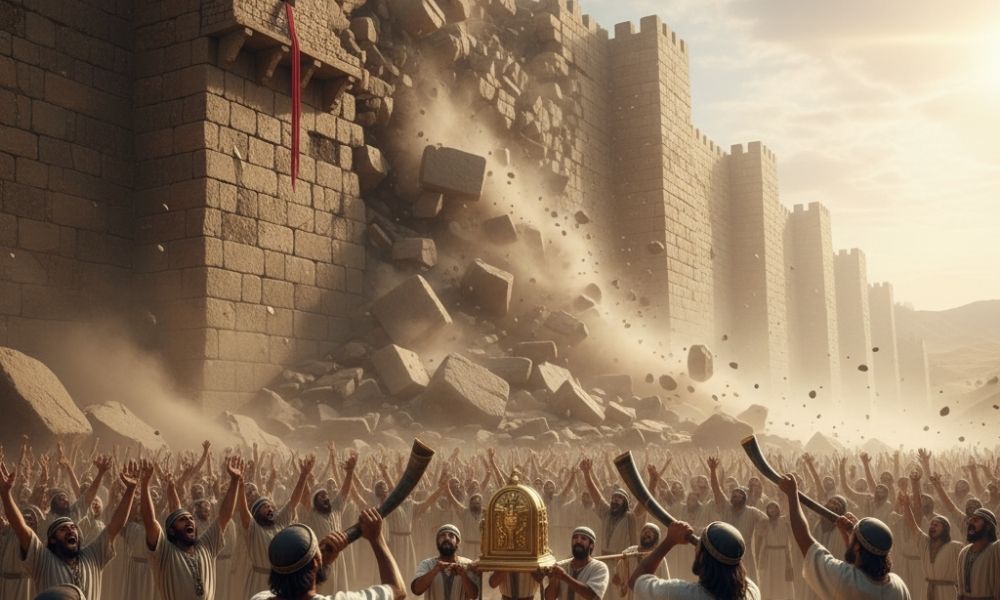
Joshua 6 tells of the miraculous fall of Jericho. God gives Joshua a unique battle plan: the Israelites are to march around the city once a day for six days, led by seven priests blowing trumpets before the Ark of the Covenant. On the seventh day, they circle the city seven times, then the priests blow their trumpets, and the people shout as God commands. The walls of Jericho collapse, and Israel captures the city. They destroy everything as devoted to the Lord, except Rahab and her family, who are spared for protecting the spies. The city is burned, and Joshua places a curse on anyone who would rebuild it. The Lord is with Joshua, and his fame spreads throughout the land.
1. The Fall of Jericho Foretold (Joshua 6:1–5)
“Now the gates of Jericho were tightly shut because the people were afraid of the Israelites. No one was allowed to go out or in.
But the Lord said to Joshua, ‘I have given you Jericho, its king, and all its strong warriors.
You and your fighting men should march around the town once a day for six days.
Seven priests will walk ahead of the Ark, each carrying a ram’s horn. On the seventh day you are to march around the town seven times, with the priests blowing the horns.
When you hear the priests give one long blast on the ram’s horns, have all the people shout as loud as they can. Then the walls of the town will collapse, and the people can charge straight into the town.’” (Joshua 6:1–5, NLT)
Commentary:
- Jericho’s gates are shut in fear, yet God declares victory before the battle begins—“I have given you Jericho.”
- The strategy is divine, not human: silent marches, priests, trumpets, and the Ark—signs of faith, not force.
- The number seven (priests, horns, days) symbolizes completeness—God’s perfect plan unfolding in His timing.
- The Ark’s presence in the procession shows that God Himself leads the conquest.
- The collapse of walls without weapons demonstrates that victory comes by obedience and faith, not military strength.
Insight:
Faith follows God’s instructions even when they defy logic, because victory is secured by His power, not human effort.
2. The Obedience of Joshua and Israel (Joshua 6:6–14)
“So Joshua called together the priests and said, ‘Take up the Ark of the Lord’s Covenant, and assign seven priests to walk in front of it, each carrying a ram’s horn.’
Then he gave orders to the people: ‘March around the town, and the armed men will lead the way in front of the Ark of the Lord.’
After Joshua spoke to the people, the seven priests with the ram’s horns started marching in the presence of the Lord, blowing the horns as they marched. And the Ark of the Lord’s Covenant followed behind them.
Some of the armed men marched in front of the priests with the horns, and some behind the Ark, with the priests continually blowing the horns.
‘Do not shout; do not even talk,’ Joshua commanded. ‘Not a single word from any of you until I tell you to shout. Then shout!’
So the Ark of the Lord was carried around the town once that day, and then everyone returned to spend the night in the camp.
Joshua got up early the next morning, and the priests again carried the Ark of the Lord.
The seven priests with the ram’s horns marched in front of the Ark of the Lord, blowing their horns. Again the armed men marched both in front of the priests and behind the Ark of the Lord.
All this time the priests were blowing their horns. On the second day they again marched around the town once and returned to the camp. They followed this pattern for six days.” (Joshua 6:6–14, NLT)
Commentary:
- Joshua obeys every detail of God’s instructions without hesitation.
- The silent march reflects discipline, reverence, and trust—faith acts quietly before it shouts in victory.
- The Ark remains central, reminding all that God is leading, not man.
- The daily repetition teaches patience and perseverance in obedience.
- Silence and steady faith precede the sound of triumph.
Insight:
Obedience often requires quiet persistence; God’s plans unfold in His timing, not ours.
3. The Fall of Jericho (Joshua 6:15–21)
“On the seventh day the Israelites got up at dawn and marched around the town as they had done before. But this time they went around the town seven times.
The seventh time around, as the priests sounded the long blast on their horns, Joshua commanded the people, ‘Shout! For the Lord has given you the town!
Jericho and everything in it must be completely destroyed as an offering to the Lord. Only Rahab the prostitute and the others in her house will be spared, for she protected our spies.
Do not take any of the things set apart for destruction, or you yourselves will be completely destroyed, and you will bring trouble on the camp of Israel.
Everything made from silver, gold, bronze, or iron is sacred to the Lord and must be brought into his treasury.’
When the people heard the sound of the rams’ horns, they shouted as loud as they could. Suddenly, the walls of Jericho collapsed, and the Israelites charged straight into the town and captured it.
They completely destroyed everything in it with their swords—men and women, young and old, cattle, sheep, goats, and donkeys.” (Joshua 6:15–21, NLT)
Commentary:
- On the seventh day, the climax comes—faith culminates in obedient action and divine intervention.
- The shout of the people follows the sound of the trumpets, symbolizing unified faith and praise before victory.
- The fall of the walls fulfills God’s promise—He alone brings down what human strength cannot.
- The destruction of Jericho is an act of divine judgment, showing God’s holiness and justice against Canaanite sin.
- The command to spare Rahab shows God’s mercy within judgment.
- The ban on taking spoils emphasizes that the first victory belongs wholly to God—Jericho is His portion.
Insight:
Victory belongs to God alone. Faith shouts in praise before the walls fall, trusting God to fulfill His word.
4. Rahab and Her Family Saved (Joshua 6:22–25)
“Meanwhile, Joshua said to the two spies, ‘Keep your promise. Go to the prostitute’s house and bring her out, along with all her family.’
The men who had been spies went in and brought out Rahab, her father, mother, brothers, and all the other relatives who were with her. They moved her whole family to a safe place near the camp of Israel.
Then the Israelites burned the town and everything in it. Only the things made from silver, gold, bronze, or iron were kept for the treasury of the Lord’s house.
So Joshua spared Rahab the prostitute and her relatives who were with her in the house, because she had hidden the spies Joshua sent to Jericho. And she lives among the Israelites to this day.” (Joshua 6:22–25, NLT)
Commentary:
- God honors Rahab’s faith through the fulfillment of the promise of salvation.
- Her rescue contrasts with the destruction around her—faith brings life in the midst of judgment.
- Rahab’s inclusion “among the Israelites” marks her full acceptance into God’s people.
- Her story points forward to the gospel: faith in God’s promise brings salvation to all who believe, regardless of background.
Insight:
Faith not only saves but also integrates the believer into God’s family—Rahab becomes part of Israel and later part of Christ’s lineage.
5. The Curse on Jericho (Joshua 6:26–27)
“At that time Joshua invoked this curse: ‘May the curse of the Lord fall on anyone who tries to rebuild the town of Jericho.
At the cost of his firstborn son, he will lay its foundation. At the cost of his youngest son, he will set up its gates.’
So the Lord was with Joshua, and his reputation spread throughout the land.” (Joshua 6:26–27, NLT)
Commentary:
- Joshua declares Jericho to be under a curse, symbolizing total dedication to God—no rebuilding of what God has destroyed.
- The curse is later fulfilled in 1 Kings 16:34, showing the seriousness of God’s word.
- The closing verse affirms that the Lord’s presence with Joshua brings fame and respect throughout the land.
- Joshua’s success flows from obedience and divine partnership.
Insight:
God’s victories must not be undone by human pride or defiance. What He sets apart must remain His.
Theological Significance of Joshua 6
- God gives victory through faith and obedience, not strength or strategy.
- The fall of Jericho reveals His power to overcome any obstacle.
- Rahab’s salvation shows God’s mercy in the midst of judgment.
- The curse on Jericho symbolizes separation from sin and devotion to God’s holiness.
- God’s presence is the true source of every triumph.
Practical Applications
- Obey Completely: Even strange instructions can lead to breakthrough when they come from God.
- Wait Patiently: Faith sometimes marches in silence before it sees results.
- Give God the Glory: First victories belong entirely to Him—honor Him with the spoils.
- Trust God’s Justice and Mercy: He judges sin but saves those who believe.
- Stay Devoted: Never rebuild what God has called you to leave behind.
Final Insight:
Joshua 6 teaches that walls fall when God’s people obey in faith. The shout of victory rises from hearts that trust in God’s power, and salvation shines even amid judgment. God’s presence, not human strength, brings lasting triumph.







Leave a Reply