
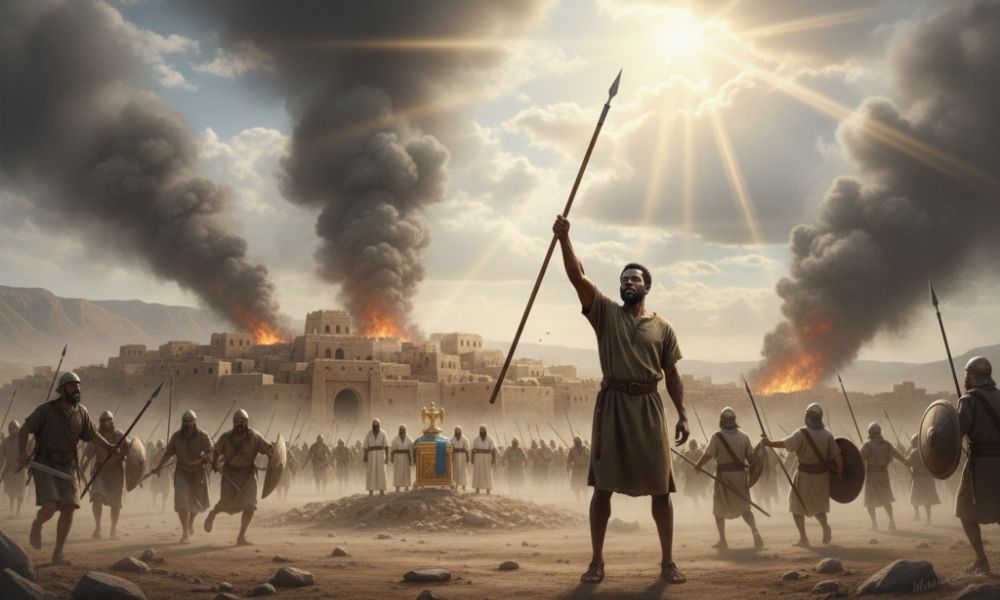
Joshua 8 recounts Israel’s victory over Ai after dealing with Achan’s sin. God encourages Joshua to attack again, promising success. This time, Joshua sets an ambush behind the city. As the main force feigns retreat, Ai’s army pursues them, leaving the city unguarded. The hidden troops then rise, capture, and burn Ai. When the enemy sees the smoke, Israel turns and defeats them completely. The king of Ai is captured and executed. Joshua builds an altar on Mount Ebal, offering sacrifices and writing the Law of Moses on stones. He then reads all the words of the law—blessings and curses—to the entire assembly of Israel, reaffirming their covenant with God.
1. God Encourages Joshua and Gives a New Strategy (Joshua 8:1–2)
“Then the Lord said to Joshua, ‘Do not be afraid or discouraged. Take all your fighting men and attack Ai, for I have given you the king of Ai, his people, his town, and his land.
You will destroy them as you destroyed Jericho and its king. But this time you may keep the plunder and the livestock for yourselves. Set an ambush behind the town.’” (Joshua 8:1–2, NLT)
Commentary:
- After judgment on Achan, God restores fellowship and renews His promise of victory.
- The command “Do not be afraid or discouraged” shows God’s grace and reassurance after failure.
- Unlike Jericho, God now allows Israel to keep the plunder—obedience always brings blessing in God’s timing.
- The strategy changes: victory will come through wisdom and cooperation, not pride.
- God teaches Joshua that past failure is not final when sin is confessed and faith is renewed.
Insight:
When God forgives, He restores confidence and gives new strategy for victory.
2. Joshua Sets the Ambush (Joshua 8:3–9)
“So Joshua and all the fighting men set out to attack Ai. Joshua chose 30,000 of his best warriors and sent them out at night with these orders:
‘Hide in ambush close behind the town and be ready for action.
When our main army attacks, the men of Ai will come out to fight as they did before, and we will run away from them.
We will let them chase us until they have all left the town. Then your men will jump up from your ambush and take possession of the town, for the Lord your God will give it to you.
Set the town on fire, as the Lord has commanded. You have your orders.’
So they left and went to the place of ambush between Bethel and the west side of Ai, but Joshua remained among the people in the camp that night.” (Joshua 8:3–9, NLT)
Commentary:
- Joshua obeys God’s detailed plan, showing humility and renewed dependence on divine guidance.
- The ambush plan contrasts the overconfidence of chapter 7—this time, Israel moves with discipline and faith.
- Joshua divides the army strategically, balancing human wisdom with divine instruction.
- The Lord’s assurance—“for the Lord your God will give it to you”—anchors the plan in faith, not self-reliance.
- Preparation, patience, and precision replace presumption.
Insight:
Restored faith expresses itself in careful obedience—victory follows divine order and human diligence.
3. The Battle of Ai (Joshua 8:10–23)
“Early the next morning Joshua roused his men and started toward Ai, accompanied by the elders of Israel.
All the fighting men who were with Joshua marched in front of the town and camped on the north side of Ai, with a valley between them and the town.
That night Joshua sent about 5,000 men to lie in ambush between Bethel and Ai, on the west side of the town.
So they stationed the main army north of the town and the ambush west of the town. Joshua himself spent that night in the valley.
When the king of Ai saw the Israelites across the valley, he and all his army hurried out early in the morning and attacked the Israelites at a place overlooking the Jordan Valley.
But he didn’t realize there was an ambush behind the town.
Joshua and the Israelite army fled toward the wilderness as though they were badly beaten.
Then all the men in the town were called out to chase after them.
Not a single man was left in Ai or Bethel; they went too far away from the town.
Then the Lord said to Joshua, ‘Point the spear in your hand toward Ai, for I will hand the town over to you.’ Joshua did as he was commanded.
As soon as Joshua gave this signal, all the men in ambush jumped up from their position and poured into the town.
They quickly captured it and set it on fire.
When the men of Ai looked behind them, smoke from the town was filling the sky, and they had nowhere to go.
The Israelites who had fled turned and attacked their pursuers.
When Joshua and the other Israelites saw that the ambush had succeeded and that smoke was rising from the town, they turned and struck down the men of Ai.
Meanwhile, the Israelites who were inside the town came out and attacked the enemy from the rear.
So the men of Ai were caught in the middle, with Israelite fighters on both sides. Israel attacked them, and not a single person survived or escaped.” (Joshua 8:10–23, NLT)
Commentary:
- The battle unfolds exactly as God planned—obedience brings perfect coordination and victory.
- Joshua’s raised spear symbolizes dependence on God and becomes the signal for triumph.
- The ambush succeeds because the enemy falls into overconfidence, just as Israel once did.
- The burning city signals judgment and divine justice.
- The enemy’s trap becomes their downfall—God turns the tables completely.
- Israel’s total victory shows that repentance restores divine strength and strategy.
Insight:
God turns past failures into wisdom for future triumphs when His people obey His word fully.
4. The King of Ai Executed (Joshua 8:24–29)
“When the Israelite army finished chasing and killing all the men of Ai in the open fields, they went back and finished off everyone inside.
So the entire population of Ai, including men and women, was wiped out that day—12,000 in all.
For Joshua kept holding out his spear until everyone who had lived in Ai was completely destroyed.
Only the livestock and the treasures of the town were not destroyed, for the Israelites kept these as plunder for themselves, as the Lord had commanded Joshua.
So Joshua burned the town of Ai, and it became a permanent mound of ruins, desolate to this very day.
Joshua impaled the king of Ai on a sharpened pole and left him there until evening.
At sunset the Israelites took down the body as Joshua commanded and threw it in front of the town gate. They piled a great heap of stones over him, which remains to this day.” (Joshua 8:24–29, NLT)
Commentary:
- The complete destruction of Ai fulfills God’s judgment, cleansing the land of wickedness.
- Joshua’s unwavering spear mirrors Moses’ raised staff during the battle with Amalek—symbolizing perseverance in dependence on God.
- The allowed plunder rewards obedience and contrasts Achan’s disobedient greed.
- The heap of stones serves as another memorial—a warning against rebellion and a reminder of victory through obedience.
- The ruined Ai stands as a visible testimony to the consequences of sin and the triumph of faith.
Insight:
When we obey God completely, He turns judgment into testimony and restores what sin once destroyed.
5. Covenant Renewal at Mount Ebal (Joshua 8:30–35)
“Then Joshua built an altar to the Lord, the God of Israel, on Mount Ebal.
He followed the commands that Moses the Lord’s servant had written in the Book of Instruction: ‘Make me an altar from stones that are uncut and have not been shaped with iron tools.’
Then on the altar they presented burnt offerings and peace offerings to the Lord.
And as the Israelites watched, Joshua copied onto the stones of the altar the instructions Moses had given them.
Then all the Israelites—foreigners and native-born alike—along with the elders, officers, and judges, were divided into two groups.
One group stood in front of Mount Gerizim, the other in front of Mount Ebal.
Each group faced the other, and between them stood the Levitical priests carrying the Ark of the Lord’s Covenant.
This was all done according to the commands that Moses, the servant of the Lord, had previously given for blessing the people of Israel.
Joshua then read to them all the blessings and curses Moses had written in the Book of Instruction.
Every word of every command that Moses had ever given was read to the entire assembly of Israel, including the women and children and the foreigners who lived among them.” (Joshua 8:30–35, NLT)
Commentary:
- After victory, Joshua leads Israel to worship and renew the covenant—success leads to surrender, not pride.
- The altar of uncut stones symbolizes purity and divine work untouched by human effort.
- The burnt offerings express atonement; the peace offerings express fellowship with God.
- Writing and reading the law reaffirms Israel’s commitment to live under God’s Word.
- The division between Mount Ebal (curses) and Mount Gerizim (blessings) reminds Israel that obedience brings life, disobedience brings loss.
- Everyone—including foreigners—is included, showing that God’s covenant is for all who submit to His rule.
Insight:
True victory leads to renewed worship and obedience—God’s Word is the foundation for lasting success.
Theological Significance of Joshua 8
- God restores and strengthens His people after repentance.
- Victory is possible only through faith, humility, and obedience.
- God uses past failures to train His people for wiser faith.
- Worship and the Word are essential responses to divine victory.
- The covenant renewal ties military success to spiritual devotion.
Practical Applications
- Learn from Defeat: God can turn past failures into future wisdom when you repent.
- Obey Completely: Victory follows full obedience, not partial faith.
- Worship After Success: Honor God after every triumph—He alone deserves the glory.
- Live by the Word: Renew your commitment to God’s Word often; it keeps success grounded.
- Trust God’s Restoration: Even after failure, God gives new beginnings when hearts are right.
Final Insight:
Joshua 8 reveals that confession restores power, obedience restores victory, and worship restores relationship. God not only forgives failure but turns it into a foundation for lasting faith and renewed purpose.







Leave a Reply