
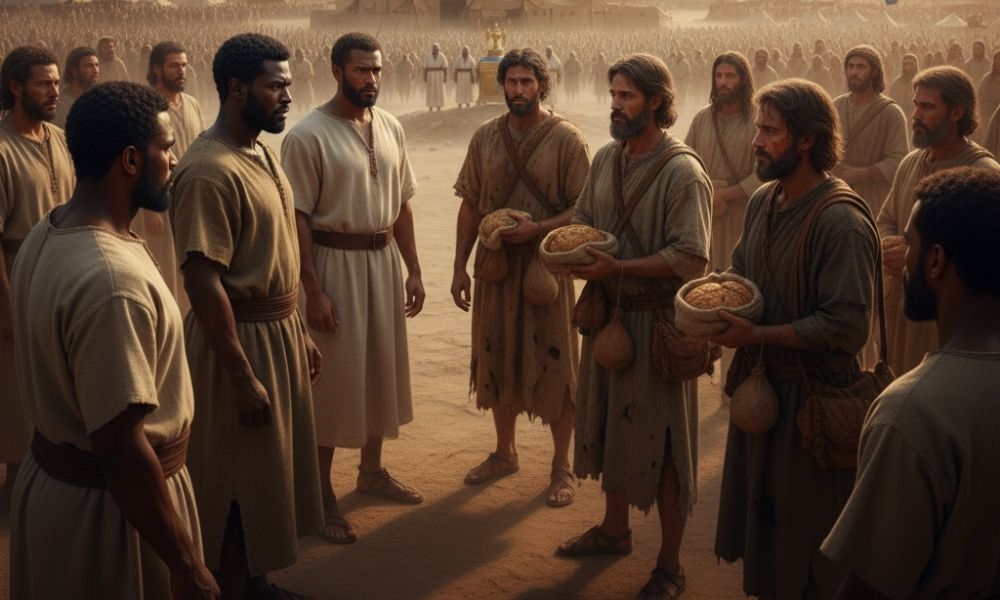
Joshua 9 tells how the Gibeonites deceive Israel into making a peace treaty. Hearing of Israel’s victories, several Canaanite kings unite to fight, but the people of Gibeon use cunning instead. They disguise themselves with worn-out clothes, cracked wineskins, and moldy bread, pretending to be travelers from a distant land. Without seeking God’s counsel, Joshua and the leaders make a treaty with them. Three days later, Israel discovers the truth — the Gibeonites live nearby. Although the people grumble, Israel keeps the oath made before the Lord. The Gibeonites are spared but made servants — woodcutters and water carriers — for the house of God, showing the seriousness of vows made in God’s name.
1. The Reaction of Canaanite Kings (9:1–2)
“As soon as all the kings who were beyond the Jordan in the hill country and in the lowland all along the coast of the Great Sea toward Lebanon, the Hittites, the Amorites, the Canaanites, the Perizzites, the Hivites, and the Jebusites heard of this, they gathered together as one to fight against Joshua and Israel.” (Joshua 9:1–2, ESV)
Commentary:
- News of Israel’s victories at Jericho and Ai spread quickly, causing fear among the Canaanite nations.
- Instead of seeking peace with God, these kings united in rebellion against His purpose.
- Their alliance shows human pride and resistance to divine will—opposing God’s plan leads to inevitable defeat.
- The unity of Canaan’s kings contrasts sharply with Israel’s unity under God; one is based on fear, the other on faith.
Insight: The world often unites against God’s people, but no alliance can prevail against His purpose.
2. The Deception of the Gibeonites (9:3–13)
“But when the inhabitants of Gibeon heard what Joshua had done to Jericho and to Ai, they on their part acted with cunning and went and made ready provisions and took worn-out sacks for their donkeys, and wineskins, worn-out and torn and mended, with worn-out, patched sandals on their feet, and worn-out clothes. And all their provisions were dry and crumbly. And they went to Joshua in the camp at Gilgal and said to him and to the men of Israel, ‘We have come from a distant country, so now make a covenant with us.’” (Joshua 9:3–6, ESV)
Commentary:
- Gibeon was a powerful city only a few miles from Jerusalem, part of the Hivite group.
- Realizing they could not defeat Israel, the Gibeonites used deception instead of confrontation.
- Their worn-out supplies were part of a clever disguise to appear as travelers from afar.
- They sought a treaty of peace under false pretenses—appealing to Israel’s compassion and sense of honor.
- The deception reveals that fear of God’s power can lead either to faith (as in Rahab) or manipulation (as in Gibeon).
Insight: Fear of God should lead to repentance and truth, not to deceitful self-preservation.
3. Israel’s Error: Failure to Seek God’s Counsel (9:14–15)
“So the men took some of their provisions, but did not ask counsel from the Lord. And Joshua made peace with them and made a covenant with them, to let them live, and the leaders of the congregation swore to them.” (Joshua 9:14–15, ESV)
Commentary:
- Israel examined the Gibeonites’ evidence (the old bread and wineskins) but failed to pray for divine guidance.
- The phrase “did not ask counsel from the Lord” marks the key turning point of the chapter.
- Joshua, though usually obedient, acted on sight rather than faith in this moment.
- A covenant was made, binding by oath before God—even though based on deception.
- This shows that spiritual discernment requires dependence on God, not human reasoning.
Insight: Many mistakes in life arise not from rebellion but from neglecting prayer and divine counsel.
4. The Discovery of the Deception (9:16–21)
“At the end of three days after they had made a covenant with them, they heard that they were their neighbors and that they lived among them. And the people of Israel set out and reached their cities on the third day. Now their cities were Gibeon, Chephirah, Beeroth, and Kiriath-jearim. But the people of Israel did not attack them, because the leaders of the congregation had sworn to them by the Lord, the God of Israel. Then all the congregation murmured against the leaders. But all the leaders said to all the congregation, ‘We have sworn to them by the Lord, the God of Israel, and now we may not touch them.’” (Joshua 9:16–19, ESV)
Commentary:
- Within three days, Israel discovered that the Gibeonites were close neighbors, not distant foreigners.
- The people were angry at their leaders for being deceived, yet the leaders chose integrity over vengeance.
- Their decision honored God’s name above national pride—breaking an oath sworn in His name would be worse than the deception itself.
- The leaders wisely transformed a mistake into a moral lesson: faithfulness to God’s word must override emotion or convenience.
Insight: True integrity is shown not only by avoiding mistakes, but by handling them righteously when they occur.
5. The Gibeonites’ Sentence and Submission (9:22–27)
“Joshua summoned them, and he said to them, ‘Why did you deceive us, saying, “We are very far from you,” when you dwell among us? Now therefore you are cursed, and some of you shall never be anything but servants, cutters of wood and drawers of water for the house of my God.’ They answered Joshua, ‘Because it was told to your servants for a certainty that the Lord your God had commanded his servant Moses to give you all the land and to destroy all the inhabitants of the land from before you—so we feared greatly for our lives because of you and did this thing.’ … But Joshua made them that day cutters of wood and drawers of water for the congregation and for the altar of the Lord, to this day, in the place that he should choose.” (Joshua 9:22–27, ESV)
Commentary:
- Joshua confronted the Gibeonites for their deceit but acknowledged their reverence for God’s power.
- Their fear of destruction drove them to deception, yet it also saved them from annihilation.
- As punishment, they became perpetual servants—cutting wood and drawing water for the altar, serving God’s house.
- This servitude, though born of deceit, placed them near God’s presence; what began as fear ended in service.
- Over time, the Gibeonites integrated into Israel’s worship life (Nehemiah 3:7), showing that mercy triumphed over judgment.
Insight: God can transform even deceitful motives into opportunities for grace and service in His kingdom.
Theological Significance of Joshua 9
- The chapter contrasts human cunning with divine wisdom—one fails when separated from prayer.
- Israel’s leaders learned that spiritual discernment requires constant dependence on God.
- The covenant with Gibeon, though flawed, became a testimony of God’s mercy and covenant faithfulness.
- The Gibeonites’ transformation from deceivers to temple servants illustrates grace that redeems human failure.
- The incident teaches the seriousness of oaths made in God’s name—they are binding even when inconvenient.
Practical Applications
- Always seek God’s guidance before making major decisions—reason and appearances can mislead.
- Keep your word, even when it costs you; integrity before God builds lasting honor.
- Don’t let fear drive you to deception; faith in God’s mercy is safer than manipulation.
- Learn from mistakes rather than hiding them; humility in correction brings restoration.
- Recognize that God can redeem failure—He turns even human error into opportunities for His glory.
Final Insight:
Joshua 9 warns that wisdom without prayer leads to error, but also reveals that God’s mercy can turn failure into service. The Gibeonites’ story teaches that while deceit has consequences, faith—even imperfect faith—can still find a place in God’s plan.







Leave a Reply