
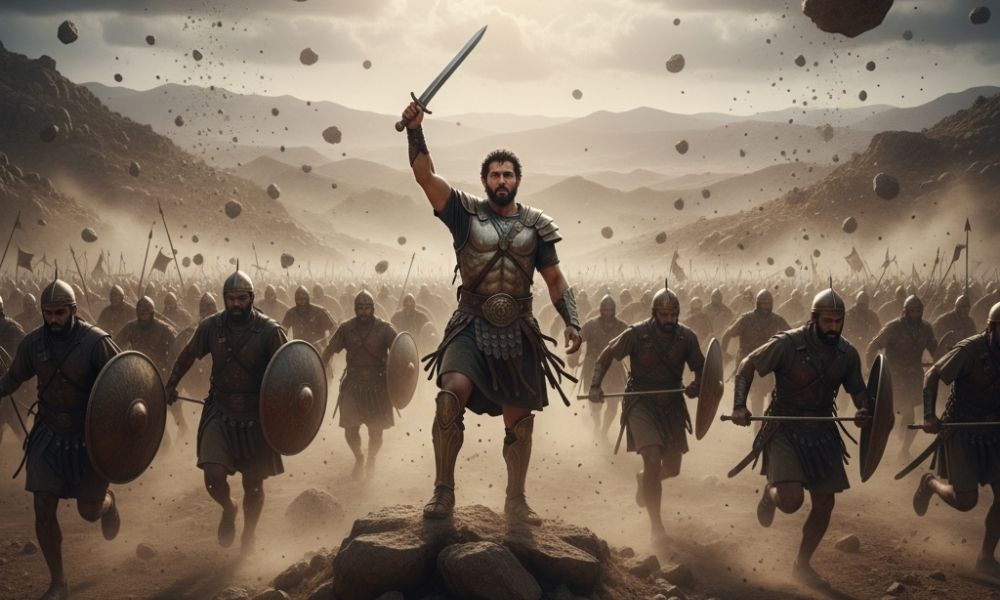
Joshua 10 records Israel’s miraculous victory over the Amorite kings. When five Canaanite kings unite to attack Gibeon (Israel’s ally), Joshua leads his army overnight to defend them. God causes panic among the enemies, sends hailstones that kill more than the sword, and — in a stunning miracle — makes the sun stand still until Israel achieves complete victory. Joshua captures and executes the five kings, conquers southern Canaan, and the Lord gives Israel success in every battle.
1. The Alliance of the Five Amorite Kings (10:1–5)
“As soon as Adoni-zedek, king of Jerusalem, heard how Joshua had captured Ai and had devoted it to destruction, doing to Ai and its king as he had done to Jericho and its king, and how the inhabitants of Gibeon had made peace with Israel and were among them, he feared greatly, because Gibeon was a great city, like one of the royal cities, and because it was greater than Ai, and all its men were warriors. So Adoni-zedek king of Jerusalem sent to Hoham king of Hebron, to Piram king of Jarmuth, to Japhia king of Lachish, and to Debir king of Eglon, saying, ‘Come up to me and help me, and let us strike Gibeon. For it has made peace with Joshua and with the people of Israel.’ Then the five kings of the Amorites—the king of Jerusalem, the king of Hebron, the king of Jarmuth, the king of Lachish, and the king of Eglon—gathered their forces and went up with all their armies and encamped against Gibeon and made war against it.” (Joshua 10:1–5, ESV)
Commentary:
- The report of Israel’s victories spreads quickly, instilling fear among the Canaanite kings.
- Adoni-zedek (“lord of righteousness”)—ironically named—leads a coalition against Gibeon, not directly against Israel.
- Gibeon’s peace treaty with Israel is seen as betrayal by its neighbors.
- The alliance of five Amorite kings shows a desperate attempt to resist God’s advancing people.
- The conflict begins because of Israel’s covenant with Gibeon—a reminder that God even uses past mistakes (the deceptive treaty of Gibeon in Joshua 9) for His purpose.
Insight:
Evil alliances often form out of fear and pride when people resist God’s purposes. Yet God can turn their opposition into opportunities for victory.
2. The Battle at Gibeon (10:6–11)
“And the men of Gibeon sent to Joshua at the camp in Gilgal, saying, ‘Do not relax your hand from your servants. Come up to us quickly and save us and help us, for all the kings of the Amorites who dwell in the hill country are gathered against us.’ So Joshua went up from Gilgal, he and all the people of war with him, and all the mighty men of valor. And the Lord said to Joshua, ‘Do not fear them, for I have given them into your hands. Not a man of them shall stand before you.’ So Joshua came upon them suddenly, having marched up all night from Gilgal. And the Lord threw them into a panic before Israel, who struck them with a great blow at Gibeon and chased them by the way of the ascent of Beth-horon and struck them as far as Azekah and Makkedah. And as they fled before Israel, while they were going down the ascent of Beth-horon, the Lord threw down large stones from heaven on them as far as Azekah, and they died. There were more who died because of the hailstones than the sons of Israel killed with the sword.” (Joshua 10:6–11, ESV)
Commentary:
- Gibeon appeals for Joshua’s help under the covenant of protection.
- Joshua responds immediately, honoring his word despite Gibeon’s earlier deception.
- God assures Joshua of total victory—“I have given them into your hand.”
- The Israelites march all night from Gilgal, showing commitment and courage.
- God Himself intervenes: panic among enemies and massive hailstones signify divine warfare.
- The hailstones killed more than Israel’s weapons, proving the victory was God’s, not man’s.
Insight:
Faithful obedience and divine intervention go hand in hand. God fights for His people when they walk in covenant loyalty and courage.
3. The Sun Stands Still (10:12–15)
“At that time Joshua spoke to the Lord in the day when the Lord gave the Amorites over to the sons of Israel, and he said in the sight of Israel,
‘Sun, stand still at Gibeon,
and moon, in the Valley of Aijalon.’
And the sun stood still, and the moon stopped,
until the nation took vengeance on their enemies.
Is this not written in the Book of Jashar? The sun stopped in the midst of heaven and did not hurry to set for about a whole day. There has been no day like it before or since, when the Lord heeded the voice of a man, for the Lord fought for Israel. So Joshua returned, and all Israel with him, to the camp at Gilgal.” (Joshua 10:12–15, ESV)
Commentary:
- Joshua’s bold prayer reflects complete dependence on God’s power.
- The request for the sun and moon to “stand still” may imply a miraculous lengthening of daylight or a suspension of celestial movement—either way, divine intervention is clear.
- The “Book of Jashar” (an ancient Hebrew collection of heroic songs) confirms the event’s historical recognition.
- The day was unique—God listened to a human voice commanding nature itself in alignment with His will.
- The miracle emphasizes that God controls all creation to fulfill His covenant promises.
Insight:
Faith dares to ask great things from a great God. When our cause aligns with His will, He can even alter nature to secure His purposes.
4. The Defeat and Execution of the Five Kings (10:16–27)
“These five kings fled and hid themselves in the cave at Makkedah. And it was told to Joshua, ‘The five kings have been found hidden in the cave at Makkedah.’ And Joshua said, ‘Roll large stones against the mouth of the cave and set men by it to guard them, but do not stay there yourselves; pursue your enemies, attack their rear guard. Do not let them enter their cities, for the Lord your God has given them into your hand.’ … And when they brought those kings out to Joshua, he summoned all the men of Israel and said to the chiefs of the men of war who had gone with him, ‘Come near; put your feet on the necks of these kings.’ Then they came near and put their feet on their necks. And Joshua said to them, ‘Do not be afraid or dismayed; be strong and courageous. For thus the Lord will do to all your enemies against whom you fight.’ … And afterward Joshua struck them and put them to death, and he hanged them on five trees.” (Joshua 10:16–27, ESV)
Commentary:
- The defeated kings hide in a cave—a fitting symbol of their fear and helplessness.
- Joshua secures them temporarily, prioritizing the ongoing battle before dealing with them.
- After victory, the kings are brought out publicly and executed as symbols of total conquest.
- Joshua’s command to place feet on their necks signifies divine triumph (cf. Psalm 110:1).
- The public hanging displays the seriousness of rebellion against God.
- By evening, their bodies are removed according to the law (Deuteronomy 21:23), showing Israel’s obedience even in victory.
Insight:
Victory must be complete but also guided by obedience and reverence for God’s law. The Lord exalts His people over enemies when they trust His leadership.
5. The Southern Conquest (10:28–43)
“That day Joshua captured Makkedah… He left none remaining. And he did to the king of Makkedah just as he had done to the king of Jericho. Then Joshua and all Israel with him passed on from Makkedah to Libnah… and from Libnah to Lachish… from Lachish to Eglon… to Hebron… to Debir… So Joshua struck the whole land, the hill country and the Negeb and the lowland and the slopes, and all their kings. He left none remaining, but devoted to destruction all that breathed, just as the Lord God of Israel commanded. And Joshua struck them from Kadesh-barnea as far as Gaza, and all the country of Goshen, as far as Gibeon. And Joshua captured all these kings and their land at one time, because the Lord God of Israel fought for Israel. Then Joshua returned, and all Israel with him, to the camp at Gilgal.” (Joshua 10:28–43, ESV)
Commentary:
- The chapter concludes with a rapid account of Israel’s southern victories.
- Cities like Lachish, Hebron, and Debir fall one after another.
- “He left none remaining” indicates total defeat of the enemy forces, not necessarily annihilation of civilians.
- Joshua acts strictly “as the Lord commanded,” fulfilling divine judgment on Canaanite wickedness.
- The repeated phrase “the Lord fought for Israel” underscores the divine source of success.
- The campaign extends from the southern desert (Kadesh-barnea) to the western plains (Gaza).
Insight:
God’s victories are decisive and far-reaching. Obedience brings momentum, and faith in His promise ensures the conquest is complete.
Theological Significance of Joshua 10
- God’s Sovereignty: The sun standing still reveals God’s authority over creation.
- Divine Partnership: God works through human obedience and courage to fulfill His purposes.
- Faith and Prayer: Joshua’s bold faith shows how prayer aligned with God’s will can bring miraculous outcomes.
- Judgment and Justice: The destruction of Canaanite kings fulfills divine justice on nations hardened in sin.
- Covenant Loyalty: Joshua honors the treaty with Gibeon, showing integrity even when costly.
Practical Applications
- Keep your word, even when it costs you—God honors integrity.
- Trust God’s power—He can turn overwhelming battles into victories.
- Pray boldly—faith-filled prayer can move heaven and earth.
- Lead courageously—as Joshua did, inspire others to be strong in the Lord.
- Acknowledge God’s hand—success without humility leads to pride; success with faith glorifies God.
Final Insight:
Joshua 10 is a dramatic reminder that the God who commands the sun and moon also commands our battles. When we stand firm in obedience and faith, He fights for us, turning impossible moments into testimonies of His power and glory.







Leave a Reply