
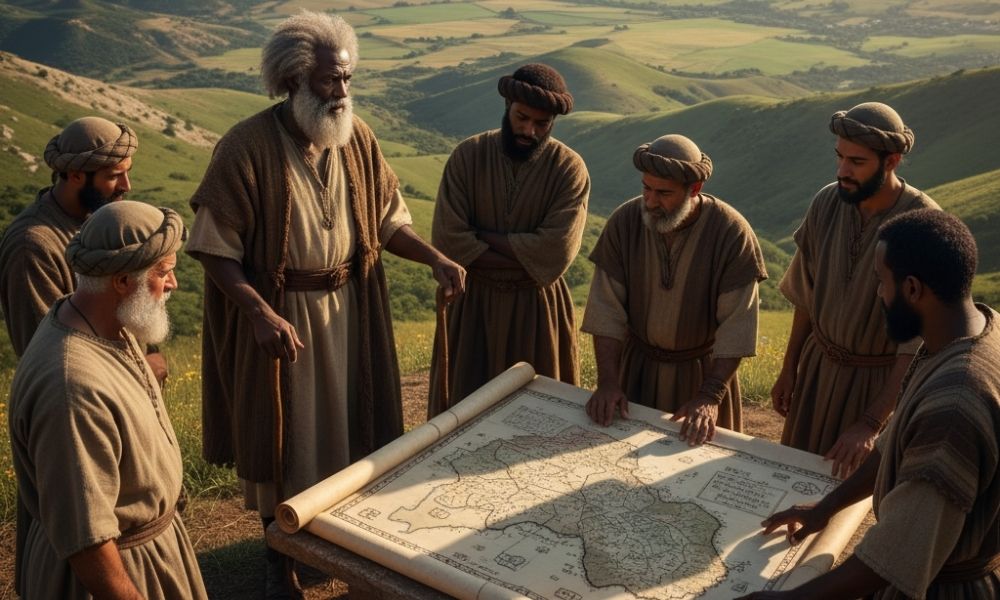
Joshua 13 describes the division of land still to be conquered and the territories assigned east of the Jordan. God tells Joshua, now old, that much land remains to be possessed—Philistine and Canaanite regions along the coast and northward. Yet God promises to drive out these nations, and the land is divided by lot for Israel’s inheritance. Moses had already allotted territory east of the Jordan to Reuben, Gad, and the half-tribe of Manasseh. The chapter details their borders and towns. Notably, the Levites receive no land inheritance, for their portion is the Lord Himself and the offerings made by fire.
1. Joshua’s Old Age and God’s Instruction (13:1–7)
“Now Joshua was old and advanced in years, and the Lord said to him, ‘You are old and advanced in years, and there remains yet very much land to possess. This is the land that yet remains: all the regions of the Philistines, and all those of the Geshurites (from the Shihor, which is east of Egypt, northward to the boundary of Ekron, it is counted as Canaanite; there are five rulers of the Philistines, those of Gaza, Ashdod, Ashkelon, Gath, and Ekron), and those of the Avvim in the south, all the land of the Canaanites, and Mearah that belongs to the Sidonians, to Aphek, to the boundary of the Amorites, and the land of the Gebalites, and all Lebanon, toward the sunrise, from Baal-gad below Mount Hermon to Lebo-hamath, all the inhabitants of the hill country from Lebanon to Misrephoth-maim, even all the Sidonians. I myself will drive them out from before the people of Israel. Only allot the land to Israel for an inheritance, as I have commanded you. Now therefore divide this land for an inheritance to the nine tribes and half the tribe of Manasseh.’” (Joshua 13:1–7, ESV)
Commentary:
- Joshua, now elderly, had fulfilled much of his mission, but the work was not yet complete.
- God acknowledges Joshua’s age but reminds him there is still “much land to possess.”
- The remaining territories include the Philistine cities (Gaza, Ashdod, Ashkelon, Gath, Ekron) and the northern Phoenician and Lebanese regions.
- God promises to continue driving out the remaining inhabitants—His power would complete what Joshua started.
- Joshua’s task shifts from leading battles to allocating inheritance. Leadership in later years moves from conquering to establishing.
Insight:
Even when strength fades, God’s purpose continues. Our later years can still be fruitful through faithful stewardship and guidance to others.
2. The Inheritance of the Tribes East of the Jordan (13:8–13)
“With the other half of the tribe of Manasseh the Reubenites and the Gadites received their inheritance, which Moses gave them, beyond the Jordan eastward, as Moses the servant of the Lord gave them: from Aroer, which is on the edge of the Valley of the Arnon, and the city that is in the middle of the valley, and all the tableland of Medeba as far as Dibon; and all the cities of Sihon king of the Amorites, who reigned in Heshbon, as far as the boundary of the Ammonites; and Gilead, and the territory of the Geshurites and Maacathites, and all Mount Hermon, and all Bashan to Salecah; all the kingdom of Og in Bashan, who reigned in Ashtaroth and in Edrei (he alone was left of the remnant of the Rephaim); these Moses had struck and driven out. Yet the people of Israel did not drive out the Geshurites or the Maacathites, but Geshur and Maacath dwell in the midst of Israel to this day.” (Joshua 13:8–13, ESV)
Commentary:
- This section reviews the inheritance east of the Jordan, granted by Moses to Reuben, Gad, and half of Manasseh.
- The land includes territories once ruled by Sihon and Og, symbolizing great victories in Moses’ time.
- The Geshurites and Maacathites, small neighboring groups, were not expelled—an early warning that partial obedience leads to long-term trouble (later, Absalom’s mother was from Geshur; cf. 2 Samuel 3:3).
- These eastern tribes received fertile lands but were geographically separated from the rest of Israel, a decision that would later affect unity.
Insight:
Incomplete obedience weakens future generations. God’s commands for holiness and separation must be followed fully, not partially.
3. The Land of Reuben (13:15–23)
“And Moses gave an inheritance to the tribe of the people of Reuben according to their clans. So their territory was from Aroer, which is on the edge of the Valley of the Arnon, and the city that is in the middle of the valley, and all the tableland by Medeba; with Heshbon, and all its cities that are in the tableland… And the border of the people of Reuben was the Jordan as a boundary. This was the inheritance of the people of Reuben according to their clans, with their cities and villages.” (Joshua 13:15–23, ESV)
Commentary:
- Reuben’s portion lay in the south, along the Arnon River and the Dead Sea.
- It included Heshbon, the former capital of Sihon’s kingdom.
- The territory was known for its fertile plains (“tableland of Medeba”).
- Despite this blessing, the tribe of Reuben would later diminish in prominence (see Genesis 49:3–4).
Insight:
Privileges do not guarantee prominence; faithfulness maintains inheritance. Reuben’s early zeal faded, showing how spiritual decline can waste a good inheritance.
4. The Land of Gad (13:24–28)
“And Moses gave an inheritance also to the tribe of Gad, to the people of Gad, according to their clans. Their territory was Jazer, and all the cities of Gilead, and half the land of the Ammonites… and the Jordan was the boundary of it, as far as the Sea of Chinneroth, eastward beyond the Jordan.” (Joshua 13:24–28, ESV)
Commentary:
- Gad’s territory lay north of Reuben, covering the central region of Gilead, near the Jordan River and Sea of Galilee.
- The land included important cities like Rabbah, the Ammonite capital.
- Gad’s location made it both strategic and vulnerable—open to invasion from the east.
- Later in history, Gad and Reuben were among the first tribes taken into exile by Assyria (1 Chronicles 5:26).
Insight:
Comfort and prosperity near the borders can bring danger. Spiritual vigilance must accompany material blessing.
5. The Half-Tribe of Manasseh (13:29–31)
“And Moses gave an inheritance to the half-tribe of Manasseh… Their territory was from Mahanaim, through all Bashan, the whole kingdom of Og king of Bashan… all the towns of Jair, which are in Bashan, sixty cities, and half of Gilead, and Ashtaroth, and Edrei, the cities of the kingdom of Og in Bashan; these were for the people of Machir the son of Manasseh, for half of the people of Machir according to their clans.” (Joshua 13:29–31, ESV)
Commentary:
- The eastern half of Manasseh, descended from Machir, received the northern region of Bashan, known for its rich pasturelands.
- The land included sixty fortified towns, showing how greatly this tribe was blessed materially.
- Their strength was renowned, but distance from the main body of Israel would test their unity with the rest of the nation.
Insight:
Wealth and distance can subtly weaken dependence on God’s people. Blessing must never lead to isolation.
6. The Levites’ Inheritance (13:14, 32–33)
“To the tribe of Levi alone Moses gave no inheritance; the offerings by fire to the Lord God of Israel are their inheritance, as he said to him… But to the tribe of Levi Moses gave no inheritance; the Lord God of Israel is their inheritance, just as he said to them.” (Joshua 13:14, 32–33, ESV)
Commentary:
- The Levites received no land inheritance, because their role was spiritual service in the tabernacle.
- Instead of land, God Himself was their portion—a higher inheritance than physical possession.
- They lived among all tribes, ministering and teaching, symbolizing God’s presence throughout Israel.
- This arrangement reinforced that spiritual ministry sustains the nation more than territorial wealth.
Insight:
True inheritance is found not in property but in relationship with God. To have Him as our portion is the richest reward.
Theological Significance of Joshua 13
- Faithfulness Despite Age: God continues His purpose through aging leaders and new generations.
- Continuity of Promise: The division of land fulfills earlier commitments made through Moses.
- Partial Obedience Warned: Incomplete conquests foreshadow later compromise and idolatry.
- God as Inheritance: The Levites’ example teaches that God Himself is the greatest possession.
- Unity Across Borders: Even tribes east of the Jordan are part of God’s covenant people—reminding us that physical distance must not create spiritual division.
Practical Applications
- Serve faithfully in every season. Even in old age, God gives new assignments.
- Guard against half-obedience. Small compromises today bring great struggles tomorrow.
- Treasure God above possessions. The Levites remind us that relationship with Him outweighs material inheritance.
- Stay connected to God’s community. Isolation, even when blessed, can weaken spiritual life.
- Record God’s faithfulness. Each allotment was a tangible proof of His fulfilled promise.
Final Insight:
Joshua 13 shifts from conquest to inheritance. The battles may slow, but God’s promises continue to unfold. It is a chapter about faithfulness—of an aging leader, of a faithful God, and of tribes learning to live in the blessings they’ve received. The message endures: victories end, but the stewardship of God’s promises never does.







Leave a Reply