
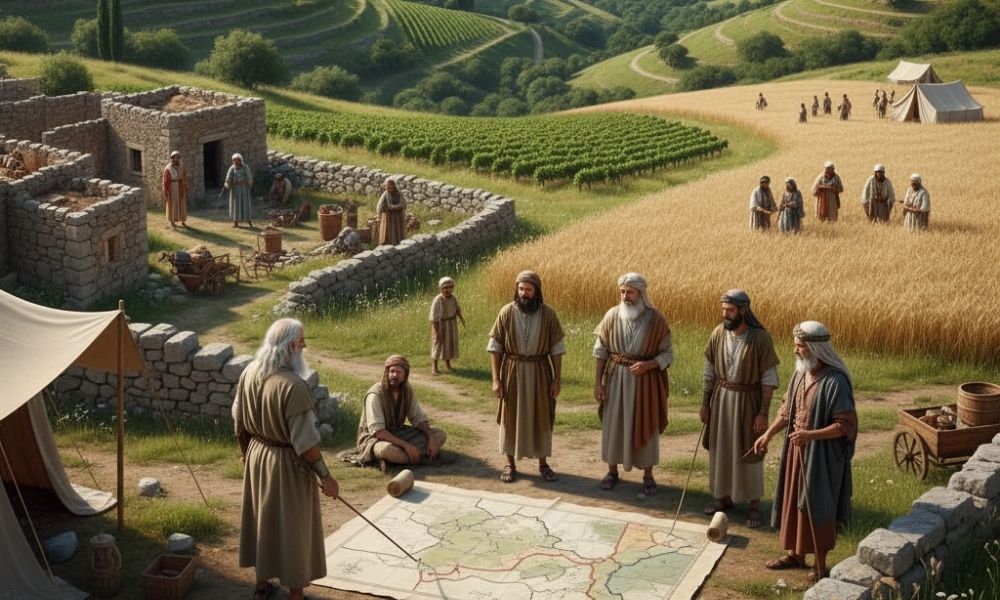
Joshua 16 describes the inheritance of the descendants of Joseph — the tribes of Ephraim and Manasseh. Their territory begins at the Jordan River near Jericho, extends through Bethel, and reaches the Mediterranean Sea. The land is divided between the two tribes. Ephraim’s specific portion is outlined, including its cities and boundaries. However, the Ephraimites fail to drive out the Canaanites living in Gezer, and those people remain in the land as forced labor. This chapter emphasizes God’s faithfulness in granting the land, while also revealing Israel’s incomplete obedience in not fully removing the Canaanite presence.
1. The Territory of Joseph’s Descendants (16:1–4)
“The allotment of the people of Joseph went from the Jordan by Jericho, east of the waters of Jericho, into the wilderness, going up from Jericho into the hill country to Bethel. Then going from Bethel to Luz, it passes along to Ataroth, the territory of the Archites; then it goes down westward to the territory of the Japhletites, as far as the territory of Lower Beth-horon, then to Gezer, and it ends at the sea. The people of Joseph, Manasseh and Ephraim, received their inheritance.” (Joshua 16:1–4, ESV)
Commentary:
- The “people of Joseph” refers collectively to Ephraim and Manasseh, the two sons of Joseph who received double inheritance through Jacob’s blessing (Genesis 48:5).
- Their territory stretched from the Jordan River near Jericho, westward through Bethel and Beth-horon, all the way to the Mediterranean Sea.
- This area lies in the central hill country of Canaan, fertile and strategically located.
- The text shows unity between Ephraim and Manasseh as they first receive their joint boundary before separating individual tribal allotments.
- The inheritance fulfills God’s promise to Joseph through Jacob—that his descendants would be “a fruitful vine” (Genesis 49:22).
Insight:
God’s blessings are abundant and far-reaching, just as Joseph’s inheritance covered fertile land and key trade routes. His fruitfulness in Egypt now translates into lasting blessing for his descendants.
2. The Boundaries of Ephraim (16:5–10)
“The territory of the people of Ephraim by their clans was as follows: the boundary of their inheritance on the east was Ataroth-addar as far as Upper Beth-horon, then the boundary goes out westward at Michmethath on the north. Then the boundary turns eastward to Taanath-shiloh and passes along beyond it on the east to Janoah, then it goes down from Janoah to Ataroth and to Naarah, and touches Jericho, ending at the Jordan. From Tappuah the boundary goes westward to the brook Kanah and ends at the sea… and there were cities that were set apart for the people of Ephraim within the inheritance of the Manassites, all those cities with their villages. However, they did not drive out the Canaanites who lived in Gezer, so the Canaanites have lived in the midst of Ephraim to this day but have been made to do forced labor.” (Joshua 16:5–10, ESV)
Commentary:
- Ephraim’s territory occupies the central highlands, bordered by Bethel to the south and the Sea (Mediterranean) to the west.
- The description details specific towns, showing precise inheritance distribution “by their clans.”
- Ephraim also received cities within Manasseh’s territory, reflecting close tribal relations.
- However, verse 10 notes a serious failure: Ephraim did not drive out the Canaanites in Gezer.
- Instead, they subjected them to forced labor, a compromise that would later lead to idolatry and spiritual decay.
- Gezer remained a Canaanite stronghold until Solomon’s reign, when Pharaoh of Egypt captured it and gave it as dowry to Solomon’s wife (1 Kings 9:16).
Insight:
Partial obedience may bring temporary comfort but long-term corruption. God calls for full faithfulness, not convenience or compromise.
3. Spiritual Significance of Ephraim’s Inheritance
- Central Location: Ephraim’s land sat at Israel’s heart—between Judah (to the south) and Manasseh (to the north). Later, it became the political and spiritual center of the northern kingdom.
- Spiritual Leadership: Shiloh, within Ephraim’s territory (Joshua 18:1), became the first permanent location of the tabernacle—a sign of spiritual privilege and responsibility.
- Prophetic Role: Ephraim’s later pride and rebellion (Hosea 4:17) contrast sharply with its early blessing, reminding us that privilege demands humility.
- Legacy of Joseph: The tribe inherited Joseph’s double portion, symbolizing abundance and leadership, yet also inherited the test of faithfulness amid prosperity.
Insight:
Blessing brings responsibility. The greater the inheritance, the greater the call to spiritual integrity and complete obedience.
Theological Significance of Joshua 16
- Fulfillment of Promise: God keeps His word to Joseph through a fertile and strategic inheritance.
- Unity and Diversity: Ephraim and Manasseh share one blessing yet distinct portions—illustrating harmony within diversity in God’s plan.
- Obedience vs. Compromise: The failure to expel the Canaanites reminds believers that sin tolerated within will eventually rule over them.
- Faithfulness in Prosperity: Ephraim’s central and rich inheritance serves as a test of stewardship and humility.
- Divine Distribution: The careful boundary descriptions reflect God’s order and justice—every tribe receives what is rightly theirs.
Practical Applications
- Fulfill God’s commands completely. Don’t settle for half victories; unfinished obedience invites future defeat.
- Stay humble in blessing. Prosperity can easily lead to pride—remember the Giver of every good inheritance.
- Preserve unity amid diversity. Like Ephraim and Manasseh, different callings can still work together within one family of faith.
- Guard spiritual territory. What you allow to remain within your borders—like Gezer—can later challenge your peace and purity.
- Live worthy of God’s favor. Every blessing is both a gift and a responsibility to honor God’s covenant.
Final Insight:
Joshua 16 records the inheritance of Joseph’s descendants—rich, central, and blessed. Yet the chapter ends with a warning: compromise within the land of blessing endangers the future. Ephraim’s story teaches that God’s promises are sure, but they must be matched with steadfast obedience. To keep the inheritance, we must conquer every “Gezer” that tempts us to comfort over conviction.







Leave a Reply