
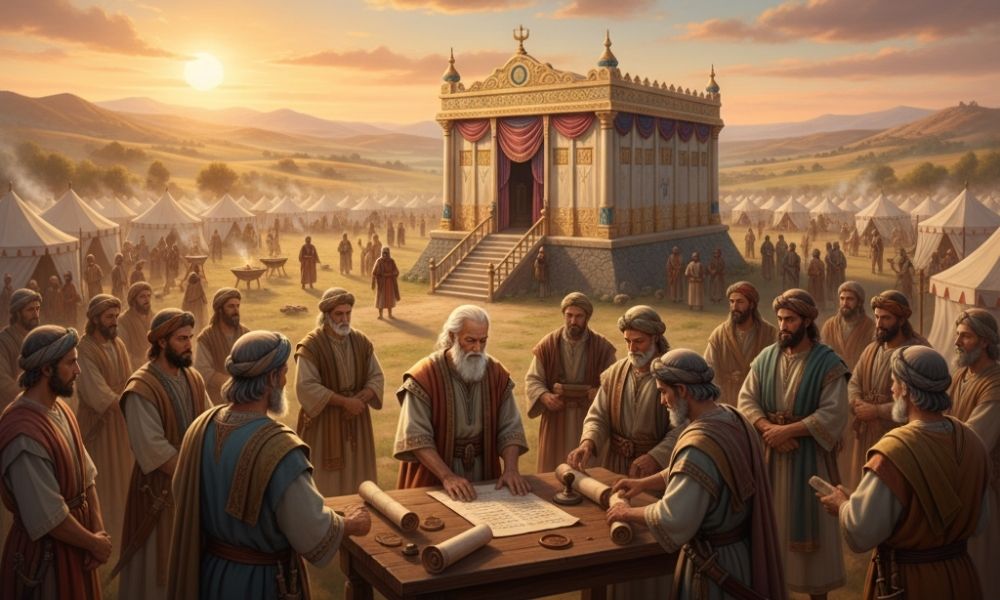
Joshua 19 records the allotment of land for the remaining six tribes of Israel: Simeon, Zebulun, Issachar, Asher, Naphtali, and Dan. Simeon’s inheritance lies within Judah’s territory because Judah’s portion was too large. Each tribe receives specific cities and borders as described in detail. The tribe of Dan later struggles to hold its land and captures the city of Leshem (Laish), renaming it Dan. Finally, when all divisions are complete, the Israelites give Joshua a special inheritance — the city of Timnath-serah in the hill country of Ephraim. He builds and settles there. The chapter ends noting that the land distribution was finished at Shiloh before the Lord.
1. The Allotment for Simeon (19:1–9)
“The second lot came out for Simeon, for the tribe of the people of Simeon according to their clans, and their inheritance was in the midst of the inheritance of the people of Judah. They had for their inheritance Beersheba, Sheba, Moladah, Hazar-shual, Balah, Ezem, Eltolad, Bethul, Hormah, Ziklag, Beth-marcaboth, Hazar-susah, Beth-lebaoth, and Sharuhen—thirteen cities with their villages… The inheritance of the people of Simeon formed part of the territory of the people of Judah, because the portion of the people of Judah was too large for them.” (Joshua 19:1–9, ESV)
Commentary:
- Simeon’s inheritance lies within Judah’s territory, mainly in the southern Negeb region.
- Judah’s original portion was so large that some land was reassigned to Simeon.
- This fulfills Jacob’s prophecy that Simeon would be “scattered in Israel” (Genesis 49:5–7).
- Over time, Simeon’s identity became absorbed into Judah—an example of divine prophecy fulfilled through geography.
- The cities listed include Beersheba and Ziklag, later significant in the life of David.
Insight:
Sometimes God places smaller callings within greater ones. Being “within Judah” did not reduce Simeon—it aligned them with strength and stability.
2. The Allotment for Zebulun (19:10–16)
“The third lot came up for the people of Zebulun according to their clans. And the territory of their inheritance reached as far as Sarid. Then their boundary goes up westward and on to Maralah and touches Dabbesheth, then the brook that is east of Jokneam… This is the inheritance of the tribe of the people of Zebulun according to their clans, these cities with their villages.” (Joshua 19:10–16, ESV)
Commentary:
- Zebulun’s inheritance lay in northern Canaan, between Issachar and Naphtali.
- The territory stretched from Sarid to Maralah and near Mount Tabor, a future site of the Transfiguration (Matthew 17:1).
- Zebulun’s position placed it between mountain and sea trade routes—fulfilling Jacob’s prophecy that it would “dwell at the seashore and become a haven for ships” (Genesis 49:13).
- Though landlocked, Zebulun’s borders reached toward the Mediterranean and trade-rich regions, symbolizing commerce and connection.
Insight:
God’s blessings position us strategically—not always in the center of attention, but at points of influence and connection.
3. The Allotment for Issachar (19:17–23)
“The fourth lot came out for Issachar, for the people of Issachar, according to their clans. Their territory included Jezreel, Chesulloth, Shunem, Hapharaim, Shion, Anaharath… twenty-two cities with their villages.” (Joshua 19:17–23, ESV)
Commentary:
- Issachar’s land covers the fertile Jezreel Valley, often called “the breadbasket of Israel.”
- Key cities like Jezreel and Shunem later appear in Israel’s history (1 Kings 21; 2 Kings 4).
- The tribe was known for wisdom and understanding of the times (1 Chronicles 12:32).
- The fertile plains symbolize discernment and productivity—a people who prosper by understanding and obeying God’s seasons.
Insight:
Spiritual insight is fertile ground. Those who discern God’s timing harvest abundant fruit.
4. The Allotment for Asher (19:24–31)
“The fifth lot came out for the tribe of the people of Asher according to their clans. Their territory included Helkath, Hali, Beten, Achshaph… and ran on to Great Sidon. Then the boundary turned to Ramah, reaching to the fortified city of Tyre… This is the inheritance of the tribe of the people of Asher according to their clans—these cities with their villages.” (Joshua 19:24–31, ESV)
Commentary:
- Asher’s land bordered the Mediterranean Sea, stretching from Carmel to Sidon and Tyre in the north.
- The region was known for olive oil, vineyards, and trade, fulfilling Moses’ blessing that Asher would “dip his foot in oil” (Deuteronomy 33:24).
- However, Asher struggled to dislodge the Canaanites and later lived among them (Judges 1:31–32).
- Despite wealth and opportunity, Asher’s partial obedience limited spiritual influence.
Insight:
Material prosperity without spiritual purity brings mixed blessing. Success is safest when submitted to God’s will.
5. The Allotment for Naphtali (19:32–39)
“The sixth lot came out for the people of Naphtali, for the people of Naphtali, according to their clans. And their boundary ran from Heleph, from the oak in Zaanannim, and Adami-nekeb, and Jabneel, as far as Lakkum, and it ended at the Jordan… Nineteen cities with their villages.” (Joshua 19:32–39, ESV)
Commentary:
- Naphtali’s territory lay in upper Galilee, near the Sea of Galilee and Lebanon mountains.
- This beautiful, fertile area later became known as “Galilee of the nations” (Isaiah 9:1–2), where Jesus began His ministry (Matthew 4:13–15).
- Naphtali’s prophetic blessing—“a deer let loose” (Genesis 49:21)—reflected freedom and fruitfulness.
- The tribe’s future role in Jesus’ ministry highlights God’s foresight in choosing their inheritance.
Insight:
God plants His people in places where His light will one day shine brightest. Today’s assignment may hold tomorrow’s divine revelation.
6. The Allotment for Dan (19:40–48)
“The seventh lot came out for the tribe of the people of Dan according to their clans. And the territory of their inheritance included Zorah, Eshtaol, Ir-shemesh, Shaalabbin, Aijalon, Ithlah, Elon, Timnah… and the territory of the people of Dan was lost to them. The people of Dan went up and fought against Leshem, and after capturing it and striking it with the sword, they took possession of it and settled in it, calling Leshem, Dan, after the name of Dan their ancestor.” (Joshua 19:40–48, ESV)
Commentary:
- Dan’s initial territory was near Judah and Benjamin, close to the Philistine frontier.
- Constant conflict with the Philistines led them to migrate north, capturing Leshem (Laish) and renaming it Dan.
- This movement is later described in Judges 18—the tribe’s northern settlement became Israel’s northernmost point (“from Dan to Beersheba”).
- Unfortunately, Dan later fell into idolatry, setting up a rival shrine (Judges 18:30–31).
- The tribe’s story is a warning against discontent and compromise.
Insight:
When we abandon God’s assigned portion, we risk trading obedience for convenience—and inheritance for instability.
7. Joshua’s Own Inheritance (19:49–51)
“When they had finished distributing the several territories of the land as inheritances, the people of Israel gave an inheritance among them to Joshua the son of Nun. By command of the Lord they gave him the city that he asked, Timnath-serah in the hill country of Ephraim. And he rebuilt the city and settled in it. These are the inheritances that Eleazar the priest and Joshua the son of Nun and the heads of the fathers’ houses of the tribes of the people of Israel distributed by lot at Shiloh before the Lord.” (Joshua 19:49–51, ESV)
Commentary:
- After every tribe received its portion, Joshua himself receives his inheritance last—a mark of humility and servant leadership.
- He chooses Timnath-serah (“portion that remains”) in the hill country of Ephraim—his home region.
- Joshua rebuilds and settles it, modeling stewardship and peace.
- The process ends “before the Lord at Shiloh”, emphasizing that all inheritance comes from God’s presence and command.
Insight:
True leaders wait their turn, serve others first, and are content with what God assigns. Reward follows faithful service.
Theological Significance of Joshua 19
- God’s Faithfulness Completed: The distribution of land fulfills God’s ancient promises to Abraham (Genesis 12:7).
- Equality Before God: Each tribe—large or small—receives a divinely appointed portion.
- Worship Central to Life: All divisions take place before the Lord at Shiloh, showing that inheritance is sacred, not merely political.
- Prophecy Fulfilled: Ancient blessings over Jacob’s sons (Genesis 49; Deuteronomy 33) unfold precisely in their land assignments.
- Servant Leadership Modeled: Joshua’s humility in receiving his portion last highlights God’s principle of “the last shall be first” (Matthew 19:30).
Practical Applications
- Be content with your portion. God’s assignment is perfectly suited to your purpose.
- Take your inheritance seriously. Steward every blessing as a sacred trust from the Lord.
- Avoid comparison or envy. Each tribe’s territory differed, yet all were God-given.
- Serve before self. Like Joshua, let leadership begin with humility and end with peace.
- Center life on worship. All true possession flows from God’s presence, not human power.
Final Insight:
Joshua 19 marks the completion of Israel’s territorial inheritance—a testimony of God’s unfailing promise and perfect order. From Simeon in the south to Dan in the north, every tribe finds its place under divine wisdom. At last, Joshua receives his portion, not as a conqueror demanding reward, but as a servant content to receive from God’s hand. The message is timeless: our inheritance is secure when we rest in God’s presence, walk in obedience, and serve with humble faith.







Leave a Reply