
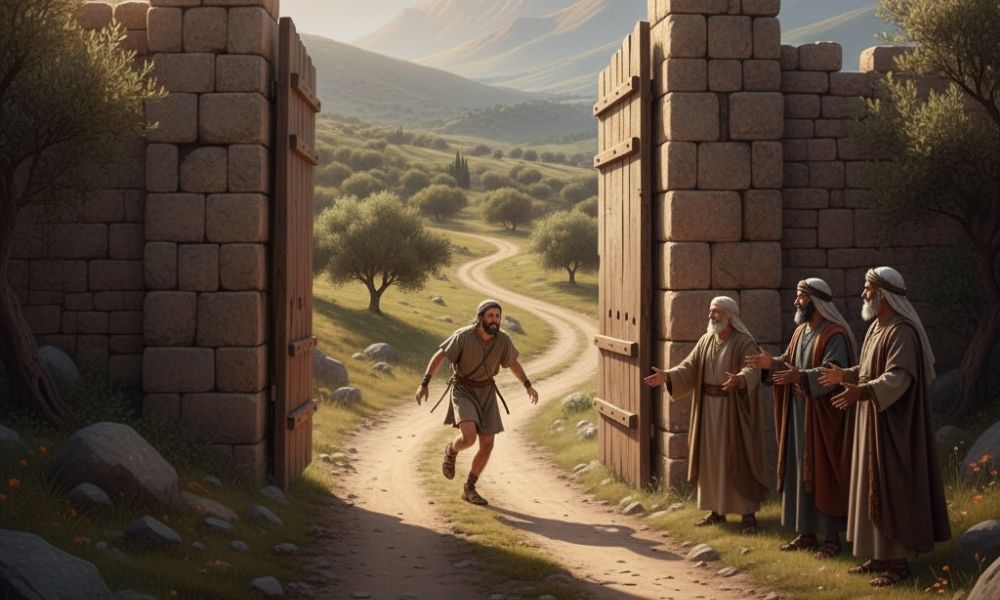
Joshua 20 outlines the establishment of the six cities of refuge, as the Lord had commanded through Moses. These cities provide protection for anyone who accidentally kills another person, allowing them to flee there until they stand trial before the congregation. The cities are appointed throughout the land—three on each side of the Jordan: Kedesh in Galilee, Shechem in Ephraim, and Kiriath-arba (Hebron) in Judah to the west; and Bezer, Ramoth, and Golan to the east. These cities ensure justice and mercy, preventing blood vengeance while upholding due process under God’s law.
1. God’s Command to Establish Cities of Refuge (20:1–3)
“Then the Lord said to Joshua, ‘Say to the people of Israel, “Appoint the cities of refuge, of which I spoke to you through Moses, that the manslayer who strikes any person without intent or unknowingly may flee there. They shall be for you a refuge from the avenger of blood.”’” (Joshua 20:1–3, ESV)
Commentary:
- After the land distribution, God commands Joshua to fulfill an earlier instruction given to Moses (Numbers 35; Deuteronomy 19).
- Cities of refuge were designated sanctuaries where someone who accidentally killed another could flee for safety.
- The purpose: to protect the innocent manslayer from the avenger of blood—a family member seeking retribution.
- These cities uphold justice balanced with mercy: they prevent chaos from vengeance yet ensure accountability.
- God Himself is the source of this mercy, showing His concern for fairness and human life.
Insight:
God’s justice is not blind wrath—it is compassionate, orderly, and redemptive. He provides safety even for those who err unintentionally.
2. The Process of Protection (20:4–6)
“He shall flee to one of these cities and shall stand at the entrance of the gate of the city and explain his case to the elders of that city. Then they shall take him into the city and give him a place, and he shall remain with them. And if the avenger of blood pursues him, they shall not give up the manslayer into his hand, because he struck his neighbor unknowingly and did not hate him in the past. And he shall remain in that city until he has stood before the congregation for judgment, until the death of him who is high priest at the time. Then the manslayer may return to his own town and his own home, to the town from which he fled.” (Joshua 20:4–6, ESV)
Commentary:
- The process was structured and fair:
- The manslayer fled to the city gate and pleaded his case before the elders.
- The elders received him into the city and granted protection.
- A trial would later confirm whether the killing was accidental or intentional.
- If innocent, the man stayed in the city until the death of the high priest, after which he could safely return home.
- The high priest’s death symbolized the completion of atonement and release—pointing to Christ’s future sacrifice, which brings true spiritual freedom.
- These cities reveal God’s concern for justice tempered with mercy and the sanctity of life.
Insight:
God’s mercy provides both protection and purification. Justice delays vengeance to give grace room to work.
3. The Locations of the Cities of Refuge (20:7–9)
“So they set apart Kedesh in Galilee in the hill country of Naphtali, and Shechem in the hill country of Ephraim, and Kiriath-arba (that is, Hebron) in the hill country of Judah. And beyond the Jordan east of Jericho, they appointed Bezer in the wilderness on the tableland, from the tribe of Reuben, and Ramoth in Gilead, from the tribe of Gad, and Golan in Bashan, from the tribe of Manasseh. These were the cities designated for all the people of Israel and for the stranger sojourning among them, that anyone who killed a person without intent could flee there, so that he might not die by the hand of the avenger of blood, till he stood before the congregation.” (Joshua 20:7–9, ESV)
Commentary:
- Six cities are appointed—three west of the Jordan and three east of the Jordan, ensuring accessibility for all Israelites:
- Their distribution shows God’s fairness—no one was too far from mercy.
- The provision extended not only to Israelites but also to foreigners and sojourners living among them—revealing God’s inclusive grace.
Insight:
God’s mercy is near and accessible. No matter where one lives, His provision for forgiveness and refuge is within reach.
Theological Significance of Joshua 20
- Mercy and Justice United: The cities demonstrate God’s perfect balance—protecting the innocent without excusing sin.
- Christ Foreshadowed: The cities of refuge prefigure Christ our Refuge—the One to whom sinners flee for safety from judgment (Hebrews 6:18).
- High Priest as Mediator: The death of the high priest symbolizes atonement through Christ’s death, which releases us from guilt and restores us to peace.
- God’s Accessibility: The evenly spaced cities show that divine mercy is available to all—north, south, east, and west.
- Community and Law: Justice was handled within a structured, godly system that prevented revenge and preserved unity.
Practical Applications
- Run to your Refuge. Christ is the ultimate city of refuge—run to Him for forgiveness and safety from sin’s judgment.
- Be accessible in mercy. Just as every city was within reach, believers should make God’s grace easy for others to find.
- Value justice with compassion. Truth and mercy must guide every judgment and relationship.
- Stay in the place of safety. The manslayer was secure only within the city—remaining in God’s will ensures lasting peace.
- Live with gratitude for grace. The cities remind us that our safety is not earned—it’s provided by a merciful God.
Final Insight:
Joshua 20 turns legal provision into a picture of divine grace. Six cities, open to all, show that God’s justice always makes room for mercy. Each refuge points forward to Jesus Christ—our eternal sanctuary. In Him, the guilty find forgiveness, the fearful find safety, and every wanderer finds a home.







Leave a Reply