
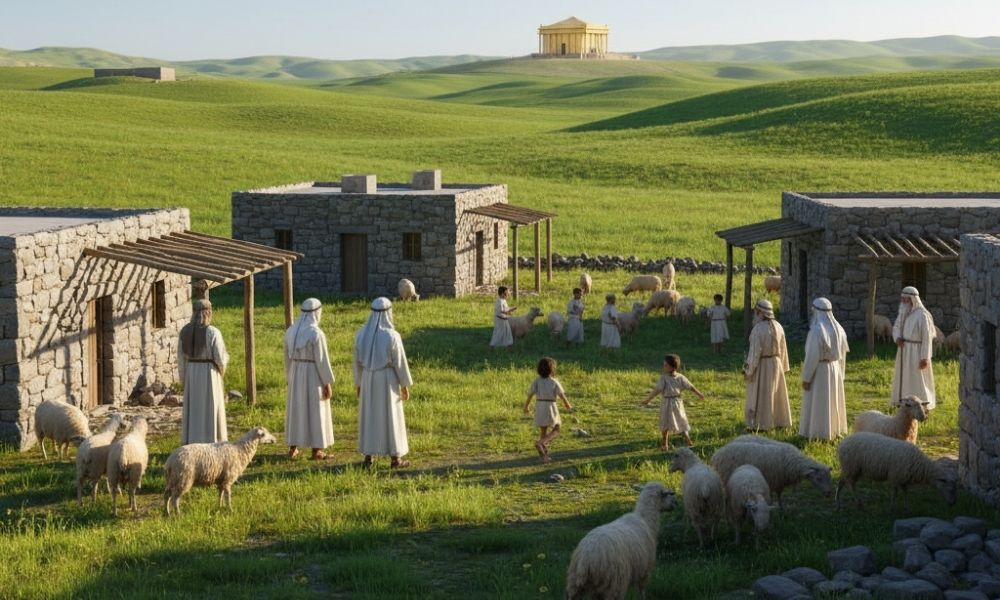
Joshua 21 describes how the Levites receive their towns and pasturelands throughout Israel, fulfilling God’s command through Moses. Since the Levites have no tribal territory of their own, forty-eight cities are allotted to them—spread among the tribes of Israel. These include the cities of refuge and surrounding pasturelands for their livestock. The chapter lists the cities given to the Kohathites, Gershonites, and Merarites, the three Levitical families. It concludes triumphantly: “Not one word of all the good promises that the Lord had made to the house of Israel had failed; all came to pass.” God’s faithfulness stands as the central message of the chapter.
1. The Oath of the Israelites (Judges 21:1–7)
“Now the men of Israel had sworn at Mizpah, ‘No one of us shall give his daughter in marriage to Benjamin.’ And the people came to Bethel and sat there till evening before God, and they lifted up their voices and wept bitterly. And they said, ‘O Lord, the God of Israel, why has this happened in Israel, that today there should be one tribe lacking in Israel?’ And the next day the people rose early and built there an altar and offered burnt offerings and peace offerings. And the people of Israel said, ‘Which of all the tribes of Israel did not come up in the assembly to the Lord?’ For they had taken a great oath concerning him who did not come up to the Lord to Mizpah, saying, ‘He shall surely be put to death.’ And the people of Israel had compassion for Benjamin their brother and said, ‘One tribe is cut off from Israel this day. What shall we do for wives for those who are left, since we have sworn by the Lord that we will not give them any of our daughters for wives?’” (Judges 21:1–7, ESV)
Commentary:
- The Israelites realize the devastating result of their civil war—one tribe, Benjamin, is nearly wiped out.
- They weep before God, acknowledging the tragedy but not their rashness.
- The oath at Mizpah forbidding intermarriage with Benjamin was made hastily and now creates a moral dilemma.
- Their grief is mixed with guilt; they lament the destruction but fail to see how their own actions caused it.
- The people offer burnt and peace offerings, seeking reconciliation with God.
- Israel faces the tension between justice and mercy—they punished Benjamin for sin but went to extremes that endangered a whole tribe.
Insight: Rash vows made in emotional moments often lead to unintended consequences. Religious zeal without wisdom can bring deep regret.
2. The Slaughter at Jabesh-gilead (Judges 21:8–12)
“And they said, ‘What one is there of the tribes of Israel that did not come up to the Lord to Mizpah?’ And behold, no one had come to the camp from Jabesh-gilead, to the assembly. For when the people were mustered, behold, not one of the inhabitants of Jabesh-gilead was there. So the congregation sent twelve thousand of their bravest men there and commanded them, ‘Go and strike the inhabitants of Jabesh-gilead with the edge of the sword; also the women and the little ones. This is what you shall do: every male and every woman that has lain with a male you shall devote to destruction.’ And they found among the inhabitants of Jabesh-gilead four hundred young virgins who had not known a man by lying with him, and they brought them to the camp at Shiloh, which is in the land of Canaan.” (Judges 21:8–12, ESV)
Commentary:
- The Israelites discover Jabesh-gilead failed to join the national assembly at Mizpah.
- Their response is violent—they annihilate the town, treating it as disobedient to the national covenant.
- Twelve thousand soldiers execute the mission, showing organized vengeance.
- Only 400 virgins are spared, to serve as wives for the surviving Benjaminites.
- The same people who lamented Benjamin’s near-extinction now create more death, showing the cycle of bloodshed.
Insight: The Israelites try to fix one sin (Benjamin’s near destruction) by committing another (mass killing). Human solutions to spiritual problems often deepen the damage.
3. Wives for the Benjaminites (Judges 21:13–24)
“Then the whole congregation sent word to the people of Benjamin who were at the rock of Rimmon and proclaimed peace to them. And Benjamin returned at that time, and they gave them the women whom they had saved alive of the women of Jabesh-gilead, but they were not enough for them. And the people had compassion on Benjamin because the Lord had made a breach in the tribes of Israel. Then the elders of the congregation said, ‘What shall we do for wives for those who are left, since the women are destroyed out of Benjamin?’ And they said, ‘There must be an inheritance for the survivors of Benjamin, that a tribe not be blotted out from Israel. Yet we cannot give them wives from our daughters.’ For the people of Israel had sworn, ‘Cursed be he who gives a wife to Benjamin.’ So they said, ‘Behold, there is the yearly feast of the Lord at Shiloh, which is north of Bethel, on the east of the highway that goes up from Bethel to Shechem, and south of Lebonah.’ And they commanded the people of Benjamin, saying, ‘Go and lie in ambush in the vineyards and watch. If the daughters of Shiloh come out to dance in the dances, then come out of the vineyards and snatch each man his wife from the daughters of Shiloh, and go to the land of Benjamin. And when their fathers or their brothers come to complain to us, we will say to them, “Grant them graciously to us, because we did not take for each man of them his wife in battle, neither did you give them to them, else you would now be guilty.”’ And the people of Benjamin did so and took their wives, according to their number, from the dancers whom they carried off. Then they went and returned to their inheritance and rebuilt the towns and lived in them. And the people of Israel departed from there at that time, every man to his tribe and family, and they went out from there every man to his inheritance.” (Judges 21:13–24, ESV)
Commentary:
- The remaining Benjaminites, hiding at Rimmon Rock, are invited back in peace.
- The 400 women from Jabesh-gilead are not enough, so a new plan is devised.
- To avoid breaking their oath, Israel encourages the Benjaminites to “capture” wives during the festival at Shiloh.
- This event becomes known as the “abduction of the daughters of Shiloh.”
- It shows the moral confusion of Israel: they try to circumvent their vow instead of repenting for it.
- Despite the chaos, Israel’s goal is to preserve tribal unity—a fractured people still seeking identity.
- The Benjaminites rebuild their towns, symbolizing restoration after judgment, but on shaky moral ground.
Insight: Compromise without repentance cannot bring true peace. Israel restored a tribe, but not righteousness.
4. The Final Verdict: A Nation Without a King (Judges 21:25)
“In those days there was no king in Israel. Everyone did what was right in his own eyes.” (Judges 21:25, ESV)
Commentary:
- This verse summarizes the entire book of Judges.
- Without a king or godly leadership, moral chaos reigns.
- Israel’s actions, though religiously framed, reflect self-governed morality and spiritual decay.
- The narrative ends not in triumph but in tragedy and confusion.
- The people needed not just political leadership but spiritual renewal—a king who would lead in righteousness.
Insight: When people reject God’s authority, they replace it with human reasoning, leading to moral and societal collapse. Israel’s chaos prepares the way for the longing for a righteous king—fulfilled ultimately in Christ.
Theological Significance of Judges 21
- Spiritual Decline: Israel’s violence and compromise reveal how far the nation has drifted from God.
- Misguided Zeal: They try to fix spiritual problems with human strategies instead of repentance.
- Divine Patience: Despite moral decay, God preserves the tribe of Benjamin, keeping the covenant people intact.
- Need for Righteous Leadership: The refrain “no king in Israel” foreshadows the coming of David—and ultimately, Jesus, the true King of righteousness.
Practical Applications
- Think before making vows or emotional decisions; rash promises can cause lasting harm.
- Avoid solving sin with sin—only repentance and obedience can restore what’s broken.
- Leadership matters: without godly guidance, communities drift toward moral confusion.
- Even in dark times, God’s purpose endures—He preserves His people for redemption.
Final Insight:
Judges 21 closes with chaos and compromise, a mirror of Israel’s heart without God. Yet from this brokenness, God prepares the stage for kingship—and ultimately for Christ, the true Shepherd-King who restores justice, order, and grace.







Leave a Reply