
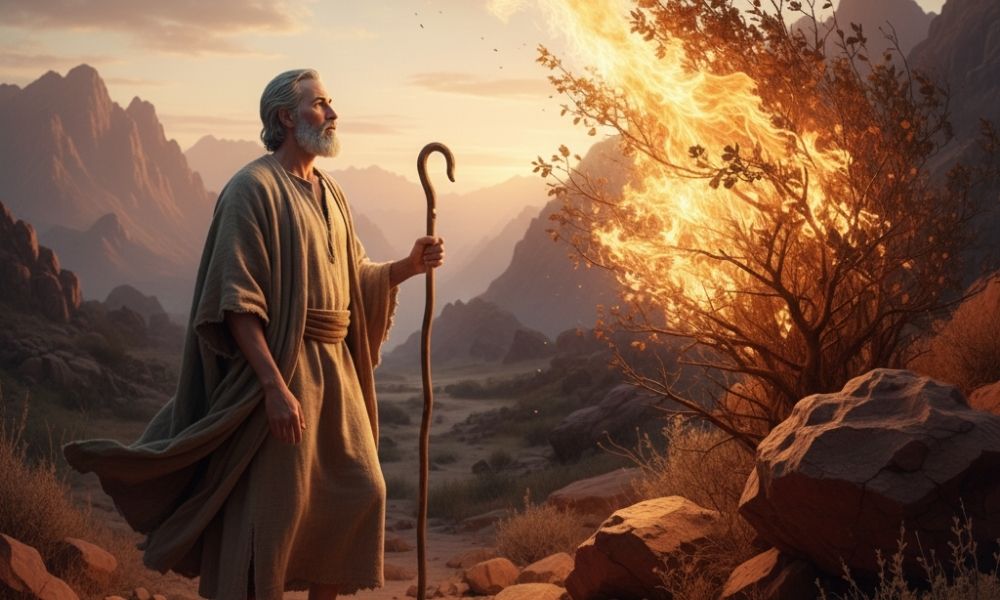
God Speaks Through the Burning Bush

God revealed His holy presence and mission to Moses through a bush that burned without being consumed, calling him to deliver Israel from oppression.


The encounter at the burning bush is a pivotal moment in Scripture—where God breaks into Moses’ ordinary life with a holy presence, a clear calling, and a message that would reshape the destiny of an entire nation. It is a story of revelation, identity, mission, and the God who steps into human suffering with power and compassion.


Quick Facts

Event: The Lord appears to Moses in a burning bush
Location: Mount Horeb, also called Mount Sinai
Biblical Passage: Exodus 3:1–15
Key Themes: Calling, holiness, covenant, deliverance, divine identity
Purpose: To commission Moses and reveal God’s name and mission


The Wilderness Setting

Moses was living far from Egypt, working as a shepherd for his father-in-law Jethro. This quiet, rugged terrain—often seen as a place of exile—became the very ground where God prepared him for leadership. The wilderness, both harsh and silent, created space for God’s voice to break through.


The Sign of the Burning Bush

Moses noticed a bush engulfed in flames but not consumed. This was no ordinary fire. The miracle drew him closer, and that act of turning aside revealed his readiness to listen. God often uses signs to capture attention before revealing deeper truths.


A Holy Moment

As Moses approached, God called him by name. The double call—“Moses, Moses”—signaled intimacy and urgency. God instructed him to remove his sandals, marking the place as holy ground. In an instant, the ordinary became sacred because of God’s presence.


The God Who Sees and Responds

God revealed that He had seen the suffering of His people in Egypt, heard their cries, and knew their pain. This is one of the clearest portraits of God’s compassion. He does not ignore injustice. He acts. And His chosen instrument for this mission was Moses.


The Call and Commission

God told Moses that he would go to Pharaoh and lead Israel out of bondage. Moses felt inadequate and hesitant, but God promised His presence. The strength of Moses’ mission was never in his ability—it was in God’s constant companionship.


The Divine Name Revealed

When Moses asked, “Who should I say sent me?” God answered with a profound declaration: I AM WHO I AM. This name revealed God as eternal, self-sufficient, unchanging, and faithful to His covenant. It anchored Moses’ authority and Israel’s hope.


Why the Burning Bush Matters Today

The burning bush teaches that God interrupts ordinary life with purpose. He calls people who feel unqualified. He stands with those He sends. He sees suffering and moves to deliver. And His presence transforms any place—wilderness or home—into holy ground.


Leave a Reply

Your email address will not be published. Required fields are marked *

Bible Characters

  • Jonathan
  • Jonathan

    Jonathan was the valiant crown prince of Israel who chose loyalty to God’s anointed over his own ambition, becoming the Bible’s ultimate example of sacrificial friendship.


  • Michal

    Michal was the daughter of King Saul who saved David’s life out of love but ultimately ended her life in barren isolation because she valued royal dignity over humble worship.


  • Abner

    Abner was the powerful commander of Saul’s army who, after a long rivalry with David, sought to unite all Israel under David’s crown before being tragically assassinated by Joab.


Biblical Events

  • The Error of Uzzah
  • Jonathan

    Jonathan was the valiant crown prince of Israel who chose loyalty to God’s anointed over his own ambition, becoming the Bible’s ultimate example of sacrificial friendship.


  • Michal

    Michal was the daughter of King Saul who saved David’s life out of love but ultimately ended her life in barren isolation because she valued royal dignity over humble worship.


  • Abner

    Abner was the powerful commander of Saul’s army who, after a long rivalry with David, sought to unite all Israel under David’s crown before being tragically assassinated by Joab.


Bible Locations

  • The City of David
  • The City of David

    The City of David is the ancient, fortified ridge where King David established his capital, serving as the historical seed from which Jerusalem grew and the spiritual center of the Israelite kingdom.


  • Mahanaim

    Mahanaim, meaning “Two Camps,” was the historic fortress city east of the Jordan where Jacob met angels and where kings Ishbosheth and David found refuge during Israel’s greatest civil wars.


  • Jabesh-gilead

    Jabesh-gilead was a city defined by a legacy of survival and fierce loyalty, best known for the valiant night raid to retrieve the bodies of King Saul and his sons from Philistine desecration.


You May Also Like:

  • The Error of Uzzah serves as a stark warning that God’s absolute holiness demands profound reverence, and that sincere human intentions can never replace strict obedience to His commands.

  • Lamentations 3:22–23 reveals that God’s faithfulness is not dependent on human strength. Even in devastation, His love sustains, His mercy renews daily, and His covenant remains unbroken. When we are emptied of strength, we discover the fullness of His constancy. When you run out, God remains faithful.

  • “The faithful love of the Lord never ends! His mercies never cease.”

  • On the first day of the new year, Moses sets up the Tabernacle exactly as commanded, and the glory of the Lord fills the tent so intensely that even Moses cannot enter, marking God’s permanent dwelling among His people.

Bibliva

FREE
VIEW




