
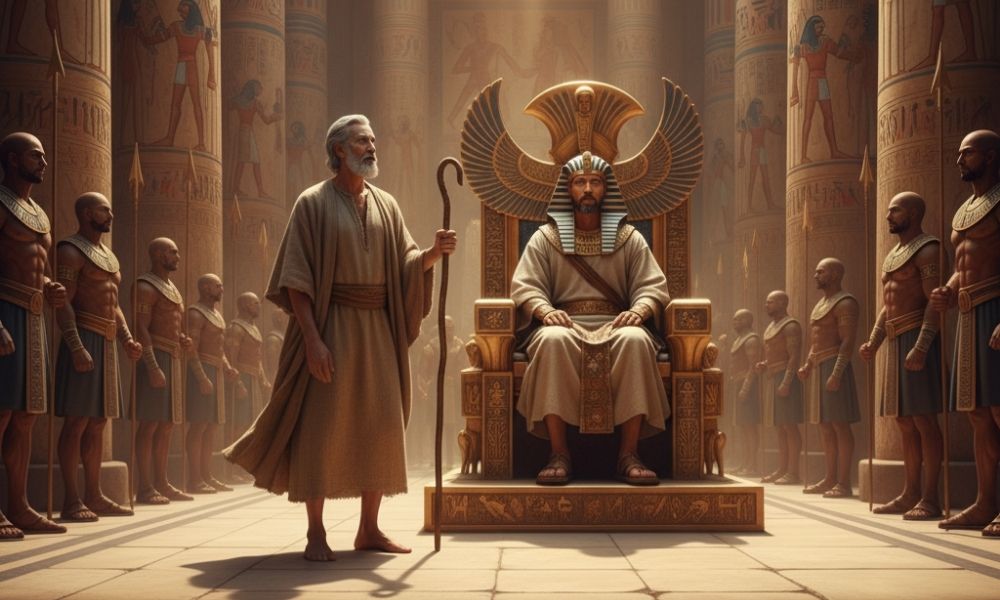
Moses Sent to Pharaoh

Moses was sent by God to confront Pharaoh with the command to free the Israelites from slavery.


Moses being sent to Pharaoh marks one of the most decisive turning points in the Exodus story. After years in Midian, God called Moses through the burning bush and commissioned him to confront the most powerful ruler in Egypt, demanding the release of the Israelites from slavery. This mission reveals God’s authority, Moses’ growth in courage, and the unfolding of a liberation that shaped the identity of Israel.

Quick Facts
Name: Moses
Mission: Deliver God’s message to Pharaoh
Setting: Egypt, during Israel’s oppression
Key Event: Burning bush call (Exodus 3–4)
Message to Pharaoh: “Let my people go”
Opposition: Pharaoh’s hardened heart
Outcome: Signs, plagues, and Israel’s eventual freedom


The Call at the Burning Bush

God appeared to Moses on Mount Horeb in a flame of fire within a bush that did not burn out. From this sacred encounter, Moses received a clear assignment: return to Egypt and lead Israel out of bondage. Though hesitant and aware of his weaknesses, he was assured of God’s presence and power.


The Message to Pharaoh

Moses carried a divine command: “Let my people go, so that they may worship me.” This was not a negotiation but a declaration of God’s authority over human kings and oppressive systems. Aaron became Moses’ spokesperson, strengthening the mission.


Pharaoh’s Resistance

Pharaoh rejected Moses’ message repeatedly. His hardened heart led to escalating confrontation between God’s signs and Egypt’s stubborn power. Each refusal intensified the struggle and revealed God’s supremacy.


Signs and Wonders

To validate Moses’ calling, God empowered him with miraculous signs: the staff turning into a serpent, the leprous hand restored, and the plagues that struck Egypt. These signs displayed that Moses was not acting on his own but on behalf of the Almighty.


The Road to Deliverance

Though the journey was difficult, Moses’ obedience set in motion the liberation that would redefine Israel as a nation under God’s care. His mission to Pharaoh was the first step toward the covenant at Sinai and the shaping of a people destined for a promised future.


Leave a Reply

Your email address will not be published. Required fields are marked *

Bible Characters

  • Mark (John Mark)
  • Mark (John Mark)

    John Mark was a young disciple who overcame early failure to become a trusted companion of Paul and Peter, ultimately authoring the dynamic Gospel that bears his name.


  • Matthew

    Matthew was a despised tax collector transformed by grace into a devoted apostle, whose Gospel bridges the Old and New Testaments by proclaiming Jesus as the promised Messiah and King.


  • Nabal

    Nabal was a wealthy but foolish landowner whose arrogance and refusal to show hospitality to David led to divine judgment and his sudden death.


Biblical Events

  • David lies to Ahimelech
  • Mark (John Mark)

    John Mark was a young disciple who overcame early failure to become a trusted companion of Paul and Peter, ultimately authoring the dynamic Gospel that bears his name.


  • Matthew

    Matthew was a despised tax collector transformed by grace into a devoted apostle, whose Gospel bridges the Old and New Testaments by proclaiming Jesus as the promised Messiah and King.


  • Nabal

    Nabal was a wealthy but foolish landowner whose arrogance and refusal to show hospitality to David led to divine judgment and his sudden death.


Bible Locations

  • Jezreel
  • Jezreel

    Jezreel was the fertile royal seat of King Ahab and Queen Jezebel, famous for the murder of Naboth and the site where divine judgment eventually wiped out their entire dynasty.


  • Aphek

    Aphek was a strategic military stronghold and staging ground on the Sharon Plain where the Philistines gathered to capture the Ark and where David was providentially released from the Philistine army.


  • Lachish

    Lachish was the second most powerful city in ancient Judah, a mighty fortress whose dramatic fall to Assyria and Babylon serves as a pivotal moment in biblical history and archaeology.


You May Also Like:

  • The Twelve Tribes of Israel were the tribal divisions descended from the sons of Jacob that formed the foundation of the Israelite nation and the prophetic lineage of the Messiah.

  • After burying Jacob in Canaan with great honor, Joseph reassures his fearful brothers that their past evil was overruled by God for good, and he dies in Egypt with a prophetic command that his bones be carried to the Promised Land.

  • On his deathbed, Jacob gathers his twelve sons to prophesy their destinies, disqualifying the firstborns for their sins and appointing Judah as the royal line and Joseph as the fruitful recipient of the double portion.

  • On his deathbed, Jacob adopts Joseph’s two sons as his own, deliberately crossing his hands to give the greater blessing to the younger Ephraim, declaring God as his Shepherd and Redeemer.

Bibliva

FREE
VIEW




