
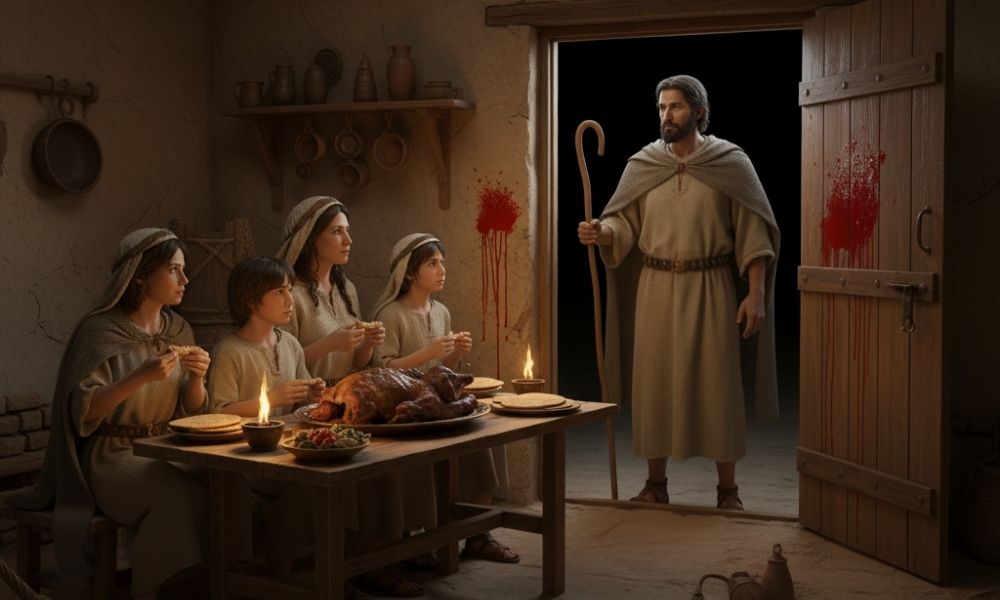
The Passover was the divine ordinance and memorial feast established by God on the eve of Israel’s deliverance from Egypt. Instituted in the midst of judgment, it was an act of faith that protected the Israelites from the tenth and final plague—the death of the firstborn. By sacrificing a lamb and applying its blood to their doorposts, the Israelites marked themselves as God’s covenant people, and the “Destroyer” passed over their homes. This event, detailed in the Book of Exodus, became the foundational celebration of redemption in Jewish history, marking the birth of the nation of Israel.
- Event: The Institution of the Passover
- Biblical Name: Pesach (Hebrew: פֶּסַח, meaning “to pass over”)
- Location: The Land of Goshen, Egypt
- Biblical Era: The Time of the Exodus (~15th–13th century BCE)
- Book: The Book of Exodus (Chapter 12)
- Key Figures: God (Yahweh), Moses, Aaron, the children of Israel
- Purpose: To save Israel from the final plague, demonstrate God’s judgment and mercy, and serve as a perpetual memorial of redemption.
- Key Elements: A spotless lamb, its blood on the doorposts, unleavened bread, bitter herbs
- Legacy: The Exodus from Egypt; the annual Feast of Passover (Pesach) and Feast of Unleavened Bread; the theological basis for the Christian “Lord’s Supper”
Event Definition
The institution of the Passover was a direct command from God, given to Moses and Aaron, while Israel was still in bondage. It was a sacrificial meal and a set of instructions that, when obeyed by faith, would shield the Israelites from the coming “Destroyer.” The name “Passover” (Pesach) comes from God’s promise that He would see the blood on the doorposts and “pass over” that house, sparing the firstborn within.
Biblical Context
This event is the climax of the confrontation between God and Pharaoh. God, through Moses, had already sent nine plagues upon Egypt to prove His power and to demand the release of His people. After the ninth plague (darkness), Pharaoh remained defiant. God announced a final, devastating judgment: the death of every firstborn male in Egypt. The Passover was God’s provision of mercy and deliverance for His own people in the face of this widespread judgment.
Cultural / Religious Context
Israel was a nation of slaves, having been in Egypt for over 400 years. This event marked their “new beginning.” God commanded that this month (Abib, later called Nisan) would become the first month of their new calendar (Exodus 12:2). This signified that their identity was no longer defined by Egyptian slavery but by divine redemption. The act of God “passing over” was a direct judgment on the gods of Egypt, proving Yahweh’s supreme authority.
Key Figures Involved
- God: The one who gave the command and executed the judgment.
- Moses and Aaron: The leaders who received God’s instructions and delivered them to the elders and the people.
- The Israelites: The participants who had to obey God’s commands in faith (select a lamb, apply the blood, and eat the meal) to receive deliverance.
- The “Destroyer”: The agent of judgment God sent to carry out the tenth plague (Exodus 12:23).
Main Elements of the First Passover
God’s instructions were specific and symbolic:
- The Lamb: Each household was to take a year-old male lamb “without blemish” on the tenth day of the month.
- The Sacrifice: The lamb was to be kept until the fourteenth day and then slaughtered at twilight.
- The Blood: They were to take a bunch of hyssop, dip it in the lamb’s blood, and strike the blood on the lintel (top) and the two doorposts of their houses. This blood was the “sign” for God to pass over.
- The Meal: The lamb was to be roasted with fire (not boiled or raw) and eaten that same night.
- The Accompaniments: It was to be eaten with unleavened bread (Matzah), signifying their haste to leave (no time for bread to rise), and bitter herbs (Maror), to remind them of the bitterness of their slavery.
- The Manner: The Israelites were to eat the meal “in haste”—with their cloaks tucked in, sandals on their feet, and a staff in their hand, ready for immediate departure.
The Divine Act
That night, as commanded, the Israelites stayed inside their homes. At midnight, God moved through Egypt, and the “Destroyer” struck down every firstborn—from the son of Pharaoh on his throne to the firstborn of the prisoner in the dungeon. However, in the land of Goshen, when the Destroyer saw the blood on the doorposts of the Israelite homes, he “passed over” them, and their families were spared. This act broke Pharaoh’s will, and he finally commanded the Israelites to leave.
Notable Passages
- Exodus 12:13: “The blood shall be a sign for you, on the houses where you are. And when I see the blood, I will pass over you, and no plague will befall you to destroy you, when I strike the land of Egypt.”
- Exodus 12:14: “This day shall be for you a memorial day, and you shall keep it as a feast to the LORD; throughout your generations, as a statute forever, you shall keep it as a feast.”
- Exodus 12:26–27: “And when your children say to you, ‘What do you mean by this service?’ you shall say, ‘It is the sacrifice of the LORD’s Passover, for he passed over the houses of the people of Israel in Egypt, when he struck the Egyptians but spared our houses.’”
Legacy & Impact
- The Exodus: The Passover directly led to the Exodus, the mass departure of the Israelites from Egypt, which is the central redeeming event of the Old Testament.
- Perpetual Ordinance: God commanded that the Passover and the adjoining seven-day Feast of Unleavened Bread be celebrated every year as a “lasting ordinance” to remember their deliverance.
- Jewish Identity: It became one of Judaism’s three great pilgrimage festivals and remains a central part of Jewish faith and identity, celebrated annually as the Seder.
- Christian Theology: The institution of the Passover provides the deep theological framework for the New Testament. Jesus’ “Last Supper” was a Passover meal, where He gave the elements new meaning, identifying the bread as His body and the wine as His blood of the “new covenant.”
Symbolism / Typology
- The Lamb: The spotless, sacrificial lamb is a powerful prefigurement (or “type”) of Jesus Christ, whom John the Baptist called “the Lamb of God, who takes away the sin of the world” (John 1:29).
- The Blood: The blood on the wood of the doorframe, which provided protection from death, is a type of the atoning blood of Christ shed on the wood of the cross.
- Unleavened Bread: Leaven (yeast) is often a symbol of sin or corruption in the Bible. The unleavened bread represents purity and the “new life” of the redeemed, separate from the corruption of their old lives (Egypt/sin).
- Bitter Herbs: A symbol of remembering the “bitterness” of bondage, from which they were redeemed.
- Haste: Represents a readiness to leave the old life of sin and follow God into a new covenant.
Extra-Biblical References
- The Haggadah is the traditional Jewish text that is read during the Passover Seder, which details the story of the Exodus and the order of the meal.
- The Last Supper (Matthew 26, Mark 14, Luke 22) was a Passover meal during which Jesus established the ordinance of Communion (the Lord’s Supper) for His followers, fulfilling the Passover’s symbolic meaning in His own impending sacrifice.







Leave a Reply