
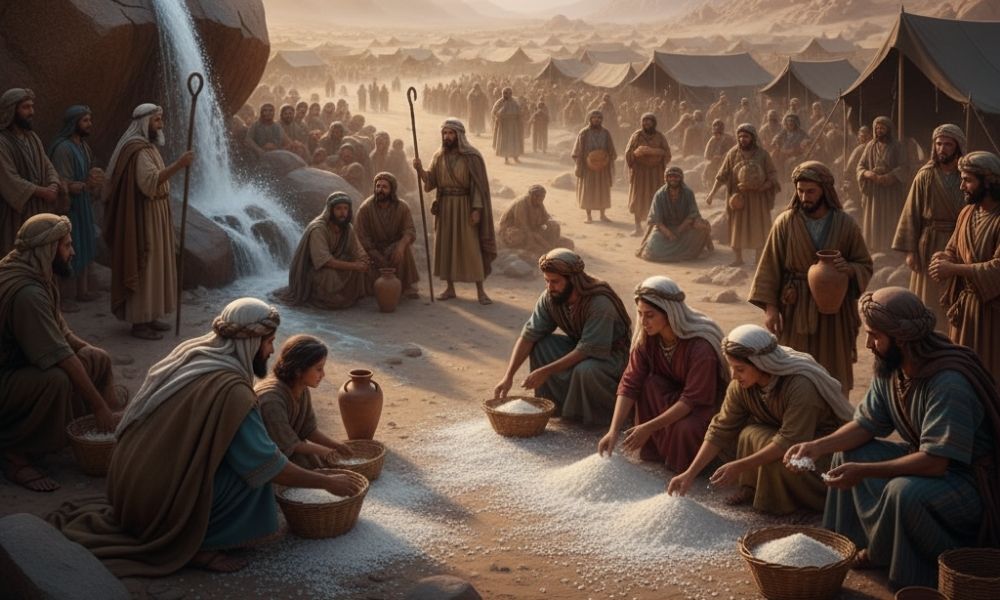
The provision of manna and water in the wilderness is the story of God’s supernatural sustenance for the nation of Israel after their exodus from Egypt. Immediately following their deliverance, the Israelites found themselves in a barren desert without food or drink. They grumbled against Moses, but God responded by providing for them directly. This miraculous provision of “bread from heaven” (manna) and water from a rock became the defining lesson in God’s faithfulness and Israel’s need for daily dependence.
- Event: Divine Provision of Manna and Water
- Biblical Name: Manna (Hebrew: Man hu, meaning “What is it?”)
- Location: The Wilderness of Sin and Rephidim (Sinai)
- Era: The Exodus, immediately after leaving Egypt
- Books: Exodus (Chapters 16 & 17); Numbers (Chapters 11 & 20); Deuteronomy 8
- Key Figures: God (Yahweh), Moses, Aaron, the Israelites
- Purpose: To sustain Israel physically, to test their obedience, and to teach them to trust God daily
- Key Themes: Providence, faithfulness, grumbling vs. faith, daily dependence
- Legacy: A foundational story of God’s grace; symbolic types for Jesus Christ (the Bread of Life) and the Holy Spirit (the Living Water)
Event Definition
This event describes the two primary miracles God performed to sustain the Israelites during their 40-year wilderness wanderings. The Manna was a daily, edible substance that appeared on the ground, and the Water from the Rock was the miraculous provision of springs from solid rock, initiated by Moses.
Biblical Context
Having just crossed the Red Sea and celebrated God’s victory, the Israelites quickly faced the harsh realities of the desert.
- Manna (Exodus 16): Only weeks after the Exodus, the people grumbled against Moses and Aaron, “You have brought us out into this wilderness to kill this whole assembly with hunger.” God’s response was not judgment, but grace.
- Water (Exodus 17): At a place called Rephidim, the people again “quarreled with Moses,” saying, “Why did you bring us up out of Egypt, to kill us and our children and our livestock with thirst?” This led to the first miracle of water from the rock.
The Provision of Manna
God promised to “rain bread from heaven.” This provision came with specific rules to test Israel’s obedience and teach them dependence.
- Description: It appeared each morning with the dew; it was a “fine, flake-like thing… like coriander seed, white, and the taste of it was like wafers made with honey” (Exodus 16:14, 31).
- The Rules:
- Duration: This provision continued daily for the entire 40 years they were in the wilderness (Exodus 16:35).
The Provision of Water
At Rephidim, the people’s thirst led them to the brink of stoning Moses. God gave Moses specific instructions:
- The Location: God designated a rock at Horeb (Mount Sinai).
- The Act: God commanded Moses to take his staff—the same one used to strike the Nile—and strike the rock in front of the elders of Israel.
- The Result: When Moses struck the rock, “water came out of it, and the people drank” (Exodus 17:6).
- The Name: Moses named the place Massah (“testing”) and Meribah (“quarreling”) because the Israelites tested God by demanding, “Is the LORD among us or not?”
Key Figures Involved
- God: The faithful and merciful provider, who sustains His people even when they are faithless and grumbling.
- Moses: The mediator who listens to the people’s complaints, intercedes with God, and follows God’s instructions to be the agent of the miracle.
- The Israelites: A “stiff-necked” people, quick to forget God’s redemptive acts (the Ten Plagues, the Red Sea) and to fall into fear and unbelief.
Notable Passages
- Exodus 16:4: “Then the LORD said to Moses, ‘Behold, I am about to rain bread from heaven for you, and the people shall go out and gather a day’s portion every day, that I may test them, whether they will walk in my law or not.’”
- Exodus 16:15: “When the people of Israel saw it, they said to one another, ‘What is it?’ (Man hu?). For they did not know what it was. And Moses said to them, ‘It is the bread that the LORD has given you to eat.’”
- Exodus 17:6: “Behold, I will stand before you there on the rock at Horeb, and you shall strike the rock, and water shall come out of it, and the people will drink.”
- Deuteronomy 8:3: “And he humbled you and let you hunger and fed you with manna, which you did not know… that he might make you know that man does not live by bread alone, but man lives by every word that comes from the mouth of the… LORD.”
Legacy & Impact
- The Ark of the Covenant: God commanded that a jar of manna be kept and placed before the Ark as a permanent testimony of His provision for all future generations.
- Theological Foundation: This story became the primary example of God’s sustaining grace. It showed that God’s plan was not just to redeem (out of Egypt) but also to provide and sustain (in the wilderness).
- A Lesson in Faith: The rules of the manna were a practical, daily exercise in trusting God. Trust Him today (gather one portion), trust Him for tomorrow (it will be there), and trust Him for His Sabbath (the double portion will last).
Symbolism / Typology
The New Testament draws powerful parallels from this event:
- Manna as a Type of Christ: In John 6, Jesus declares, “I am the bread of life; whoever comes to me shall not hunger… Your fathers ate the manna in the wilderness, and they died. This is the bread that comes down from heaven, so that one may eat of it and not die” (John 6:35, 49–50).
- Water from the Rock as a Type of Christ: The Apostle Paul, in 1 Corinthians 10:4, makes this explicit: “For they drank from the spiritual Rock that followed them, and the Rock was Christ.” The life-giving water is often seen as a symbol of the Holy Spirit, who proceeds from Christ.







Leave a Reply