
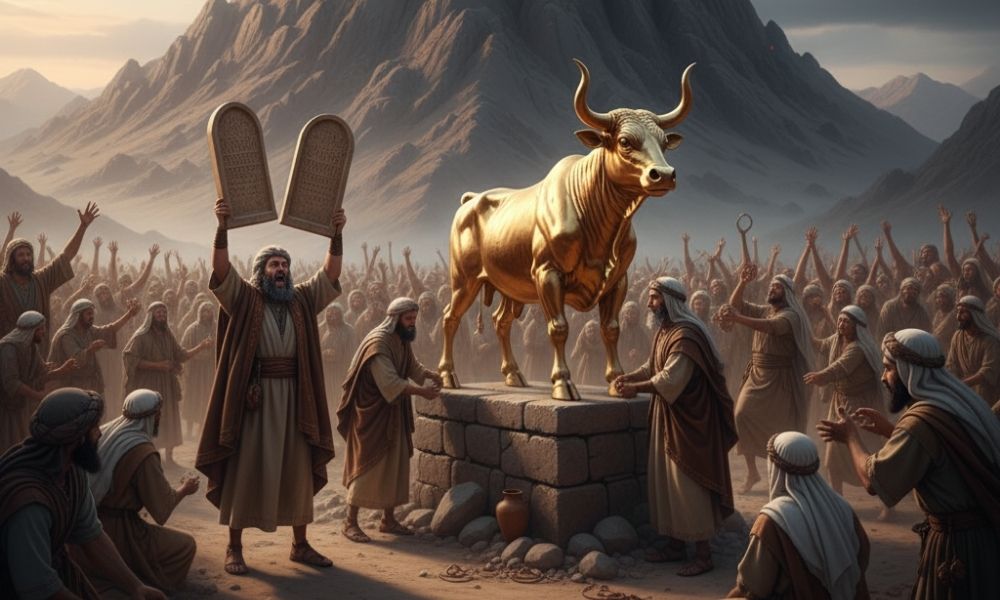
The Golden Calf rebellion is one of the most infamous acts of apostasy in the Old Testament, occurring at the very foot of Mount Sinai. While Moses was on the mountain receiving the Ten Commandments directly from God, the Israelites, in a stunning display of fear and faithlessness, violated the first two commandments. They demanded a tangible idol, and under Aaron’s weak leadership, they melted down their gold to worship a golden calf, tragically reverting to the idolatry of Egypt just weeks after God had miraculously delivered them.
- Event: The Golden Calf Rebellion (The Sin of the Golden Calf)
- Biblical Name: Egel HaZahav (Hebrew for “The Golden Calf”)
- Location: The foot of Mount Sinai (Horeb)
- Era: The Exodus, immediately after leaving Egypt
- Book: Exodus (Chapter 32)
- Key Figures: God, Moses, Aaron, the Israelites, the Tribe of Levi
- Purpose (of the story): To demonstrate Israel’s unfaithfulness, the gravity of idolatry, the necessity of intercession, and God’s just wrath and mercy.
- Key Themes: Idolatry, apostasy, broken covenants, divine judgment, intercession, God’s holiness
- Legacy: A defining moment of Israel’s unfaithfulness; a recurring symbol of apostasy; a powerful example of intercession.
Event Definition
The Golden Calf rebellion was the act of the Israelites (led by Aaron) creating and worshiping a golden calf as a visible god to “go before them.” This occurred because Moses had been on Mount Sinai for 40 days, and the people grew impatient and fearful, assuming he was lost. This act was a direct violation of the covenant God had just established with them, specifically the commandments against idolatry.
Biblical Context
This event is shocking because of its timing. The Israelites had just witnessed the Ten Plagues, the parting of the Red Sea, and the miraculous provision of manna. They had gathered at the foot of Mount Sinai, heard God’s voice speak the Ten Commandments (Exodus 20), and collectively agreed to the covenant, saying, “All that the LORD has spoken, we will do” (Exodus 24:7). The rebellion happened while Moses was on the mountain receiving the stone tablets of this very law from God.
Cultural / Religious Context
Having just left Egypt, the Israelites were deeply influenced by its polytheistic and idolatrous culture. The bull (or calf) was a common and powerful symbol of strength and fertility in the ancient Near East, associated with Egyptian gods like Apis and Hathor, as well as Canaanite gods like Baal. In their fear, the people reverted to the familiar, tangible religious practices of their former oppressors, unable to trust the unseen God who had just redeemed them.
Key Figures Involved
- God: The holy and betrayed Covenant-Maker. His reaction is righteous anger at Israel’s immediate apostasy.
- Moses: The mediator. He is on the mountain with God, and his role shifts to intercessor, pleading with God to spare the people, appealing to God’s own promises and reputation.
- Aaron: Moses’ brother and the high priest. He demonstrates a disastrous failure of leadership, succumbing to the people’s pressure and facilitating their sin by building the idol.
- The Israelites: The impatient, fearful, and unfaithful people who break the covenant almost immediately after making it.
- The Levites: The one tribe that rallies to Moses’ side to execute God’s judgment, demonstrating their loyalty to Yahweh and setting them apart for priestly service.
Main Life Events
- The Impatience (Exodus 32:1): After 40 days of Moses’ absence, the people grow restless and demand that Aaron “make us gods who shall go before us.”
- Aaron’s Complicity (Exodus 32:2-4): Aaron tells them to bring their gold earrings. He melts them, fashions them into a golden calf, and presents it.
- The False Proclamation (Exodus 32:4-6): The people declare, “These are your gods, O Israel, who brought you up out of the land of Egypt!” Aaron builds an altar and tries to co-opt the worship, declaring a “feast to the LORD.”
- God’s Wrath & Moses’ Intercession (Exodus 32:7-14): God informs Moses of the sin and declares His intention to destroy the people and make a new nation from Moses. Moses intercedes, and God relents from this specific disaster.
- The Broken Tablets (Exodus 32:19): Moses descends the mountain. Seeing the calf and the “revelry,” his own holy anger flares, and he smashes the two stone tablets of the Law at the foot of the mountain—a powerful symbol of the covenant they had just broken.
- The Judgment (Exodus 32:20-28): Moses burns the calf, grinds it to powder, puts it in the water, and makes the Israelites drink it. He then rallies the faithful: “Who is on the LORD’s side? Come to me.” The tribe of Levi responds, and at Moses’ command, they execute about 3,000 of the primary idolaters.
- The Aftermath (Exodus 32:30-35): Moses intercedes again for the people’s sin, but God still sends a plague upon them for their rebellion.
Notable Passages
- Exodus 32:1: “When the people saw that Moses delayed to come down from the mountain, the people gathered themselves together to Aaron and said to him, ‘Up, make us gods who shall go before us…’”
- Exodus 32:4: “…And they said, ‘These are your gods, O Israel, who brought you up out of the land of Egypt!’”
- Exodus 32:19: “And as soon as he came near the camp and saw the calf and the dancing, Moses’ anger burned hot, and he threw the tablets out of his hands and broke them at the foot of the mountain.”
- Exodus 32:26: “Then Moses stood in the gate of the camp and said, ‘Who is on the LORD’s side? Come to me.’ And all the sons of Levi gathered themselves together to him.”
Legacy & Impact
- The Broken Covenant: This event showed Israel’s innate inability to keep God’s Law. The broken tablets symbolized the broken relationship and the human failure to live up to God’s standard.
- The Priesthood: The Levites’ faithfulness in this moment of crisis set them apart and was a key reason for their selection as the priestly tribe, dedicated to the service of God and the Tabernacle.
- The Need for Intercession: It established Moses’ primary role as an intercessor, “standing in the gap” between God’s perfect holiness and the people’s sin.
- A Besetting Sin: Idolatry, the “sin of the golden calf,” would become the defining struggle and recurring sin of Israel for the next thousand years, constantly referenced by the prophets.
Symbolism / Typology
- The Golden Calf: The ultimate symbol of apostasy, idolatry, and replacing the unseen, true God with a tangible, man-made substitute. It represents a “religion of our own hands.”
- Moses’ Intercession: Moses pleading for the people, even offering to have his own name blotted out of God’s book (Exodus 32:32), is a profound type (a foreshadowing) of Christ, the greater Mediator who stands in the gap for sinners.
- The Broken Tablets: A powerful symbol of the broken covenant, showing that the Law itself, when met with human sin, only condemns and is broken. This points to the need for a new covenant written on the heart.







Leave a Reply