
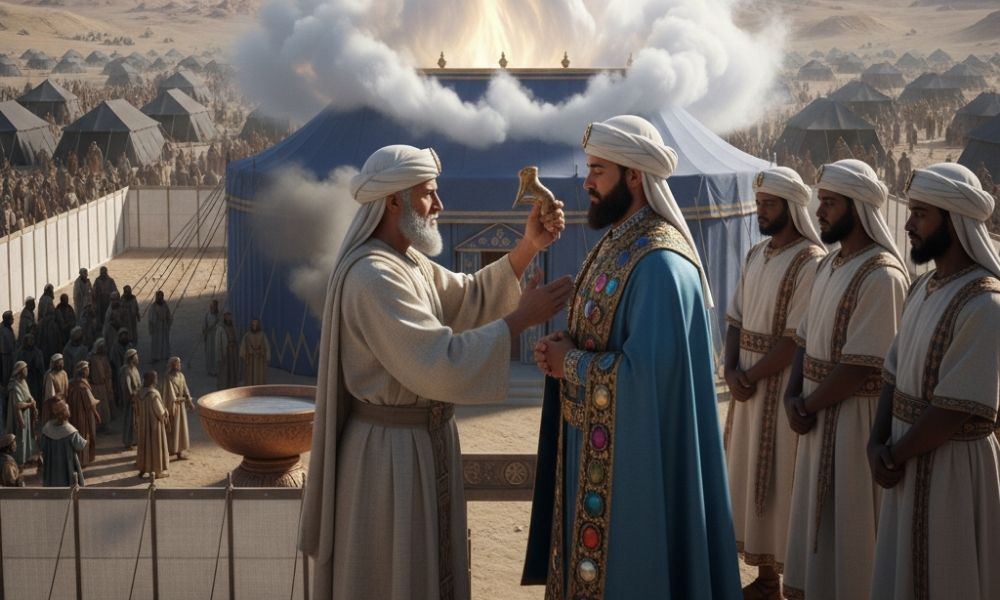
Aaron’s investiture as High Priest was the foundational event of the Israelite priesthood, where God, through Moses, formally consecrated Aaron and his sons for sacred service. This solemn ceremony, detailed in Exodus and Leviticus, set Aaron apart as the nation’s spiritual mediator. He was the one man chosen to represent the people before God and God to the people, officiating the sacrificial system and bearing the responsibility of the nation’s atonement.
- Event: The Consecration of Aaron as High Priest
- Biblical Name: Kohan HaGadol (Hebrew for “The High Priest”)
- Location: At the entrance of the Tabernacle, at the base of Mount Sinai
- Era: The Exodus, immediately following the construction of the Tabernacle
- Books: Exodus (Chapters 28–29, 40); Leviticus (Chapters 8–9)
- Key Figures: God (who chose), Moses (who officiated), Aaron (the appointee), Nadab, Abihu, Eleazar, and Ithamar (Aaron’s sons)
- Purpose: To ordain a holy mediator to stand between a holy God and a sinful people, to make atonement, and to lead Israel in worship.
- Key Themes: Divine calling, consecration, holiness, mediation, atonement
- Legacy: Established the Aaronic priesthood, which lasted over 1,000 years; serves as a primary type (foreshadowing) of the high priestly ministry of Jesus Christ.
Event Definition
Aaron’s consecration was the formal, seven-day ordination ceremony that transitioned him from a layman of the tribe of Levi into Israel’s first High Priest. This was not a human appointment; God himself chose Aaron. The ceremony involved ritual washings, being clothed in specific holy garments, anointing with sacred oil, and a complex series of sacrifices, all designed to purify and sanctify Aaron for his unique role.
Biblical Context
This event occurs just after the Israelites, in an act of profound obedience and generosity, completed the construction of the Tabernacle. God had given the Law and the blueprint for His “dwelling place” (Exodus 25-31). Now that the place of worship was built, God instituted the personnel of worship. This call came after Aaron’s grievous sin with the Golden Calf (Exodus 32), making his appointment a powerful testament to God’s sovereign choice and grace over human merit.
The Consecration Ceremony (Leviticus 8)
The ordination was a public and highly symbolic, seven-day process:
- Washing: Moses brought Aaron and his sons to the entrance of the Tabernacle and washed them with water, symbolizing their purification from sin.
- Vesting: Moses dressed Aaron in the “holy garments,” each piece symbolic: the blue robe, the ephod (a vest), and the Breastplate set with 12 stones, representing the 12 tribes of Israel, whom he would “carry” on his heart. He was given the Urim and Thummim (for discerning God’s will) and the turban, which bore a golden plate inscribed “Holy to the LORD.”
- Anointing: Moses took the sacred anointing oil and poured it on Aaron’s head, consecrating him. This act set him apart as God’s chosen.
- Sacrifices: A series of sacrifices were offered: a bull as a sin offering (to atone for Aaron’s own sin), and a ram as a burnt offering (for dedication).
- The Ram of Ordination: This was the key act. Blood from this ram was applied to the lobe of Aaron’s right ear (to hear God’s word), his right thumb (to do God’s work), and his right big toe (to walk in God’s ways).
- Seven-Day Duty: Aaron and his sons had to remain at the Tabernacle for seven days to complete their consecration before they could begin their ministry.
Key Figures Involved
- God: The one who sovereignly called and appointed Aaron.
- Moses: The prophet and leader, who acted as the officiant of the ceremony, consecrating his own brother.
- Aaron: The first High Priest. His role was one of immense privilege and grave responsibility, as he alone was permitted to enter the Most Holy Place, and only once per year on the Day of Atonement.
- Aaron’s Sons (Nadab, Abihu, Eleazar, Ithamar): They were consecrated as priests alongside their father, establishing the hereditary line of the Aaronic priesthood.
Notable Passages
- Exodus 28:1: “Then bring near to you Aaron your brother, and his sons with him, from among the people of Israel, to serve me as priests…”
- Leviticus 8:12: “And he poured some of the anointing oil on Aaron’s head and anointed him to consecrate him.”
- Leviticus 8:23: “And Moses… put some of its blood on the lobe of Aaron’s right ear and on the thumb of his right hand and on the big toe of his right foot.”
- Hebrews 5:4: “And no one takes this honor for himself, but only when called by God, just as Aaron was.”
Legacy & Impact
- The Aaronic Priesthood: This event established the central institution of Israel’s worship for over a millennium. The priesthood was the unbroken line of mediators who taught the Law and offered sacrifices until the destruction of the Temple in 70 AD.
- Day of Atonement: As High Priest, Aaron’s most critical duty was to enter the Holy of Holies on the Day of Atonement (Yom Kippur) to make atonement for the sins of the entire nation.
- Triumph and Tragedy: Aaron’s priesthood began in divine grace, but was almost immediately marked by tragedy when two of his sons, Nadab and Abihu, were killed by God for offering “unauthorized fire” (Leviticus 10), a stark reminder of the intense holiness of the office.
Symbolism / Typology
The entire story of Aaron’s priesthood is seen in the New Testament as a profound foreshadowing (“type”) of Jesus Christ.
- The Imperfect Priest: Aaron was a sinful man who had to offer sacrifices for his own sin first (Hebrews 5:3). This pointed to the need for a perfect High Priest.
- Christ, the Perfect High Priest: The Book of Hebrews argues that Jesus is the superior High Priest. He did not need to be purified (He was sinless), He was not from Aaron’s temporary line but from the eternal order of Melchizedek, and He did not offer animals, but offered Himself as the one, perfect, “once-for-all” sacrifice for sin (Hebrews 7–10).
- The Garments: Aaron carried the 12 tribes on his heart. Christ, our High Priest, intercedes for His people.







Leave a Reply