
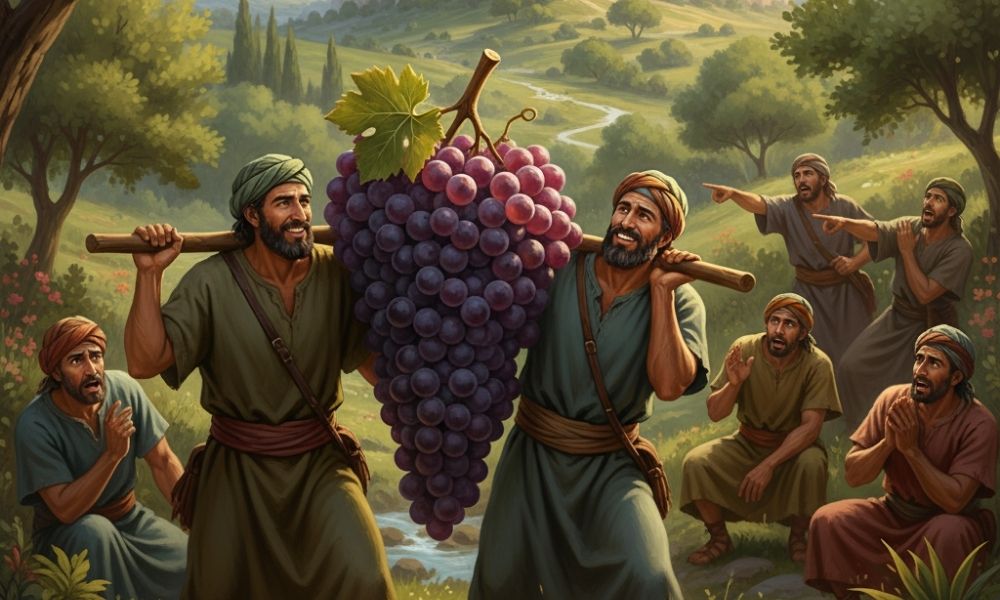
The mission of the twelve spies was a pivotal and tragic turning point for the nation of Israel. Sent by Moses from the border of Kadesh-barnea, this reconnaissance mission was intended to finalize their plans for invading and possessing the Promised Land. Instead, the spies returned with a report that, while confirming the land’s bounty, was dominated by fear. The resulting panic and unbelief of the people, stirred by the ten faithless spies, led directly to God’s judgment: an entire generation was condemned to wander and die in the wilderness.
- Event: The Reconnaissance of Canaan by the Twelve Spies
- Biblical Name: Meraglim (Hebrew for “Spies”)
- Location: The Wilderness of Paran (Kadesh-barnea) and the land of Canaan
- Era: The Exodus, approximately one year after leaving Egypt
- Books: Numbers (Chapters 13–14); Deuteronomy 1
- Key Figures: Moses, Caleb (spy from Judah), Joshua (spy from Ephraim), and 10 other spies (one from each tribe, except Levi)
- Purpose: To scout the Promised Land’s defenses, inhabitants, and resources.
- Key Themes: Faith vs. Fear, Unbelief, Disobedience, Divine Judgment, Covenant Faithfulness
- Legacy: Caused the 40-year wilderness wandering; established Joshua and Caleb as the next generation’s leaders.
Event Definition
At God’s command, Moses sent twelve leaders, one from the head of each tribe, on a 40-day mission to explore the land of Canaan. Their instructions were to assess the land’s fertility, the strength and number of its inhabitants, and the nature of their cities (whether they were open camps or fortified strongholds). This was the final step before the anticipated conquest.
Biblical Context
The Israelites had been redeemed from Egypt, delivered through the Red Sea, and had received the Law at Mount Sinai. They had traveled from Sinai to Kadesh-barnea, the southern edge of the Promised Land. After more than a year in the wilderness, they were now poised to enter and receive the inheritance promised to their ancestor, Abraham. The mission was meant to be a military reconnaissance, not a referendum on God’s promise.
The Mission and the Report
The twelve spies entered Canaan, exploring from the Negev in the south to the far north. They found the land was indeed “flowing with milk and honey.” As proof, they cut down a single cluster of grapes from the Valley of Eshcol, so large it had to be carried on a pole between two men.
After 40 days, they returned to the camp at Kadesh-barnea and delivered their report:
- The Majority Report (10 Spies): They began by confirming the land’s fertility. But they quickly pivoted to fear: “But the people who dwell in the land are strong, and the cities are fortified and very large, and besides, we saw the descendants of Anak [giants] there… We are not able to go up against the people, for they are stronger than we are… we seemed to ourselves like grasshoppers, and so we seemed to them” (Numbers 13:28, 31, 33).
- The Minority Report (Caleb and Joshua): Caleb interrupted the panic: “Let us go up at once and occupy it, for we are well able to overcome it” (Numbers 13:30). He and Joshua insisted that the people should not fear, arguing, “If the LORD delights in us, he will bring us into this land… Do not rebel against the LORD, and do not fear the people of the land, for they are bread for us” (Numbers 14:8–9).
The Rebellion and Judgment
The congregation responded to the majority report with terror. They wept all night, grumbled against Moses and Aaron, and declared their wish to die in Egypt. They even proposed appointing a new leader to take them back to slavery.
This mass rebellion provoked God’s judgment:
- Divine Wrath: God appeared, declaring His intention to destroy the people and start a new nation from Moses.
- Moses’ Intercession: Moses pleaded for the people, appealing to God’s own reputation and His proclaimed character of being “slow to anger and abounding in steadfast love.”
- The Sentence: God relented from destroying them, but He passed a new sentence. The 10 faithless spies were struck dead with a plague. The entire adult generation (20 years and older) who had grumbled would not enter the land. They were condemned to wander the wilderness for 40 years—one year for each day of the scouting mission—until all of them had died.
- The Exception: Only Caleb and Joshua, who had a “different spirit” and followed God fully, would be allowed to enter the Promised Land along with the new generation.
Notable Passages
- Numbers 13:30: “But Caleb quieted the people before Moses and said, ‘Let us go up at once and occupy it, for we are well able to overcome it.’”
- Numbers 13:33: “And there we saw the Nephilim (the sons of Anak…); and we seemed to ourselves like grasshoppers, and so we seemed to them.”
- Numbers 14:8–9: “If the LORD delights in us, he will bring us into this land… Only do not rebel against the LORD. And do not fear the people of the land, for they are bread for us.”
- Numbers 14:29: “…your dead bodies shall fall in this wilderness, and of all your number, listed from twenty years old and upward, who have grumbled against me…”
Legacy & Impact
- The 40-Year Wandering: This event is the direct cause of the 40-year delay in entering Canaan. It marks the failure and end of the original Exodus generation.
- A Warning Against Unbelief: The story became the primary biblical example of the disastrous consequences of unbelief and disobedience.
- Heroes of Faith: It established Joshua and Caleb as men of exceptional faith, setting the stage for Joshua to succeed Moses as Israel’s next leader.
Symbolism / Typology
- Kadesh-barnea: Represents a critical moment of decision, a “crisis of faith” where one must choose between God’s promise and the obstacles of the world.
- The Land: A symbol of God’s promised “rest” or inheritance.
- The Giants: Represent obstacles that appear insurmountable from a human perspective but are nothing when compared to God’s power.
- The 10 Spies: Symbolize a faith based only on sight and human reason.
- The 2 Spies: Symbolize a faith based on God’s character and His promises.
- The Wilderness Wandering: A period of testing, purification, and judgment. The New Testament (Hebrews 3–4) uses this event as a powerful warning to Christians not to “harden their hearts” in unbelief and fail to enter God’s ultimate rest.







Leave a Reply