
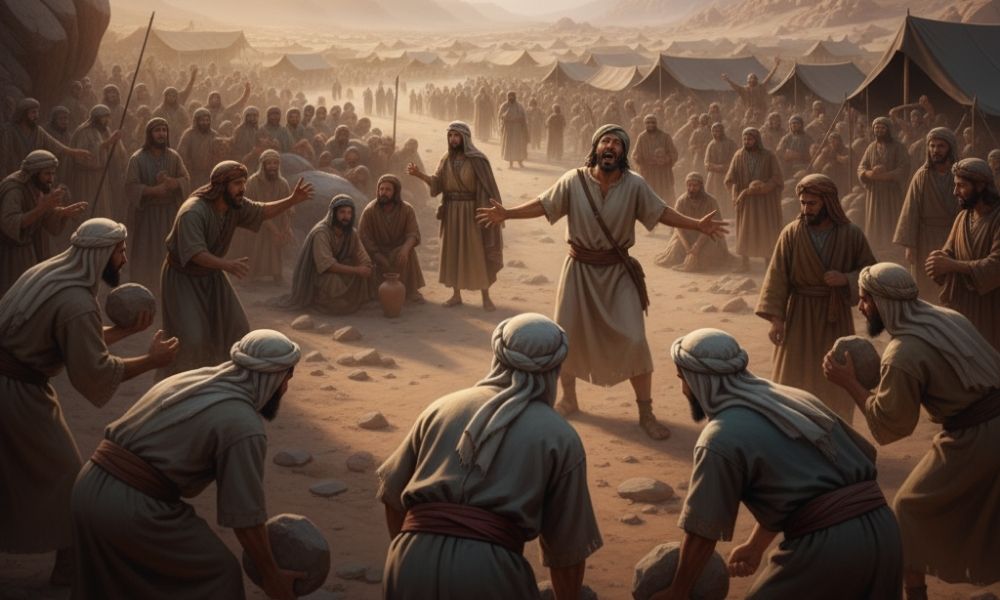
Israel’s refusal to enter the Promised Land was the nation’s catastrophic rebellion at Kadesh-barnea. Immediately after hearing the fearful report from the ten spies, the entire congregation rejected God’s promise and His command to take the land. This act of profound unbelief, where they wept, grumbled, and even attempted to appoint a new leader to return to Egypt, resulted in God’s judgment that the entire rebellious generation would die in the wilderness.
- Event: The Rebellion at Kadesh-barnea
- Biblical Name: Ma’as (Hebrew for “rejection” or “contempt”)
- Location: Kadesh-barnea, in the Wilderness of Paran (the border of Canaan)
- Era: The Exodus, approximately one year after leaving Egypt
- Books: Numbers (Chapter 14); Deuteronomy 1
- Key Figures: The Congregation of Israel, Moses, Aaron, Joshua, Caleb, the 10 faithless spies
- Purpose (of the story): To detail the decisive act of unbelief that led to the 40-year wandering.
- Key Themes: Unbelief, rebellion, fear, grumbling, rejection of God’s promise, divine judgment
- Legacy: The defining sin of the Exodus generation; the direct cause of the 40-year delay in entering the land.
Event Definition
Israel’s refusal to enter was not a simple military hesitation; it was an active, emotional, and corporate rejection of God’s leadership, His goodness, and His power. Despite God’s promise and the evidence of the land’s bounty (the grapes), the people chose to trust the spies’ report of “giants” over God’s assurance of victory. This refusal was a direct violation of their covenant, and they were, in effect, “firing” God and trying to return to their former slavery.
Biblical Context
This event is the immediate and direct consequence of the spies’ report (Numbers 13). The 10 faithless spies had declared, “We are not able to go up against the people, for they are stronger than we are… we seemed to ourselves like grasshoppers.” This “evil report” acted as the spark, and the congregation’s fear and faithlessness became the tinder, exploding into a full-blown mutiny.
The Anatomy of the Rebellion (Numbers 14)
- The Grief of Unbelief: The first reaction was not anger, but despair. “Then all the congregation raised a loud cry, and the people wept that night” (14:1). They were grieving the loss of a promise they were too afraid to accept.
- The Grumbling and Accusation: Their grief turned to anger, directed at God’s chosen leaders. “And all the people of Israel grumbled against Moses and Aaron” (14:2).
- The Blasphemous Charge: They then accused God Himself: “Why is the LORD bringing us into this land, to fall by the sword? Our wives and our little ones will become a prey. Would it not be better for us to go back to Egypt?” (14:3). This was a total distortion of God’s redemptive purpose.
- The Seditious Plan: The rebellion became an organized plot. “And they said to one another, ‘Let us choose a leader and go back to Egypt’” (14:4). This was the ultimate act of apostasy—preferring slavery under Pharaoh to freedom under God.
- The Rejection of Faith: Joshua and Caleb tore their clothes and made a passionate plea, “The LORD is with us; do not fear them” (14:9).
- The Climax of Refusal: The people’s final answer to this call to faith was violent. “Then all the congregation said to stone them with stones” (14:10).
The Divine Response
At the very moment the people were preparing to murder the faithful spies, “the glory of the LORD appeared at the tent of meeting” (14:10). God intervened. He pronounced judgment, not for their fear, but for their unbelief (“How long will this people despise me? And how long will they not believe in me…”). Their refusal to enter became a permanent sentence: that entire generation would never enter. They would wander until they died in the same wilderness they chose over the Promised Land.
Notable Passages
- Numbers 14:2–3: “And all the people of Israel grumbled… ‘Why is the LORD bringing us into this land, to fall by the sword?… Would it not be better for us to go back to Egypt?’”
- Numbers 14:4: “And they said to one another, ‘Let us choose a leader and go back to Egypt.’”
- Numbers 14:9: “Only do not rebel against the LORD. And do not fear the people of the land… their protection is removed from them, and the LORD is with us; do not fear them.”
- Numbers 14:10: “Then all the congregation said to stone them with stones. But the glory of the LORD appeared at the tent of meeting…”
Legacy & Impact
- The 40-Year Sentence: This act of refusal is the single event that defines the next four decades of Israel’s history. It is the reason the Book of Numbers is largely a story of wandering.
- The “Wilderness Generation”: This event sealed the fate of the “Exodus generation,” who, despite seeing all of God’s miracles, failed the ultimate test of faith.
- A Warning for All Time: The New Testament book of Hebrews uses this event as its primary warning to Christians. It exhorts believers to “take care… lest there be in any of you an evil, unbelieving heart” and to “strive to enter that rest” (Hebrews 3:12, 4:11), lest they fall by the same example of disobedience.
Symbolism / Typology
- Kadesh-barnea: A symbol of the critical “moment of decision” where faith must be acted upon, and the failure to do so has irreversible consequences.
- “Going back to Egypt”: A powerful biblical metaphor for desiring to return to a life of sin, bondage, and the old self after being redeemed.
- The Giants: The “giants” (obstacles) became larger in the people’s eyes than God Himself, symbolizing how fear, when indulged, eclipses faith in God’s power.







Leave a Reply