
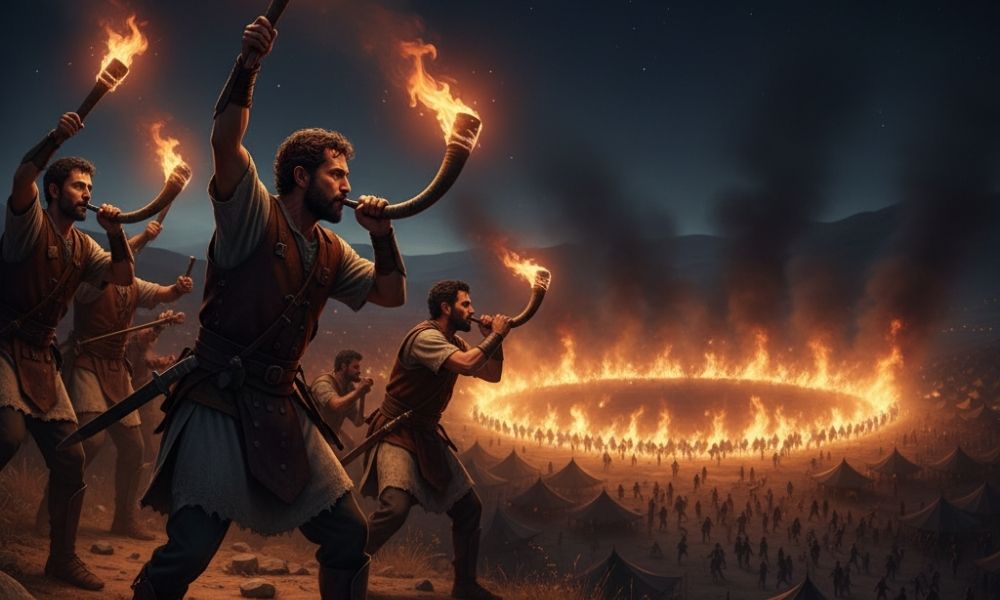
Judges 7 recounts one of the most famous military victories in biblical history. Following his call in Chapter 6, Gideon assembles an army of 32,000 to fight the Midianites. However, God declares the army too large, lest Israel claim the glory for themselves. Through a series of tests, God whittles the force down to a mere 300 men. God then reassures a frightened Gideon by allowing him to overhear a prophetic dream in the enemy camp. Armed only with trumpets, torches, and clay jars, Gideon’s small band surrounds the vast Midianite camp at night. Their sudden noise and light cause panic, leading the Midianites to turn on each other and flee, resulting in a total victory for Israel.
1. The Winnowing of the Army (Judges 7:1–8 ESV)
Then Jerubbaal (that is, Gideon) and all the people who were with him rose early and encamped beside the spring of Harod. And the camp of Midian was north of them… The Lord said to Gideon, “The people with you are too many for me to give the Midianites into their hand, lest Israel boast over me, saying, ‘My own hand has saved me.’ Now therefore proclaim in the ears of the people, saying, ‘Whoever is fearful and trembling, let him return home and hurry away from Mount Gilead.’” Then 22,000 of the people returned, and 10,000 remained. And the Lord said to Gideon, “The people are still too many. Take them down to the water… Everyone who laps the water with his tongue, as a dog laps, you shall set by himself. Likewise, everyone who kneels down to drink.” And the number of those who lapped, putting their hands to their mouths, was 300 men…
Commentary:
- The Danger of Pride: God identifies the greatest threat to Israel not as the Midianite army, but as their own pride. If they won with 32,000, they would claim credit. God’s strategy is designed to ensure He receives the glory.
- The First Test (Fear): In accordance with Deuteronomy 20:8, the fearful are invited to leave. Fear is contagious in battle. The result is shocking: over two-thirds of the army (22,000) walks away, revealing the spiritual state of the nation.
- The Second Test (The Water): God reduces the remaining 10,000. The distinction is between those who knelt to drink directly from the stream and those who scooped water to their mouths (“lapped”).
- Interpretation: While some commentators suggest those who scooped water were more “alert” soldiers, the text emphasizes God’s sovereign choice to reduce the number.
- The Result: Only 300 remain. Facing an army of 135,000 (Judges 8:10), the ratio is 1 Israelite to 450 Midianites. This makes a military victory impossible without divine intervention.
2. Encouragement in the Enemy Camp (Judges 7:9–14 ESV)
That same night the Lord said to him, “Arise, go down against the camp, for I have given it into your hand. But if you are afraid to go down, go down to the camp with Purah your servant. …” …And behold, a man was telling a dream to his comrade. And he said, “Behold, I dreamed a dream, and behold, a cake of barley bread tumbled into the camp of Midian and came to the tent and struck it so that it fell and turned it upside down…” And his comrade answered, “This is no other than the sword of Gideon the son of Joash, a man of Israel; God has given into his hand Midian and all the camp.”
Commentary:
- God’s Mercy on Fear: Despite the miracles in Chapter 6, Gideon is still afraid. God does not rebuke him but provides a mechanism for courage: a reconnaissance mission.
- The Barley Cake: In the dream, a loaf of barley bread rolls into the camp and flattens a tent.
- Symbolism: Barley was the food of the poor and livestock (wheat was for the rich). Israel, impoverished by raids, is the “barley cake”—rough and seemingly insignificant.
- The Tent: Represents the nomadic power of Midian.
- Psychological Warfare: Gideon learns that while he is afraid of the Midianites, the Midianites are terrified of him (and his God). The enemy is already defeated psychologically before the battle begins.
3. The Torch and Trumpet Attack (Judges 7:15–22 ESV)
As soon as Gideon heard the telling of the dream and its interpretation, he worshiped. And he returned to the camp of Israel and said, “Arise, for the Lord has given the host of Midian into your hand.” …He put a trumpet in every man’s hand and empty jars, with torches inside the jars. …So they blew the trumpets and broke the jars that were in their hands. They held in their left hands the torches, and in their right hands the trumpets to blow, and they cried out, “A sword for the Lord and for Gideon!” …And the army fled as they cried out and ran. When they blew the 300 trumpets, the Lord set every man’s sword against his comrade and against all the army.
Commentary:
- Worship First: Gideon’s first response to the good news is worship. Faith leads to praise, which then leads to action.
- The Weapons: They carry no swords—only trumpets (shofars), empty clay jars, and torches. They are not equipped to fight, but to announce.
- The Strategy of Illusion: In ancient warfare, a torchbearer usually signaled a company of troops. Seeing 300 torches surround them, the waking Midianites would assume an attacking force of thousands.
- Light in Darkness: Breaking the jars concealed the light until the last moment, maximizing the shock factor.
- The Chaos: The noise (shattering clay and blowing horns) and sudden light in the pitch black caused a stampede.
- Divine Intervention: Verse 22 clarifies that “the Lord set every man’s sword against his comrade.” In the confusion, the diverse coalition of Midianites and Amalekites turned on one another.
4. The Pursuit and the Capture of Princes (Judges 7:23–25 ESV)
And the men of Israel were called out from Naphtali and from Asher and from all Manasseh, and they pursued after Midian. Gideon sent messengers throughout all the hill country of Ephraim, saying, “Come down against the Midianites and capture the waters against them…” …And they captured the two princes of Midian, Oreb and Zeeb. They killed Oreb at the rock of Oreb, and Zeeb they killed at the winepress of Zeeb… and brought the heads of Oreb and Zeeb to Gideon beyond the Jordan.
Commentary:
- Mobilization: Once the victory is assured, the men who were previously sent home (or those from surrounding tribes) join the pursuit. It is easier to join a battle that is already being won.
- Strategic Blockade: Gideon calls the powerful tribe of Ephraim to seize the watering places (likely fords of the Jordan River) to cut off the retreat.
- Oreb and Zeeb: The capture of these two commanders is significant. Their names mean “Raven” and “Wolf.” They are executed at locations that later bore their names, serving as monuments to the victory (referenced later in Isaiah 10:26).
Theological Significance of Judges 7
- Sola Gratia (Grace Alone): The reduction of the army creates a scenario where human boasting is impossible. Salvation belongs entirely to the Lord.
- Quality over Quantity: God is not interested in the majority; He works through the faithful remnant.
- The Power of Weakness: God uses “barley bread” and clay jars to destroy iron-willed empires. As Paul writes in 2 Corinthians 4:7, “We have this treasure in jars of clay, to show that the surpassing power belongs to God and not to us.”
- God’s Sovereignty over Enemies: God uses the enemies’ own dreams and their own swords to defeat them. He turns the chaos of evil against itself.
Practical Applications
- Trust God’s Math: When resources seem insufficient (money, time, people), remember that God often subtracts to multiply. He may be reducing your “army” to ensure you trust Him rather than your assets.
- Face Your Fears: Like Gideon, you may be afraid. God doesn’t demand the absence of fear; He asks for obedience within the fear. He provides the encouragement we need when we step out.
- Break the Jar: Sometimes the “light” of the Gospel is hidden inside the “jar” of our self-preservation or comfort. We must be broken—humbling ourselves and stepping out of comfort zones—for the light to shine and the enemy to be defeated.
- Worship Before War: Before engaging in the conflict, Gideon bowed in worship. Spiritual battles are won in prayer before they are fought in the world.
Final Insight
Judges 7 demonstrates that the size of the obstacle is irrelevant to the God of the outcome. Gideon’s 300 did not win by fighting; they won by standing their ground and letting their light shine, causing the darkness to defeat itself.







Leave a Reply