
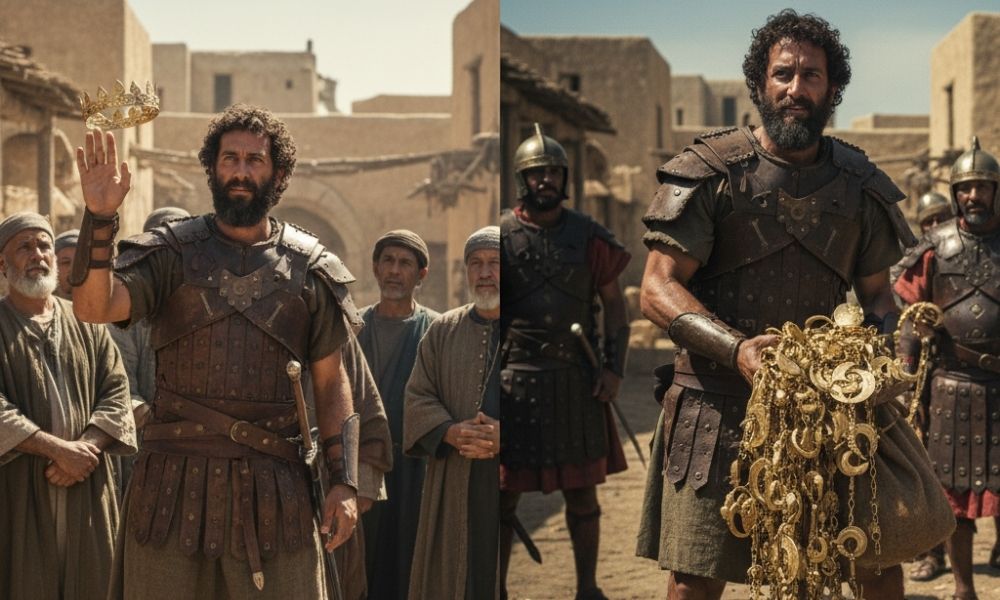
Judges 8 depicts the tragic decline of Gideon. While the chapter begins with the final military victory over the Midianites, it quickly shifts focus to internal strife, personal vengeance, and spiritual compromise. Gideon displays diplomatic skill in calming the tribe of Ephraim but shows brutal cruelty to the Israelite towns of Succoth and Penuel. Although he verbally refuses the kingship, claiming “the Lord will rule over you,” his actions—accumulating wealth, wives, and creating a golden ephod that leads Israel into idolatry—betray a heart that has drifted from pure devotion. The narrative serves as a sober warning about how a hero can become a stumbling block.
1. Diplomacy with Ephraim (Judges 8:1–3 ESV)
And the men of Ephraim said to him, “What is this that you have done to us, not to call us when you went to fight with Midian?” And they accused him fiercely. And he said to them, “What have I done now in comparison with you? Is not the gleaning of the grapes of Ephraim better than the grape harvest of Abiezer? God has given into your hands the princes of Midian, Oreb and Zeeb. What have I been able to do in comparison with you?” Then their anger against him subsided when he said this.
Commentary:
- Tribal Pride: Ephraim, a powerful and dominant tribe, feels slighted that they were not invited to the initial battle. They wanted the glory of the victory.
- Gideon’s Tact: Unlike his later harshness, Gideon here displays great diplomatic wisdom. He uses a rhetorical question to flatter them (“Is not the gleaning of Ephraim better…?”).
- The Metaphor: He argues that their “mopping up” operation (capturing the princes Oreb and Zeeb) was more significant than his main harvest (the initial battle).
- Soft Answer: As Proverbs 15:1 states, “A soft answer turns away wrath.” Gideon pacifies a potential civil war through humility.
2. The Pursuit and the Refusal of Aid (Judges 8:4–9 ESV)
And Gideon came to the Jordan and crossed over, he and the 300 men who were with him, exhausted yet pursuing. So he said to the men of Succoth, “Please give loaves of bread to the people who follow me, for they are exhausted, and I am pursuing after Zebah and Zalmunna, the kings of Midian.” And the officials of Succoth said, “Are the hands of Zebah and Zalmunna already in your hand, that we should give bread to your army?” So Gideon said, “Well then, when the Lord has given Zebah and Zalmunna into my hand, I will flail your flesh with the thorns of the wilderness and with briers.” And from there he went up to Penuel… and the men of Penuel answered him as the men of Succoth had answered. And he said to the men of Penuel, “When I come again in peace, I will break down this tower.”
Commentary:
- Faint Yet Pursuing: This phrase captures the tenacity of Gideon’s 300. They are physically spent but spiritually driven to finish the mission.
- Betrayal by Brothers: Succoth and Penuel are Israelite cities (tribe of Gad). Their refusal to feed their starving brothers is a shocking breach of hospitality and covenant loyalty.
- Pragmatic Atheism: The officials of Succoth are hedging their bets. They fear the Midianite kings more than they trust Gideon’s God. They want proof of victory before offering support.
- Gideon’s Vow: Gideon promises severe retribution. His focus is shifting from delivering Israel to punishing those who disrespect him.
3. Vengeance on Succoth and Penuel (Judges 8:10–17 ESV)
Now Zebah and Zalmunna were in Karkor with their army, about 15,000 men… And Gideon went up by the way of the tent dwellers… and attacked the army, for the army felt secure. … And he captured a young man of Succoth and questioned him. And he wrote down for him the officials and elders of Succoth, seventy-77 men. …And he took the elders of the city, and he took thorns of the wilderness and briers and with them taught the men of Succoth a lesson. And he broke down the tower of Penuel and killed the men of the city.
Commentary:
- The Surprise Attack: Gideon attacks the remnant of the Midianite army (15,000 strong) at Karkor. The enemy “felt secure,” thinking they were out of range, but Gideon’s persistence caught them off guard.
- The List of Names: Gideon acts methodically, capturing a youth to get a hit list of the elders responsible for the insult.
- Brutal Justice:
- Succoth: He “taught them a lesson” (torture) using desert thorns. The punishment matches the crime—they were “prickly” and unhelpful, so they are disciplined with briers.
- Penuel: He destroys their tower (their source of security and pride) and executes the men.
- A Shift in Character: This violence is directed at Israelites. While they deserved punishment for treason, Gideon’s severity suggests personal vendetta rather than divine justice.
4. Execution of the Kings (Judges 8:18–21 ESV)
Then he said to Zebah and Zalmunna, “Where are the men whom you killed at Tabor?” They answered, “As you are, so were they. Every one of them resembled the son of a king.” And he said, “They were my brothers, the sons of my mother. …” So he said to Jether his firstborn, “Rise and kill them!” But the youth did not draw his sword, for he was afraid… Then Zebah and Zalmunna said, “Rise yourself and fall upon us, for as the man is, so is his strength.” And Gideon arose and killed Zebah and Zalmunna, and he took the crescent ornaments that were on the necks of their camels.
Commentary:
- Blood Feud: It is revealed that the Midianite kings had previously killed Gideon’s brothers. This changes the dynamic of the war from a divine deliverance to a family blood feud.
- Jether’s Fear: Gideon tries to humiliate the kings by having his teenage son execute them. The boy freezes, mirroring Gideon’s own initial fear in Chapter 6, but without the divine reassurance.
- The Kings’ Request: The kings prefer to die by the hand of a warrior (Gideon) than be hacked to death by a frightened boy.
- Spoils of War: Gideon takes their crescent ornaments (symbols of the moon god), foreshadowing his attraction to their wealth.
5. The Snare of the Ephod (Judges 8:22–27 ESV)
Then the men of Israel said to Gideon, “Rule over us, you and your son and your grandson also, for you have saved us from the hand of Midian.” Gideon said to them, “I will not rule over you, and my son will not rule over you; the Lord will rule over you.” And Gideon said to them, “Let me request of you… that you give me every man the earrings of his spoil.” … And Gideon made an ephod of it and put it in his city, in Ophrah. And all Israel whored after it there, and it became a snare to Gideon and to his family.
Commentary:
- Request for Monarchy: The people want to make Gideon a dynastic king. They attribute salvation to Gideon (“you have saved us”) rather than God.
- The Verbal Refusal: Gideon gives the theologically correct answer: Yahweh is the only King of Israel.
- The Practical Acceptance: Despite refusing the title, Gideon acts like a king. He levies a tax (the gold earrings) totaling 1,700 shekels (approx. 40-50 lbs of gold).
- The Ephod: An ephod was a priestly garment used to determine God’s will (Exodus 28). By making one and keeping it in his hometown (Ophrah), Gideon establishes a rival cult center, bypassing the tabernacle at Shiloh.
- The Result: The object meant to honor God becomes an idol. The text says Israel “whored after it.” Gideon’s legacy is ruined by this unauthorized religious innovation.
6. Death and Apostasy (Judges 8:28–35 ESV)
So Midian was subdued before the people of Israel… And the land had rest forty years in the days of Gideon. …Gideon had seventy sons, his own offspring, for he had many wives. And his concubine who was in Shechem also bore him a son, and he called his name Abimelech. And Gideon… died in a good old age… As soon as Gideon died, the people of Israel turned again and whored after the Baals and made Baal-berith their god. And the people of Israel did not remember the Lord their God…
Commentary:
- Living Like a King: Gideon maintains a royal harem (“many wives”) and has 70 sons. This clearly violates the instructions for kings in Deuteronomy 17:17 (“he shall not acquire many wives”).
- Abimelech: He names his concubine’s son Abimelech, which literally means “My father is king.” This contradicts his earlier statement in verse 23. It reveals his hidden pride.
- Immediate Regression: As soon as the strong leader dies, the people revert to idolatry. Their faith was in Gideon, not in God.
- Baal-berith: They worship “Baal of the Covenant.” They have exchanged the covenant of Yahweh for a covenant with a Canaanite idol.
Theological Significance of Judges 8
- The Corruption of Success: Gideon handles adversity (Chapter 6-7) better than he handles success (Chapter 8). Victory leads to pride, entitlement, and self-indulgence.
- Incomplete Obedience: Gideon refuses the title of king but seizes the power, wealth, and lifestyle of one. Partial obedience often leads to total apostasy.
- The Danger of Good Intentions: The ephod was likely intended to honor God or consult Him, but because it was unauthorized and self-centered, it became a snare. Good motives do not justify unbiblical methods.
- Legacy: A leader’s private compromise (polygamy, gold hoarding) eventually destroys their public legacy (the apostasy of the nation).
Practical Applications
- Finish Well: Many start like Gideon in Chapter 6 (humble, dependent) but end like Gideon in Chapter 8 (proud, independent). The end of the race matters more than the beginning.
- Beware of “Ephods”: Be careful of creating “religious” things (ministries, buildings, objects) that draw attention away from God and become idols themselves.
- Soft Words: In conflict, emulate Gideon’s diplomacy with Ephraim. A humble response can diffuse a volatile situation.
- Credit Where Due: When people praise you for success (“Rule over us, for you saved us”), immediately redirect the glory to God, not just with words, but with your lifestyle.
Final Insight
Judges 8 serves as a tragedy within a triumph. It illustrates that a man can conquer an army of 135,000 yet be defeated by his own ego. Gideon delivered Israel from Midian, but he could not deliver himself from the snare of pride.







Leave a Reply