
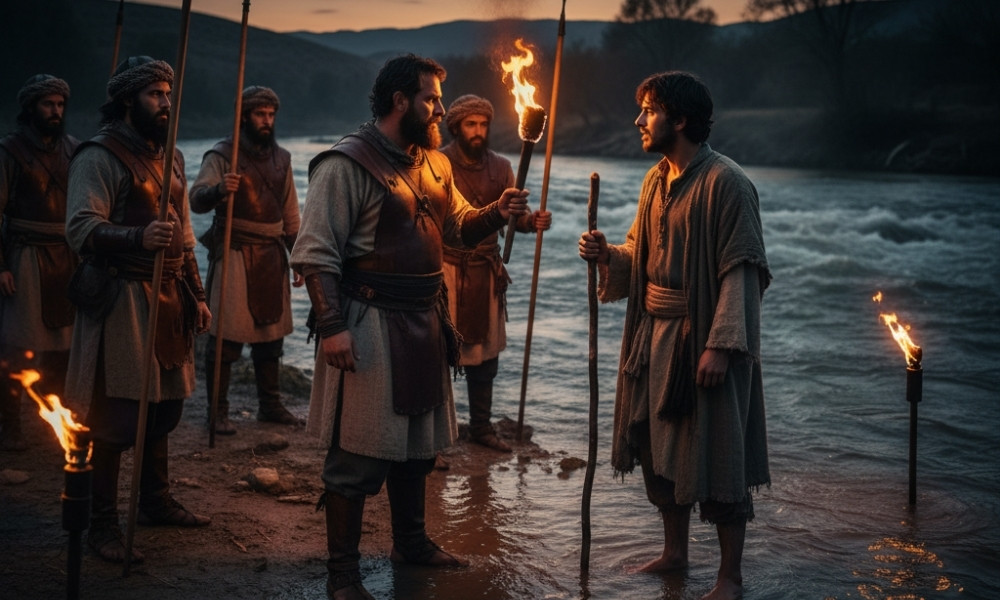
Judges 12 records the tragic aftermath of Jephthah’s victory, where internal jealousy leads to civil war between the tribes of Israel. Unlike Gideon, who diffused Ephraim’s anger with diplomacy, Jephthah responds with force, leading to the slaughter of 42,000 Ephraimites at the fords of the Jordan. The chapter concludes by listing three “minor” judges—Ibzan, Elon, and Abdon—who ruled in relative peace, characterized by their wealth and large families, yet without recorded spiritual reform. The chapter highlights the deteriorating unity of Israel and the shift from spiritual mission to tribal ambition.
1. The Conflict with Ephraim (Judges 12:1–4 ESV)
The men of Ephraim were called to arms, and they crossed to Zaphon and said to Jephthah, “Why did you cross over to fight against the Ammonites and did not call us to go with you? We will burn your house over you with fire.” And Jephthah said to them, “I and my people had a great dispute with the Ammonites, and when I called you, you did not save me from their hand. And when I saw that you would not save me, I took my life in my hand and crossed over against the Ammonites, and the Lord gave them into my hand. Why then have you come up to me this day to fight against me?” Then Jephthah gathered all the men of Gilead and fought with Ephraim. And the men of Gilead struck Ephraim, because they said, “You are fugitives of Ephraim, you Gileadites, in the midst of Ephraim and Manasseh.”
Commentary:
- Ephraim’s Pride: The tribe of Ephraim, the dominant tribe in the north, feels slighted because they were not the center of the victory. Their threat (“burn your house over you”) is disproportionately violent and reveals deep tribal jealousy.
- Comparison with Gideon: In Judges 8:1–3, Gideon faced a similar complaint from Ephraim but defused it with humility and flattery. Jephthah, a man of war and rough background, responds with facts and aggression rather than diplomacy.
- Jephthah’s Defense: He argues that he did call for help, but they failed to respond. He emphasizes that he “took my life in my hand”—risking everything while they stayed safe.
- The Lord’s Role: Jephthah correctly attributes the victory to Yahweh (“the Lord gave them into my hand”), exposing Ephraim’s quarrel as ultimately being against God’s choice of deliverer.
- Civil War: The verbal insult from Ephraim (calling the Gileadites “fugitives” or “renegades”) sparks a physical battle. Brother turns against brother, signaling the spiritual and social disintegration of the nation.
Insight: Pride and a demand for recognition can turn a victory into a tragedy. When we care more about credit than the cause, we destroy unity.
2. The Test of Shibboleth (Judges 12:5–6 ESV)
And the Gileadites captured the fords of the Jordan against the Ephraimites. And when any of the fugitives of Ephraim said, “Let me go over,” the men of Gilead said to him, “Are you an Ephraimite?” When he said, “No,” they said to him, “Then say Shibboleth,” and he said, “Sibboleth,” for he could not pronounce it right. Then they seized him and slaughtered him at the fords of the Jordan. At that time 42,000 of the Ephraimites fell.
Commentary:
- Strategic Ambush: The Gileadites secure the crossing points of the Jordan River to prevent the Ephraimites from retreating home.
- The Linguistic Trap: The word Shibboleth likely means “flowing stream” or “ear of grain.” The test relied on a dialect difference: Ephraimites evidently could not pronounce the “sh” sound, using a soft “s” instead.
- Tragic Slaughter: The test was not about truth or justice, but purely tribal identity. The result is a massacre of 42,000 Israelites by other Israelites—a far greater loss of life than in many battles against foreign oppressors.
- Loss of Perspective: The ability to pronounce a word correctly became a matter of life and death, highlighting the absurdity and pettiness of the conflict.
Insight: In times of division, minor differences are often weaponized to justify major cruelty. The Shibboleth incident stands as a grim reminder of how easily God’s people can turn on one another over superficial distinctions.
3. The Death of Jephthah (Judges 12:7 ESV)
Jephthah judged Israel six years. Then Jephthah the Gileadite died and was buried in his city in Gilead.
Commentary:
- Short Tenure: Jephthah’s rule lasted only six years, a relatively short period compared to other judges. This may suggest that his violent leadership brought little long-term stability.
- Burial: He is buried in “his city,” reinforcing his connection to Gilead. Despite his rejection by his brothers earlier in life (Judges 11), he dies an established leader of his people.
- Legacy: His life began as an outcast and ended as a judge, yet his legacy is marred by a rash vow (sacrifice of his daughter) and a bloody civil war.
Insight: A leader’s effectiveness is not just measured by military victory but by the peace and unity left behind. Jephthah brought deliverance, but not shalom.
4. The Minor Judges: Ibzan, Elon, and Abdon (Judges 12:8–15 ESV)
After him Ibzan of Bethlehem judged Israel. He had thirty sons, and thirty daughters he gave in marriage outside his clan, and thirty daughters he brought in from outside for his sons. And he judged Israel seven years. Then Ibzan died and was buried at Bethlehem. After him Elon the Zebulunite judged Israel, and he judged Israel ten years. Then Elon the Zebulunite died and was buried at Aijalon in the land of Zebulun. After him Abdon the son of Hillel the Pirathonite judged Israel. He had forty sons and thirty grandsons, who rode on seventy donkeys, and he judged Israel eight years. Then Abdon the son of Hillel the Pirathonite died and was buried at Pirathon in the land of Ephraim, in the hill country of the Amalekites.
Commentary:
- Ibzan of Bethlehem (vv. 8–10):
- Wealth and Influence: Having thirty sons and thirty daughters indicates polygamy and significant wealth.
- Political Alliances: “Giving in marriage outside his clan” suggests he used his children to build political treaties and expand his influence across tribes.
- Focus: His record focuses on family expansion rather than spiritual deliverance or military feats.
- Elon the Zebulunite (vv. 11–12):
- Obscurity: Very little is recorded of him other than his dates and burial place. This period likely represents a time of quiet stability.
- Abdon the Pirathonite (vv. 13–15):
- Dynastic Ambition: Like Ibzan, Abdon has a massive family (40 sons, 30 grandsons).
- Symbol of Status: Riding on “seventy donkeys” was a status symbol of nobility and wealth in a time before horses were common in Israel.
- Location: He is buried in Ephraim, in the “hill country of the Amalekites,” hinting that foreign influence or remnants of enemies were still present in the land.
Insight: These judges represent a shift toward establishment and aristocracy. While there was no war, there is also no mention of the “Spirit of the Lord” or repentance. Israel was settling for worldly stability over spiritual vitality.
Theological Significance of Judges 12
- The Horror of Disunity: This chapter illustrates the theological danger of internal strife within the covenant community. When God’s people fight each other, the enemy (sin and chaos) wins.
- Diplomacy vs. Pride: The contrast between Gideon (soft answer) and Jephthah (harsh answer) teaches that leadership requires wisdom and humility, not just raw power.
- The Silence of God: In the latter half of the chapter, God speaks less and less. The judges become more focused on their own dynasties (sons, daughters, donkeys) than on Yahweh’s law.
- Tribalism: The Shibboleth incident shows how tribal identity can eclipse covenant identity. They were Ephraimites and Gileadites first, and Israelites second.
Practical Applications
- Pursue Peace: In conflicts, especially within the church or family, strive to be a “Gideon” who de-escalates, rather than a “Jephthah” who escalates.
- Watch Your Words: A harsh response can lead to devastating consequences (Proverbs 15:1).
- Avoid “Shibboleths”: Do not create arbitrary tests or cultural hurdles to exclude other believers. Focus on the core unity of faith rather than minor differences in expression or background.
- Steward Influence Well: The minor judges used their position to build personal empires. We are called to use our resources and influence for God’s Kingdom, not just our own comfort.
Final Insight
Judges 12 serves as a sober warning that deliverance from external enemies does not guarantee internal peace. Jephthah defeated the Ammonites but could not conquer his own pride or the jealousy of his brothers. The chapter reveals that without a King who rules in true righteousness (Jesus), God’s people are prone to self-destruction and worldly ambition.







Leave a Reply