
Judges 16 marks the tragic climax and conclusion of Samson’s life. It details his moral descent, his fatal attraction to Delilah, and the loss of his divine strength due to a broken covenant. The chapter contrasts Samson’s physical strength with his moral weakness. Betrayed and blinded, Samson is reduced to a slave in Gaza. However, the narrative ends with a final act of judgment where God answers Samson’s prayer, allowing him to destroy the temple of Dagon, killing more Philistines in his death than he did during his life.
1. The Gates of Gaza (Judges 16:1–3)
1 Samson went to Gaza, and there he saw a prostitute, and he went in to her. 2 The Gazites were told, “Samson has come here.” And they surrounded the place and set an ambush for him all night at the gate of the city. They kept quiet all night, saying, “Let us wait till the light of the morning; then we will kill him.” 3 But Samson lay till midnight, and at midnight he arose and took hold of the doors of the gate of the city and the two posts, and pulled them up, bar and all, and put them on his shoulders and carried them to the top of the hill that is in front of Hebron.
Commentary:
- Samson’s Recklessness: Samson enters Gaza, a deep Philistine stronghold, driven by lust (“saw a prostitute”). He treats his calling and safety with casual disdain.
- The Ambush: The Gazites plan to kill him at dawn, assuming he is trapped within the city walls.
- The Feat of Strength: Samson tears the city gates out of the ground, including the posts and the locking bar. This leaves the city militarily defenseless and humiliated.
- The Journey to Hebron: He carries this massive weight to a hill facing Hebron. Hebron was roughly 40 miles away and at a much higher elevation. This was a supernatural display of dominance, signaling to the Philistines that their fortifications could not contain him.
- Divine Patience: Despite Samson’s sin with the prostitute, God’s Spirit still empowers him. This highlights God’s commitment to delivering Israel despite the flaw of the deliverer.
2. The Deception of Delilah (Judges 16:4–14)
4 After this he loved a woman in the Valley of Sorek, whose name was Delilah. 5 And the lords of the Philistines came up to her and said to her, “Seduce him, and see where his great strength lies, and by what means we may overpower him, that we may bind him to humble him. And we will each give you 1,100 pieces of silver.” 6 So Delilah said to Samson, “Please tell me where your great strength lies, and how you might be bound, that one could subdue you.” … 13 Then Delilah said to Samson, “Until now you have mocked me and told me lies. Tell me how you might be bound.” And he said to her, “If you weave the seven locks of my head with the web and fasten it tight with the pin, then I shall become weak and be like any other man.” 14 So while he slept, Delilah took the seven locks of his head and wove them into the web. And she made them tight with the pin and said to him, “The Philistines are upon you, Samson!” But he awoke from his sleep and pulled away the pin, the loom, and the web.
Commentary:
- Delilah: Unlike the previous woman, the text says Samson “loved” Delilah. She lived in the Valley of Sorek, a border region between Israel and Philistia.
- The Bribe: The five lords of the Philistines each offer 1,100 shekels of silver (5,500 total). This is an astronomical sum, indicating Samson was a national security threat.
- The Question: The Philistines realized Samson’s strength was not natural (e.g., huge muscles), but supernatural. They needed to know the “secret.”
- Samson’s Flirting with Disaster: Samson treats the danger as a game. He gives three false answers:
- Spiritual Lethargy: Samson is so confident in his invincibility that he sleeps while his enemy plots his destruction. He fails to see that Delilah values money more than his love.
3. The Great Fall (Judges 16:15–22)
15 And she said to him, “How can you say, ‘I love you,’ when your heart is not with me? You have mocked me these three times, and you have not told me where your great strength lies.” … 17 And he told her all his heart, and said to her, “A razor has never come upon my head, for I have been a Nazirite to God from my mother’s womb. If my head is shaved, then my strength will leave me, and I shall become weak and be like any other man.” … 19 She made him sleep on her knees. And she called a man and had him shave off the seven locks of his head. Then she began to torment him, and his strength left him. 20 And she said, “The Philistines are upon you, Samson!” And he awoke from his sleep and said, “I will go out as at other times and shake myself free.” But he did not know that the Lord had left him. 21 And the Philistines seized him and gouged out his eyes and brought him down to Gaza and bound him with bronze shackles. And he ground at the mill in the prison. 22 But the hair of his head began to grow again after it had been shaved.
Commentary:
- Emotional Manipulation: Delilah weaponizes Samson’s love (“How can you say I love you…”). She “vexed his soul to death,” wearing down his resistance.
- The Revelation: Samson reveals the Nazarite vow (Numbers 6). The long hair was not the source of the strength (magic), but the symbol of his consecration to God. To cut it was to renounce the vow.
- The Tragic Reality: Verse 20 contains perhaps the saddest sentence in the Old Testament: “But he did not know that the Lord had left him.” Samson assumed the power was his own, permanently possessed. He failed to realize his strength was relational, dependent on the Spirit of God.
- The Punishment:
- A Glimmer of Hope: Verse 22 notes, “the hair of his head began to grow again.” The Philistines ignored the biological sign of the returning covenant. God’s mercy was not yet exhausted.
4. Samson’s Death and Victory (Judges 16:23–31)
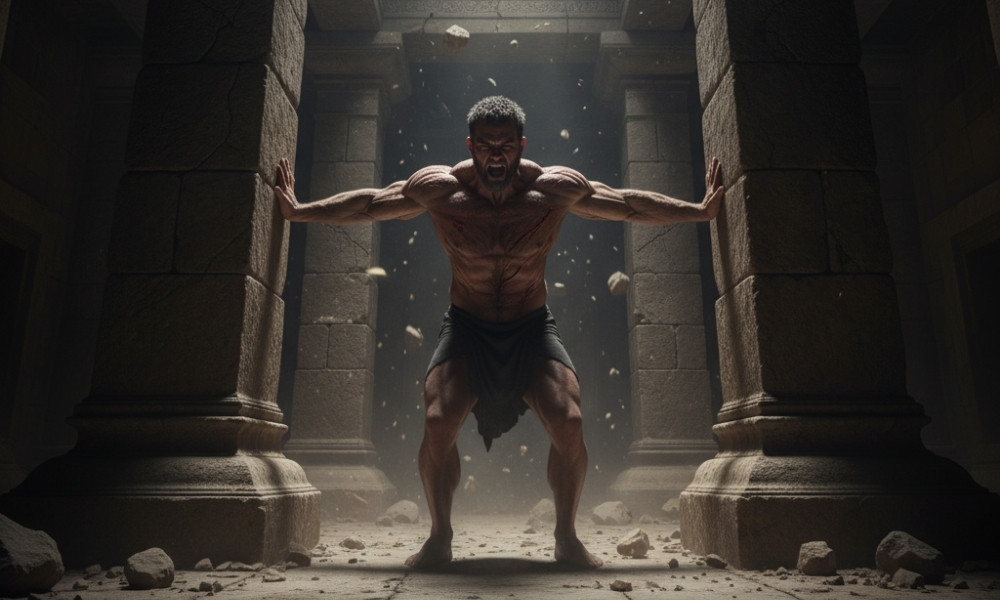
23 Now the lords of the Philistines gathered to offer a great sacrifice to Dagon their god and to rejoice, and they said, “Our god has given Samson our enemy into our hand.” … 25 And when their hearts were merry, they said, “Call Samson, that he may entertain us.” So they called Samson out of the prison, and he entertained them. They made him stand between the pillars. … 28 Then Samson called to the Lord and said, “O Lord God, please remember me and please strengthen me only this once, O God, that I may be avenged on the Philistines for my two eyes.” 29 And Samson grasped the two middle pillars on which the house rested, and he leaned his weight against them, his right hand on the one and his left hand on the other. 30 And Samson said, “Let me die with the Philistines.” Then he bowed with all his strength, and the house fell upon the lords and upon all the people who were in it. So the dead whom he killed at his death were more than those whom he had killed during his life. 31 Then his brothers and all his family came down and took him and brought him up and buried him…
Commentary:
- The Theological Battle: The Philistines credit Dagon (a grain or fish deity) for their victory. The final confrontation is not just Samson vs. Philistines, but Yahweh vs. Dagon.
- The Scene: The temple is packed with 3,000 spectators on the roof alone. Samson is brought out to be mocked (“entertain us”).
- Samson’s Prayer:
- The Collapse: Archaeological evidence of Philistine temples reveals they often had a central roof supported by two main wooden pillars resting on stone bases. Pushing these apart would cause a catastrophic structural failure.
- The Outcome: Samson dies as a suicide soldier, sacrificing his life to destroy the enemy leadership. He fulfilled the prophecy of the angel in Judges 13:5—he “began” to deliver Israel.
- Burial: His family retrieves the body. The Philistines, crushed and leaderless, do not stop them. He is buried with honor in his father’s tomb.
Theological Significance
- The Danger of Compromise: Samson thought he could live like a pagan (sleeping with prostitutes) and fight like a judge. His gradual compromise led to total collapse.
- Sovereignty over Sin: God used Samson’s sin and the Philistines’ arrogance to accomplish His purpose. Even in the dungeon, God was working toward the final victory.
- The Nature of Spiritual Power: Gifts (strength) and graces (holiness) are different. A person can be gifted by God yet live an unholy life, but eventually, the lack of character destroys the vessel.
- Grace in Judgment: God heard the prayer of a blinded, enslaved, and failed leader. It shows that one is never too far gone to call upon the Lord one last time.
Practical Applications
- Guard Your Heart: Samson could kill a lion but could not control his own lust. Strength of character is more vital than talent or ability.
- Beware of “Delilahs”: Temptation often comes in the form of persistence and emotional manipulation. Recognized when you are being pressured to compromise your convictions.
- Don’t Presume on God: Samson “did not know the Lord had left him.” We should not assume God’s blessing will remain if we persistently walk in disobedience.
- Failure is Not Final: Even after a disastrous fall, repentance is possible. God can still use a broken vessel to achieve a great victory.
Final Insight
Samson is a paradox—a man of great faith (Hebrews 11:32) and great flesh. His life serves as a mirror to Israel: blessed with strength and calling, yet constantly distracted by pagan neighbors, leading to blindness and bondage, yet ultimately saved by God’s intervening grace.







Leave a Reply