
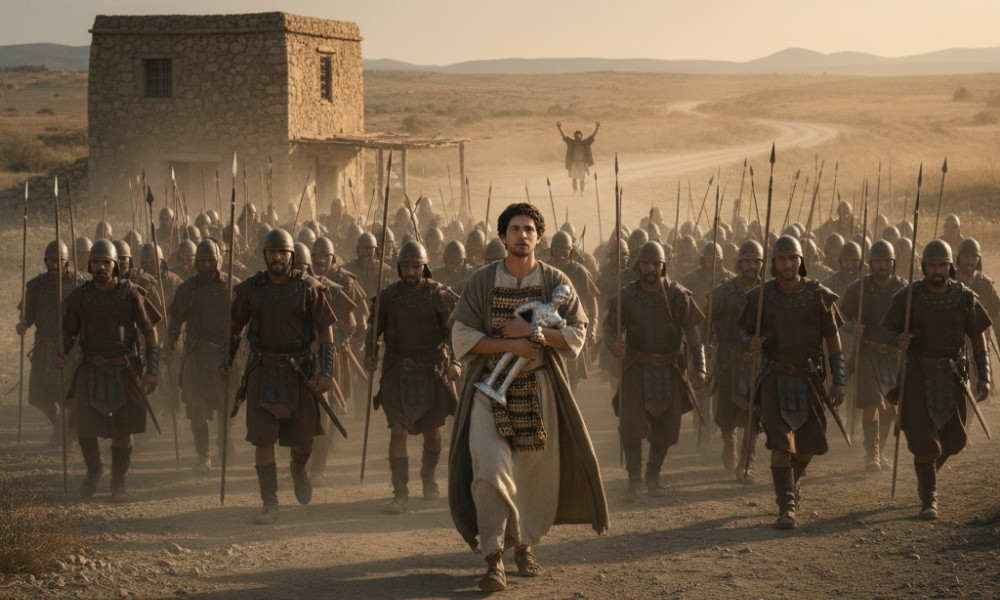
Judges 18 continues the narrative of Israel’s moral disintegration. Following the establishment of Micah’s private shrine in Chapter 17, this chapter broadens the scope from personal idolatry to tribal apostasy. The tribe of Dan, failing to secure their God-given inheritance due to a lack of faith, decides to find an easier territory to conquer. They encounter Micah, steal his idols, and bribe his mercenary Levite priest to join them. The chapter culminates in the brutal slaughter of the peaceful people of Laish and the establishment of a rival, idolatrous cult center in the city of Dan, led by none other than the grandson of Moses. It illustrates the chaotic refrain: “In those days there was no king in Israel.”
1. The Spies and the Mercenary Oracle (Judges 18:1–6)
1 In those days there was no king in Israel. And in those days the tribe of the people of Dan was seeking for itself a territory to dwell in, for until then no inheritance among the tribes of Israel had fallen to them. 2 So the people of Dan sent five able men from the whole number of their tribe, from Zorah and from Eshtaol, to spy out the land and to explore it. And they said to them, “Go and explore the land.” And they came to the hill country of Ephraim, to the house of Micah, and lodged there. 3 When they were by the house of Micah, they recognized the voice of the young Levite. And they turned aside and said to him, “Who brought you here? What are you doing in this place? What is your business here?” 4 And he said to them, “This is how Micah dealt with me: he has hired me, and I have become his priest.” 5 And they said to him, “Inquire of God, please, that we may know whether the journey on which we are setting out will succeed.” 6 And the priest said to them, “Go in peace. The journey on which you go is under the eye of the Lord.”
Commentary:
- The Failure of Dan: Verse 1 states no inheritance had “fallen to them,” but Joshua 19:40–48 reveals they were allotted land. Their problem was not a lack of divine provision, but a lack of faith and military resolve to drive out the Amorites and Philistines occupying their designated territory. They sought an easier path.
- Recognizing the Voice: The five spies recognize the Levite (v. 3). Since the Levite was from Bethlehem (Judah) and the Danites were from Zorah (nearby), they may have recognized his southern dialect or perhaps knew him personally before he wandered north.
- The Three Questions: The spies ask, “Who brought you? What are you doing? What is your business?” These questions highlight the oddity of a Levite priest operating for profit in a private home in Ephraim rather than serving at the Tabernacle.
- The Counterfeit Oracle: When asked to inquire of God (v. 5), the Levite gives a vague, positive affirmation: “Go in peace.”
- There is no evidence he actually consulted God (no mention of the Urim and Thummim).
- The phrase “under the eye of the Lord” is ambiguous—it could mean God favors it, or simply that God is watching it happen. The spies interpret it as a blessing.
2. The Target: Laish (Judges 18:7–10)
7 Then the five men departed and came to Laish and saw the people who were there, how they lived in security, after the manner of the Sidonians, quiet and unsuspecting, lacking nothing that is in the earth and possessing wealth, and how they were far from the Sidonians and had no dealings with anyone. 8 And when they came to their brothers at Zorah and Eshtaol, their brothers said to them, “What do you report?” 9 They said, “Arise, and let us go up against them, for we have seen the land, and behold, it is very good. And will you do nothing? Do not be slow to go, to enter in and possess the land. 10 As soon as you go, you will come to an unsuspecting people. The land is spacious, for God has given it into your hands, a place where there is no lack of anything that is in the earth.”
Commentary:
- Laish (Leshem): Located in the far north, at the foot of Mount Hermon (modern Tel Dan). It was a fertile, well-watered area (headwaters of the Jordan River).
- The Nature of the Target: The text emphasizes that Laish was “quiet and unsuspecting” and “far from the Sidonians” (their likely protectors).
- The Danites are not acting as holy warriors engaging wicked Canaanites; they are acting as opportunistic raiders targeting a peaceful, isolated settlement because it is an easy win.
- Twisted Theology: In verse 10, the spies claim, “God has given it into your hands.” They misuse God’s name to justify a conquest He never commanded. They conflate their own covetousness (“the land… is very good”) with divine will.
3. The Theft of the Gods (Judges 18:11–20)
11 So 600 men of the tribe of Dan, armed with weapons of war, set out from Zorah and Eshtaol. 12 And went up and encamped at Kiriath-jearim in Judah. On this account that place is called Mahaneh-dan to this day; behold, it is west of Kiriath-jearim. 13 And they passed on from there to the hill country of Ephraim, and came to the house of Micah. 14 Then the five men who had gone to scout out the country of Laish said to their brothers, “Do you know that in these houses there are an ephod, household gods, a carved image, and a metal image? Now therefore consider what you will do.” … 18 And when these went into Micah’s house and took the carved image, the ephod, the household gods, and the metal image, the priest said to them, “What are you doing?” 19 And they said to him, “Keep quiet; put your hand on your mouth and come with us and be to us a father and a priest. Is it better for you to be priest to the house of one man, or to be priest to a tribe and clan in Israel?” 20 And the priest’s heart was glad. He took the ephod and the household gods and the carved image and went along with the people.
Commentary:
- Mahaneh-dan: This camp is mentioned in the Samson narrative (Judges 13:25), linking the Danite migration chronologically or thematically to the time of Samson.
- The Robbery: The Danites steal the religious items (ephod, teraphim/household gods, images). In the ancient Near East, possessing the idols was often seen as possessing the deity’s favor and protection.
- The Proposition: The Danites offer the Levite a promotion. “Is it better for you to be priest to the house of one man, or to be priest to a tribe?”
- This exposes the Levite’s complete lack of integrity. He is not motivated by truth or loyalty, but by status and salary.
- “The Priest’s Heart Was Glad”: This chilling phrase (v. 20) highlights the corruption of the clergy. He happily helps rob his former employer to secure a better position.
4. Might Makes Right (Judges 18:21–26)
21 So they turned and departed, putting the little ones and the livestock and the goods in front of them. 22 When they had gone a distance from the home of Micah, the men who were in the houses near Micah’s house were called out, and they overtook the people of Dan. 23 And they shouted to the people of Dan, who turned around and said to Micah, “What is the matter with you, that you come with such a company?” 24 And he said, “You take my gods that I made and the priest, and go away, and what have I left? How then do you ask me, ‘What is the matter with you?’” 25 And the people of Dan said to him, “Do not let your voice be heard among us, lest angry fellows fall upon you, and you lose your life with the lives of your household.” 26 Then the people of Dan went their way. And when Micah saw that they were too strong for him, he turned and went back to his home.
Commentary:
- Tactical Formation: The Danites place their families and goods in front (v. 21), expecting a pursuit from the rear (Micah).
- The Irony of Idolatry: Micah cries out, “You take my gods that I made… what have I left?” (v. 24).
- This is a biting satire on idolatry. A god that must be carried, protected, and can be stolen is powerless to help its worshiper. Micah is left spiritually bankrupt because his faith was in objects.
- Bullying: The Danites do not argue right or wrong; they argue strength. They threaten Micah with “angry fellows” (literally: men bitter of soul). The law of the jungle prevails over the Law of Moses. Micah retreats, realizing he cannot win.
5. The Massacre and the Counter-Sanctuary (Judges 18:27–31)
27 But the people of Dan took what Micah had made, and the priest who belonged to him, and they came to Laish, to a people quiet and unsuspecting, and struck them with the edge of the sword and burned the city with fire. 28 And there was no deliverer because it was far from Sidon, and they had no dealings with anyone. It was in the valley that belongs to Beth-rehob. Then they rebuilt the city and lived in it. 29 And they named the city Dan, after the name of Dan their ancestor, who was born to Israel; but the name of the city was Laish at the first. 30 And the people of Dan set up the carved image for themselves, and Jonathan the son of Gershom, son of Moses, and his sons were priests to the tribe of the Danites until the day of the captivity of the land. 31 So they set up Micah’s carved image that he made, as long as the house of God was at Shiloh.
Commentary:
- The Slaughter: The Danites massacre a peaceful people. While God commanded the destruction of the Canaanites (due to their wickedness), the text portrays Laish as harmless. This conquest seems driven by Danite convenience rather than divine command.
- Renaming: The city is renamed Dan. It becomes the northernmost marker of Israel (hence the phrase “from Dan to Beersheba”).
- The Shocking Reveal (v. 30): The text finally identifies the young Levite: Jonathan, the son of Gershom, son of Moses.
- Textual Note: In many Hebrew manuscripts, a small “n” (nun) is suspended in the name “Moses” (Mosheh) to turn it into “Manasseh” (Menasheh). The scribes did this to protect the reputation of Moses, unable to bear that his own grandson was the first idolatrous priest of Israel. However, the genealogy confirms it is Moses’ line.
- The Rival Cult: This establishes a long-standing center of false worship.
- Comparison to Shiloh: Verse 31 explicitly contrasts the false shrine at Dan with the true “house of God” at Shiloh. The disintegration is complete: a rival religion has been institutionalized within Israel.
Theological Significance
- The Legacy of Compromise: The revelation that the idolatrous priest is Moses’ grandson is devastating. It teaches that faith is not genetically inherited. A godly heritage does not guarantee a godly life if the individual does not personally walk with God.
- The Futility of Idols: The narrative mocks man-made religion. Micah’s gods were helpless to save themselves from theft. As Isaiah later wrote, “They must be carried, for they cannot walk” (Jeremiah 10:5).
- Pragmatism vs. Obedience: The Danites judged their success by results (obtaining land), not by righteousness. They assumed that because they succeeded, God was with them. This warns against interpreting easy circumstances as God’s approval of sinful actions.
- Religious Syncretism: The tribe of Dan creates a religion that looks like Yahwism (a Levite priest, an ephod, inquiring of God) but is actually paganism.
Practical Applications
- Assess Your Ambition: The Levite (Jonathan) upgraded his career at the cost of his soul. We must evaluate if our career moves or life changes are driven by calling and integrity, or merely by status and money.
- Don’t Mistake “Open Doors” for God’s Will: The Danites found a peaceful city and assumed God gave it to them. Just because something is easy or available doesn’t mean it is right to take it.
- Examine Your “Gods”: If your source of security, peace, or identity can be taken away by “thieves” (economic crash, loss of job, change in circumstances), it is an idol. The true God cannot be stolen or removed.
Final Insight
Judges 18 is a tragedy of leadership and legacy. It begins with a tribe unwilling to fight the right battle (their inheritance) and ends with them fighting the wrong battle (slaughtering innocents), led by a priest who traded his grandfather Moses’ legacy for a comfortable salary.







Leave a Reply