
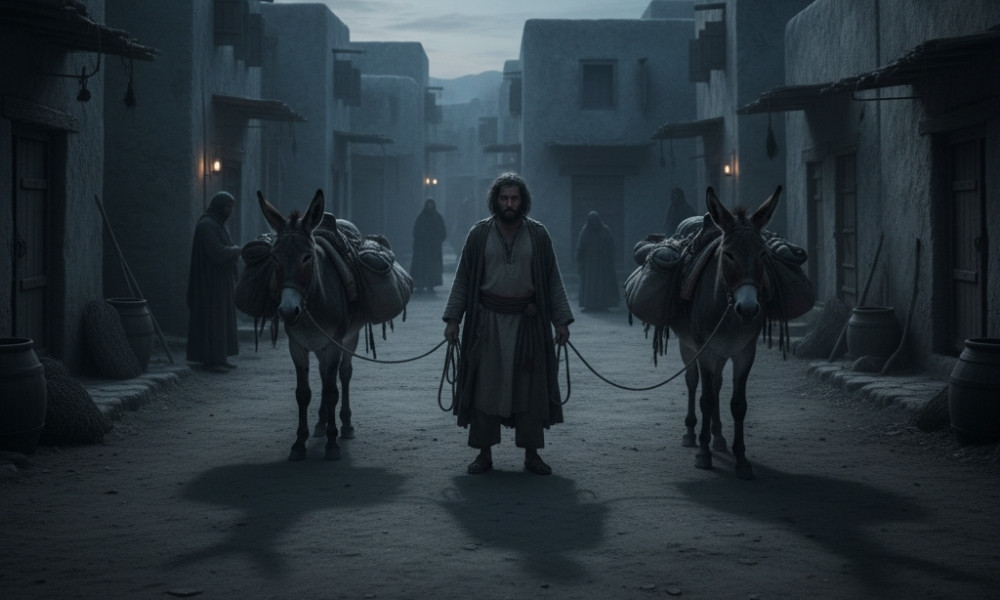
Judges 19 is widely considered the darkest chapter in the book, often called the “Sodom and Gomorrah” of Israel. It records the horrific abuse and murder of a Levite’s concubine in the town of Gibeah. The narrative follows a Levite who travels to Bethlehem to retrieve his estranged concubine. On their return journey, they bypass the pagan city of Jebus (Jerusalem) to stay in the “safe” Israelite city of Gibeah. There, they are met with extreme hostility. A mob demands to rape the Levite; instead, his concubine is thrown to them, brutally abused all night, and dies. The Levite dismembers her body into twelve pieces and sends them to the tribes of Israel, sparking a national outrage that leads to civil war.
1. The Dysfunctional Reconciliation (Judges 19:1–9)
1 In those days, when there was no king in Israel, a certain Levite was sojourning in the remote parts of the hill country of Ephraim, who took to himself a concubine from Bethlehem in Judah. 2 And his concubine was unfaithful to him, and she went away from him to her father’s house at Bethlehem in Judah, and was there some four months. 3 Then her husband arose and went after her, to speak kindly to her and bring her back. He had with him his servant and a couple of donkeys. And she brought him into her father’s house. And when the girl’s father saw him, he came with joy to meet him. 4 And his father-in-law, the girl’s father, made him stay, and he remained with him three days. So they ate and drank and spent the night there. … 9 And when the man and his concubine and his servant rose up to depart, his father-in-law, the girl’s father, said to him, “Behold, now the day has waned toward evening. Please spend the night. Behold, the day draws to its close. Lodge here and let your heart be merry, and tomorrow you shall arise early in the morning for your journey, and go home.”
Commentary:
- The Setting: The phrase “In those days, when there was no king in Israel” alerts the reader that moral chaos will follow. The protagonist is a Levite, a religious figure who should represent holiness, but instead represents the nation’s spiritual void.
- The Relationship: He takes a “concubine” (a secondary wife with fewer legal rights). The text says she “played the whore” (ESV) or was unfaithful. However, the Septuagint suggests she was “angry” with him. Regardless, she flees to her father’s house—a sign of significant domestic trouble.
- The Levite’s Mission: He goes to “speak to her heart” (literal Hebrew for “speak kindly”). This initial tenderness contrasts sharply with his callous behavior later in the chapter.
- The Father-in-Law’s Excess: The father-in-law detain the couple for five days with excessive feasting.
- Hospitality: In the Ancient Near East, hospitality was a sacred duty.
- The Delay: The father-in-law’s constant urging (“strengthen your heart,” “stay another night”) serves a narrative purpose: it forces the Levite to begin his journey late in the day (verse 9), which directly leads to the tragedy.
2. The Fatal Decision: Jebus vs. Gibeah (Judges 19:10–15)
10 But the man would not spend the night. He rose up and departed and arrived opposite Jebus (that is, Jerusalem). He had with him a couple of saddled donkeys, and his concubine was with him. 11 When they were near Jebus, the day was nearly over, and the servant said to his master, “Come now, let us turn aside to this city of the Jebusites and spend the night in it.” 12 And his master said to him, “We will not turn aside into the city of foreigners, who do not belong to the people of Israel, but we will pass on to Gibeah.” 13 And he said to his young man, “Come and let us draw near to one of these places and spend the night at Gibeah or at Ramah.” 14 So they passed on and went their way. And the sun went down on them near Gibeah, which belongs to Benjamin. 15 And they turned aside there, to go in and spend the night at Gibeah. And he went in and sat down in the open square of the city, for no one took them into his house to spend the night.
Commentary:
- Jebus (Jerusalem): At this time, Jerusalem was still a Canaanite stronghold (Jebusites) and had not yet been conquered by David.
- The Servant’s Pragmatism: The servant suggests stopping in Jebus because night is falling. Travel at night was dangerous due to bandits and wild animals.
- The Levite’s Nationalism: The Levite refuses to stay with “foreigners.” He insists on pressing forward to Gibeah or Ramah because they are Israelite cities (specifically, the tribe of Benjamin).
- The Irony: This is the central irony of the chapter. The Levite believes he will be safe among his “brothers” and unsafe among the pagans. The events prove that the Israelites have become more wicked than the Canaanites they were supposed to drive out.
- The Town Square: Upon arriving in Gibeah, they sit in the open square. In that culture, this was a request for lodging. The fact that “no one took them into his house” is a severe indictment of Gibeah. They have abandoned the basic laws of hospitality.
3. A Flicker of Hospitality (Judges 19:16–21)
16 And behold, an old man was coming from his work in the field at evening. The man was from the hill country of Ephraim, and he was sojourning in Gibeah; the men of the place were Benjaminites. 17 And he lifted up his eyes and saw the traveler in the open square of the city. And the old man said, “Where are you going? And where do you come from?” … 20 And the old man said, “Peace be to you; I will care for all your wants. Only, do not spend the night in the square.” 21 So he brought him into his house and gave the donkeys feed. And they washed their feet, and ate and drank.
Commentary:
- The Old Man: The only person to offer help is not a Benjaminite, but an Ephraimite living among them—an outsider. This underscores the moral rot of the native citizens of Gibeah.
- The Warning: The old man warns, “Only, do not spend the night in the square.” He knows the character of his neighbors. He knows the streets are not safe.
- Provision: The Levite asserts he has plenty of supplies (bread, wine, straw). He is not a beggar; he only needs a roof (protection). The old man takes them in, washing their feet—a sign of comfort and service.
4. The Atrocity: Israel Becomes Sodom (Judges 19:22–26)
22 As they were making their hearts merry, behold, the men of the city, worthless fellows, surrounded the house, beating on the door. And they said to the old man, the master of the house, “Bring out the man who came into your house, that we may know him.” 23 And the master of the house went out to them and said to them, “No, my brothers, do not act so wickedly; since this man has come into my house, do not do this vile thing. 24 Behold, here are my virgin daughter and his concubine. Let me bring them out now. Violate them and do with them what seems good to you, but against this man do not do this outrageous thing.” 25 But the men would not listen to him. So the man seized his concubine and made her go out to them. And they knew her and abused her all night until the morning. And as the dawn began to break, they let her go. 26 And as morning appeared, the woman came and fell down at the door of the man’s house where her master was, until it was light.
Commentary:
- The Parallel to Sodom: This scene is a direct mirroring of Genesis 19 (Lot in Sodom).
- Both involve two travelers (angels/Levite).
- Both involve a mob surrounding the house.
- Both involve a demand to “know” (have sex with) the male guests.
- Both involve a host offering daughters to appease the crowd.
- Conclusion: Israel has spiritually and morally descended to the level of Sodom, a city God destroyed with fire.
- The “Worthless Fellows”: Literally “Sons of Belial” (sons of worthlessness/wickedness).
- The Twisted Negotiation: The host offers his own daughter and the concubine to save the male guest. This reflects a warped cultural hierarchy where the protection of the male guest was paramount, even over the safety of the women in the household.
- The Betrayal: Verse 25 reveals the Levite’s cowardice. The mob refuses the host’s offer, so “the man” (the Levite) seizes his own concubine and throws her out to save his own skin.
- The Abuse: The text uses brutal brevity: “They knew her and abused her all night.” The gang rape continues until dawn. It is a picture of absolute depravity.
5. The Dismemberment and Call to War (Judges 19:27–30)
27 And her master rose up in the morning, and when he opened the doors of the house and went out to go on his way, behold, there was his concubine lying at the door of the house, with her hands on the threshold. 28 He said to her, “Get up, let us be going.” But there was no answer. Then he put her on the donkey, and the man rose up and went away to his home. 29 And when he entered his house, he took a knife, and taking hold of his concubine he divided her, limb by limb, into twelve pieces, and sent her throughout all the territory of Israel. 30 And all who saw it said, “Such a thing has never happened or been seen from the day that the people of Israel came up out of the land of Egypt until this day; consider it, take counsel, and speak.”
Commentary:
- The Callous Morning: The Levite opens the door “to go on his way,” seemingly ready to leave without her. When he finds her, his words are chillingly cold: “Get up, let us be going.” There is no weeping, no comfort.
- “Hands on the threshold”: A pathetic detail indicating she tried to claw her way back to safety but died (or passed out) just inches from the door.
- “No Answer”: The text leaves it ambiguous whether she is dead at this moment or unconscious, though the subsequent dismemberment implies she is dead.
- The Dismemberment: The Levite treats her body like a sacrificial animal. He cuts her into twelve pieces—one for each tribe. This is a grotesque visual message.
- It is a covenant lawsuit. He is calling the tribes to account for the breaking of God’s law within the nation.
- The National Reaction: The shock is total. The people acknowledge that this is the worst crime in their history since the Exodus. The chapter ends with a call to action: “Consider it, take counsel, and speak.” This sets the stage for the civil war in Chapter 20.
Theological Significance
- Total Depravity: Judges 19 illustrates that without God’s rule (represented by the lack of a king), humanity does not naturally drift toward good; it plunges into savagery.
- The Dehumanization of Sin: The chapter is filled with people treating others as objects. The father-in-law treats the couple as an audience for his hospitality; the mob treats the Levite as a sex object; the Levite treats the concubine as a human shield; the mob treats the concubine as a thing to be used and discarded.
- The Failure of Religious Leadership: The Levite, who should be a teacher of the Law, is self-absorbed and unfeeling. When the priesthood is corrupt, the nation rots.
- Safe Spaces are Dangerous: The Levite assumed the “people of God” (Gibeah) were safe and the “world” (Jebus) was dangerous. The reality was the opposite. This warns against assuming that merely carrying the label “God’s people” guarantees righteousness.
Practical Applications
- Protect the Vulnerable: The concubine is the voiceless victim of everyone in the story. We must be alert to those in our society who are being used and abused by the powerful.
- The Cost of Cowardice: The Levite saved his life but lost his soul and his wife. Silence and passivity in the face of evil (like the host’s willingness to give up the women) makes one complicit.
- Don’t Judge by Labels: Just as the “Israelite” city was a place of death, we must discern character by actions, not just by religious affiliation.
- Sin Affects the Community: The sin of the men of Gibeah did not stay in Gibeah; it led to the dismemberment of a woman and eventually the near-extinction of the tribe of Benjamin. Private sin often has public, catastrophic consequences.
Final Insight
Judges 19 is a horror story included in Scripture not to titillate, but to traumatize the reader into understanding the necessity of righteous leadership. It proves that anarchy is not freedom, but a terrifying bondage to the darkest impulses of the human heart.







Leave a Reply