
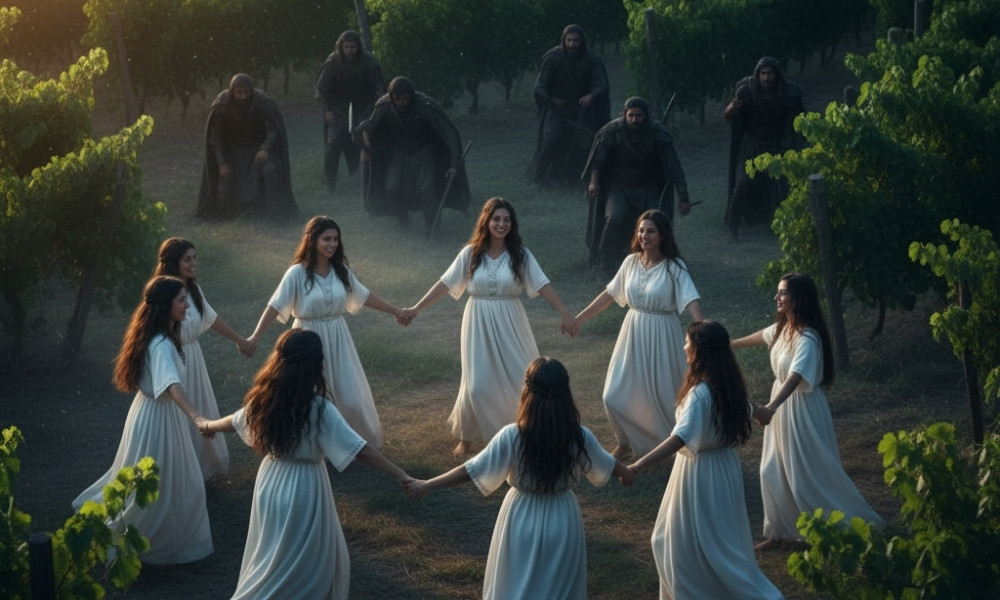
Judges 21 serves as the tragic epilogue to the book, showcasing the total moral disorientation of Israel. Following the near-annihilation of the tribe of Benjamin in the civil war (Chapter 20), the other tribes experience immediate regret, realizing one of the twelve tribes is about to go extinct. However, instead of seeking God’s will, they rely on their own twisted logic to “fix” the problem. Trapped by a rash vow not to give their daughters to Benjamin, they resort to two horrific “loopholes”: the mass slaughter of Jabesh-gilead to secure 400 virgins, and the orchestrated mass kidnapping of dancing girls at a festival in Shiloh to provide for the remaining 200 men. The book concludes with the haunting refrain that defines the era: “In those days there was no king in Israel. Everyone did what was right in his own eyes.”
1. Regret and the Rash Vow (Judges 21:1–7)
1 Now the men of Israel had sworn at Mizpah, “No one of us shall give his daughter in marriage to Benjamin.” 2 And the people came to Bethel and sat there till evening before God, and they lifted up their voices and wept bitterly. 3 And they said, “O Lord, the God of Israel, why has this happened in Israel, that today there should be one tribe lacking in Israel?” 4 And the next day the people rose early and built there an altar and offered burnt offerings and peace offerings. 5 And the people of Israel said, “Which of all the tribes of Israel did not come up in the assembly to the Lord?” For they had taken a great oath concerning him who did not come up to the Lord to Mizpah, saying, “He shall surely be put to death.” 6 And the people of Israel had compassion for Benjamin their brother and said, “One tribe is cut off from Israel this day. 7 What shall we do for wives for those who are left, since we have sworn by the Lord that we will not give them any of our daughters for wives?”
Commentary:
- The Hangover of War: The adrenaline of battle fades, replaced by the horror of reality. Only 600 Benjaminite men remain. If they die without heirs, the tribe ceases to exist.
- The Rash Vow: In their zeal at Mizpah (before the war), Israel swore never to give their daughters to Benjaminites. This mirrors Jephthah’s foolish vow (Judges 11). They are more afraid of breaking a rash oath than they are of committing further atrocities.
- Blaming God: In verse 3, they ask, “Why has this happened?” This is a deflection. It happened because of their civil war and their excessive vengeance. They lack self-awareness.
- Ritual without Righteousness: They build an altar and offer sacrifices (v. 4), but there is no record of God answering. They are going through religious motions while plotting their next violent move.
- The Second Oath: They recall another vow: anyone who didn’t join the war effort must die (v. 5). They use this second vow to solve the problem of the first vow.
2. The Slaughter of Jabesh-gilead (Judges 21:8–14)
8 And they said, “What one is there of the tribes of Israel that did not come up to the Lord to Mizpah?” And behold, no one had come to the camp from Jabesh-gilead, to the assembly. 9 For when the people were mustered, behold, not one of the inhabitants of Jabesh-gilead was there. 10 So the congregation sent 12,000 of their bravest men there and commanded them, “Go and strike the inhabitants of Jabesh-gilead with the edge of the sword; also the women and the little ones. 11 This is what you shall do: every male and every woman that has lain with a male you shall devote to destruction.” 12 And they found among the inhabitants of Jabesh-gilead 400 young virgins who had not known a man by lying with him, and they brought them to the camp at Shiloh, which is in the land of Canaan. 13 Then the whole congregation sent word to the people of Benjamin who were at the rock of Rimmon and proclaimed peace to them. 14 And Benjamin returned at that time. And they gave them the women whom they had saved alive of the women of Jabesh-gilead, but they were not enough for them.
Commentary:
- The Scapegoat: Jabesh-gilead (a city in Manasseh, east of the Jordan) failed to assemble.
- Selective Herem: The Israelites apply the law of “Herem” (devoting to destruction) to their own brethren. They command the slaughter of men, married women, and children.
- The Loophole: They spare only the virgins. The logic is brutal: Since these women are not “daughters” of the men who took the oath at Mizpah (because those men are now dead), giving them to Benjamin technically doesn’t break the vow.
- Treating Women as Cattle: The 400 young women are traumatized survivors of a massacre, orphaned and captured by their own people, then handed over to the survivors of another massacre. The dehumanization is total.
- The Math Problem: There are 600 surviving Benjaminites but only 400 virgins from Jabesh-gilead. They are still 200 wives short.
3. The Kidnapping at Shiloh (Judges 21:15–23)
15 And the people had compassion on Benjamin because the Lord had made a breach in the tribes of Israel. … 19 So they said, “Behold, there is the yearly feast of the Lord at Shiloh, which is north of Bethel, on the east of the highway that goes up from Bethel to Shechem, and south of Lebonah.” 20 And they commanded the people of Benjamin, saying, “Go and lie in ambush in the vineyards 21 and watch. If the daughters of Shiloh come out to dance in the dances, then come out of the vineyards and snatch each man his wife from the daughters of Shiloh, and go to the land of Benjamin. 22 And when their fathers or their brothers come to complain to us, we will say to them, ‘Grant them graciously to us, because we did not take for each man of them his wife in battle, neither did you give them to them, else you would now be guilty.’” 23 And the people of Benjamin did so and took their wives, according to their number, from the dancers whom they carried off. Then they went and returned to their inheritance and rebuilt the towns and lived in them.
Commentary:
- The Feast: This was likely the Feast of Tabernacles, a harvest festival associated with joy and dancing. It took place at Shiloh, where the Tabernacle stood.
- Desecration of Worship: Instead of a time of holy celebration, the leaders turn the feast into a hunting ground.
- State-Sanctioned Kidnapping: The elders actively instruct the Benjaminites to “lie in ambush” and “snatch” (literally: tear away/rob) wives. This is the same word used for a predator seizing prey.
- Casuistry (Moral Gymnastics): Verse 22 shows the twisted legal reasoning:
- The fathers of the girls didn’t give them (so they didn’t break the vow).
- The Benjaminites stole them (so the vow remains intact).
- The elders ask the fathers to “grant them graciously”—essentially asking the victims’ families to accept the crime to save the nation’s conscience.
- Rebuilding on Rot: The tribe of Benjamin is rebuilt, but the foundation is kidnapping, rape, and murder.
4. The Final Verdict (Judges 21:24–25)
24 And the people of Israel departed from there at that time, every man to his tribe and family, and they went out from there every man to his inheritance. 25 In those days there was no king in Israel. Everyone did what was right in his own eyes.
Commentary:
- Order without Peace: The people return to their “inheritance,” suggesting a return to normalcy. The crisis is “solved,” but at a horrific moral cost.
- The Thesis Statement (v. 25): This is the fourth and final time this phrase appears (17:6, 18:1, 19:1), but here it carries the weight of the entire book’s atrocities.
- “No King”: Reflects the rejection of Yahweh as King and the lack of a righteous human monarch to enforce justice.
- “Right in his own eyes”: This is not liberty; it is anarchy. The Israelites did what they felt was right—killing Jabesh-gilead felt “just,” keeping their rash vow felt “pious,” kidnapping dancers felt “necessary.”
- The End: The book ends abruptly. There is no judge to save them. The spiral has reached the bottom. The reader is left desperate for the story of Ruth (redemption) and 1 Samuel (the coming of a King).
Theological Significance
- The Dead End of Relativism: Judges 21 is the ultimate case study against moral relativism. When truth is defined by the individual (“right in his own eyes”) or by the collective need of the moment, the result is cruelty, confusion, and chaos.
- Religion vs. Relationship: The Israelites were incredibly “religious” in this chapter—making vows, building altars, attending feasts at Shiloh, and invoking the Lord’s name. Yet, their actions were entirely pagan. It serves as a warning that religious zeal without obedience to God’s Word leads to destruction.
- The Failure of Self-Salvation: Israel tries to save itself from the mess it created. Every solution they invent (slaughtering Jabesh-gilead, kidnapping at Shiloh) only compounds the sin. Humanity cannot fix its own depravity; it needs a Savior.
- The Victimization of Women: The book ends with women being completely silenced—slaughtered in Jabesh-gilead or distributed as property in Shiloh. This highlights the degradation of a society that turns away from God.
Practical Applications
- Avoid Rash Vows: Do not make promises to God or others in the heat of emotion. Integrity is good, but stubborn adherence to a foolish promise that hurts others is pride, not piety.
- The Danger of “The Ends Justify the Means”: The Israelites wanted a good thing (the survival of Benjamin), but they used evil methods to achieve it. God cares about the process as much as the result.
- Critique Your Culture: The Israelites were blind to their own wickedness because “everyone” was doing it. We must constantly measure our societal norms against Scripture, not against majority opinion.
- The Need for True Leadership: In our families, churches, and communities, the absence of godly conviction leads to chaos. We must pray for and strive to be leaders who do what is right in God’s eyes, not our own.
Final Insight
The Book of Judges begins with conquest and ends with compromise. It begins with a funeral (Joshua) and ends with a kidnapping. It demonstrates that time does not necessarily bring progress; without God, history is a spiral into darkness. The silence at the end of Chapter 21 is a scream for the Messiah.







Leave a Reply