
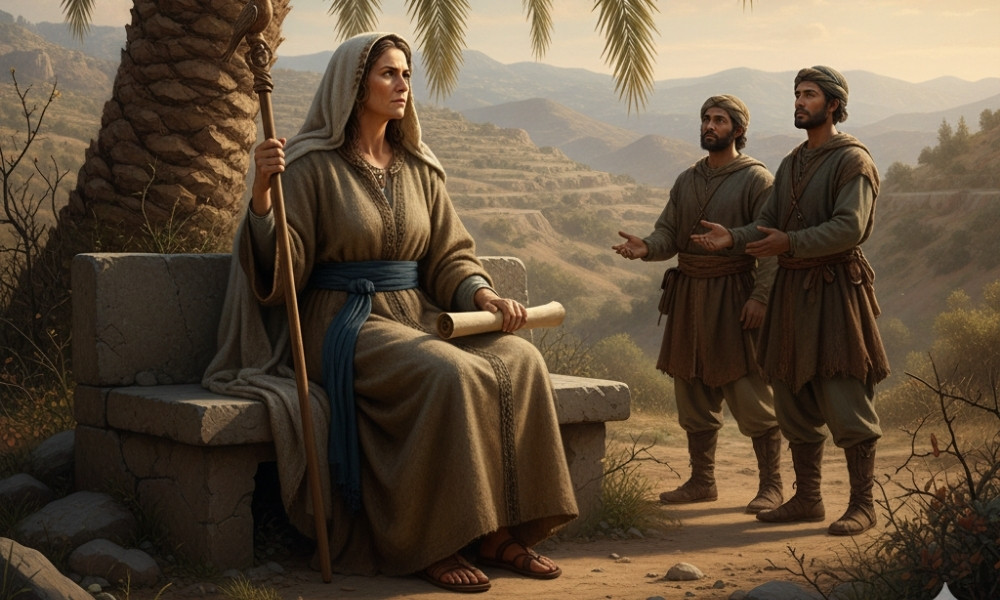
Deborah is a towering figure in the Old Testament, distinguished as the only female Judge of Israel and one of the few women explicitly identified as a prophetess. Unlike other judges who were primarily military chieftains, Deborah exercised judicial, spiritual, and civil authority before the war began, holding court and settling disputes for the nation. She described herself as a “Mother in Israel,” a title that reflects her nurturing yet fierce protection of her people. Her leadership ignited a revolution against Canaanite oppression, proving that spiritual authority transcends gender.
- Name: Deborah (Hebrew: Devorah)
- Meaning: “Bee”
- Role: Prophetess, Judge, Poet, Deliverer
- Tribe: Likely Ephraim (lived in the hill country of Ephraim)
- Husband: Lappidoth
- Era: Period of the Judges (~1150 BCE)
- Home: Under the “Palm of Deborah” between Ramah and Bethel
- Key Scripture: Judges 4–5
- Adversaries: Jabin (King of Hazor), Sisera (General)
- Key Virtues: Wisdom, courage, spiritual authority, decisiveness
- Symbol: The Palm Tree (representing justice and righteousness)
Name Meaning
“Bee”: The name Devorah means “Bee.” In biblical symbolism, this suggests an industrious and organized nature. Like a bee, she produced “honey” (wisdom and judgment) for her people but possessed a painful “sting” for the enemies of God.
Lineage / Family Background
Wife of Lappidoth: She is introduced as the wife of Lappidoth. The name Lappidoth means “Torches” or “Lightning flashes.”
Spiritual Lineage: She stands in the tradition of Miriam and Huldah as a woman gifted with direct revelation from Yahweh.
The “Palm of Deborah”: Unlike other judges who traveled or led from military encampments, Deborah had a fixed seat of judgment—a palm tree known by her name—indicating a recognized and stable institution of leadership.
Biblical Era / Context
The Canaanite Stranglehold: Israel had fallen into idolatry, and God allowed Jabin, a Canaanite king, to oppress them for 20 years. The Canaanites controlled the plains with 900 iron chariots, cutting off trade routes and forcing Israelites into the hills.
A Time of Fear: The Song of Deborah (Judges 5) notes that “village life ceased” and travelers took “byways” to avoid the main roads due to the danger.
Major Roles / Identity
The Judge: She is the only character in the Book of Judges depicted actually performing judicial duties (settling legal disputes) before becoming a military leader.
The Prophetess: She spoke with the authority of God (“Thus says the Lord”), giving her a status higher than a mere tribal chieftain.
The Strategist: While Barak commanded the troops, Deborah devised the timing and strategy of the campaign, instructing him when to deploy.
The Poet: She is the co-author/singer of one of the oldest pieces of Hebrew poetry, preserving the history of the battle in song.
Key Character Traits
Commanding Presence: She summoned Barak (a military general) to her, rather than going to him, displaying her superior authority.
Fearlessness: When Barak hesitated to go to battle without her, she agreed immediately to march into the war zone, despite the danger.
Insight: She understood the spiritual climate of Israel, recognizing that the people needed a leader to “arise” to break their paralysis.
Prophetic Accuracy: She correctly predicted that the glory of killing Sisera would go to a woman (Jael), not to the male general.
Main Life Events
Judging Israel: Israelites came to her palm tree in the hill country of Ephraim for judgment, seeking her wisdom in disputes.
The Call to War: Received a word from the Lord to command Barak to gather 10,000 men from the tribes of Naphtali and Zebulun.
The Prophecy to Barak: When Barak negotiated for her presence, she prophesied the outcome: “The Lord will sell Sisera into the hand of a woman.”
The Victory at Tabor: She accompanied the army to Kedesh and Mount Tabor. At the critical moment, she gave the signal to attack: “Up! For this is the day in which the Lord has given Sisera into your hand.”
The Song of Victory: Following the defeat of the Canaanites, she composed and sang a victory hymn celebrating God’s power and the tribes that participated.
Major Relationships
Barak: Her military counterpart. Their relationship was not one of rivalry but of necessary cooperation—Prophet and General working in tandem.
Jael: Though they likely never met on page, Jael is the “other woman” in the narrative who fulfills Deborah’s prophecy by executing Sisera.
The People of Israel: She viewed her relationship to the nation as maternal (“A mother in Israel”), indicating a deep emotional and spiritual bond with the tribes.
Notable Passages
Judges 4:4: “Now Deborah, a prophetess, the wife of Lappidoth, was judging Israel at that time.”
Judges 4:9: Her response to Barak: “I will surely go with you; nevertheless, the road on which you are going will not lead to your glory, for the Lord will sell Sisera into the hand of a woman.”
Judges 5:7: “Villagers in Israel would not fight; they held back until I, Deborah, arose, until I arose, a mother in Israel.”
Judges 5:31: The conclusion of her song: “So may all your enemies perish, O Lord! But may your friends be like the sun when he rises in his strength.”
Legacy & Impact
Biblical Womanhood: Deborah shatters the notion that women in the Bible were only domestic figures. She exercised the highest authority in the land—political, judicial, and spiritual—with God’s blessing.
Peace: Her leadership led to 40 years of rest for the land, a significant period of stability in the turbulent era of the Judges.
Model of Revival: She demonstrates that revival often begins with a single person willing to “arise” when others are afraid.
Symbolism / Typology
The Bee and Honey: Represents the sweetness of the Word of God (Psalm 119:103) which she dispensed, but also the defense of the hive (Israel).
The Palm Tree: In Scripture, the palm tree represents uprightness (Psalm 92:12). Sitting under it symbolized her unbending commitment to God’s law.
Type of the Church: As a “Bride” (woman) judging the nations and warring against the enemies of God, she typifies the Church militant.
Extra-Biblical References
Jewish Midrash: Some traditions suggest she was wealthy (owning the palm trees) and that she made wicks for the sanctuary lamps, connecting her husband’s name (Lappidoth = torches) to her service to God.
Josephus: The historian Flavius Josephus mentions her as a ruler and administrator but downplays her prophetic role, reflecting the biases of his time.







Leave a Reply