
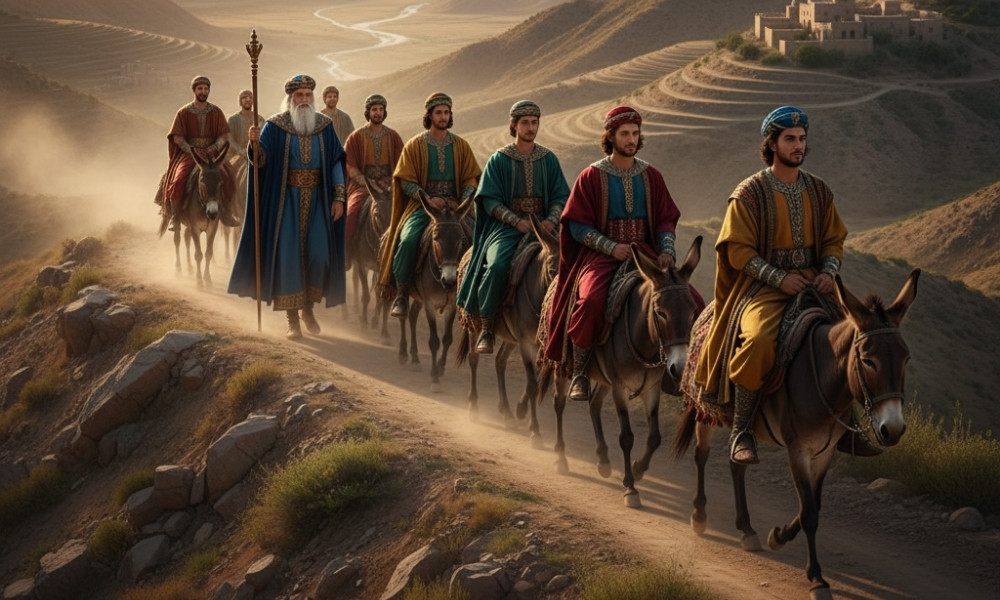
Jair is the second of the “Minor Judges” listed in this section of the book, succeeding Tola. While Tola brought stability to the heartland of Israel, Jair represents the wealth, expansion, and prestige of the Transjordan tribes (those living east of the Jordan River). His judgeship is remembered not for military exploits, but for a striking image of prosperity and dynastic influence: thirty sons, riding thirty donkeys, governing thirty towns. His era marks a time when the leadership of Israel began to resemble a localized aristocracy.
- Name: Jair (Hebrew: Yair)
- Meaning: “He Shines” or “He Enlightens”
- Role: Judge, Chieftain
- Region: Gilead (East of the Jordan, Tribe of Manasseh)
- Term: 22 Years
- Family: 30 Sons
- Symbols of Status: 30 Donkeys, 30 Towns (Havvoth-Jair)
- Predecessor: Tola
- Successor: Jephthah (after a crisis)
- Scripture: Judges 10:3–5
- Burial Place: Kamon
Name Meaning
“He Shines”: The name Yair means “He shines” or “He enlightens.” It suggests a figure of prominence and visibility, fitting for a man whose family exerted such visible control over the region of Gilead.
Lineage / Family Background
The Gileadite: Jair was from Gilead, the rugged plateau east of the Jordan River inhabited by the tribes of Reuben, Gad, and half of Manasseh. His rise shifts the center of gravity in the narrative from the west (Issachar/Ephraim) to the east, setting the stage for the Jephthah narrative.
The Dynasty: The mention of his “thirty sons” indicates a massive household and likely polygamy, which was a sign of great wealth and political power in the ancient Near East.
Biblical Era / Context
The Calm Before the Storm: Jair’s 22-year reign, combined with Tola’s 23 years, afforded Israel nearly half a century of peace. However, the text implies that during this time of prosperity, the spiritual rot was deepening, as immediately following Jair’s death, Israel plunged into its most severe phase of idolatry (Judges 10:6).
Havvoth-Jair: The thirty towns his sons governed were called Havvoth-Jair (“The Tent Villages of Jair”). This name hearkens back to an ancestor, also named Jair (a contemporary of Moses), who conquered this region (Numbers 32:41). The Judge Jair likely re-established or solidified control over these settlements.
Major Roles / Identity
The Aristocrat: Unlike the warrior-judges (Gideon, Jephthah), Jair appears as an administrator and a patriarch. He secured his legacy by placing his sons in positions of local authority.
The Decentralized Leader: By assigning a town to each son, Jair created a network of governance that maintained order across the sprawling and often lawless region of Gilead.
Key Character Traits
Wealth: In the Iron Age, the donkey was the mount of nobility and royalty (horses were for war). For a man to have thirty sons, each with his own royal mount, signifies immense wealth—equivalent to a modern leader giving each of his thirty children a luxury car.
Influence: He successfully maintained a mini-kingdom within the tribal confederacy for over two decades.
Main Life Events
Inauguration: Rose to judge Israel after Tola.
Expansion: Consolidated control over the region of Gilead through his family.
Governance: Ruled for 22 years, maintaining the status quo of prosperity.
Death: Died and was buried in Kamon (a site likely in modern-day Jordan).
Notable Passages
Judges 10:3–4: “After him arose Jair the Gileadite, who judged Israel twenty-two years. And he had thirty sons who rode on thirty donkeys, and they had thirty cities. They are called Havvoth-jair to this day, which are in the land of Gilead.”
Legacy & Impact
The Illusion of Security: Jair’s legacy is one of worldly success. However, his story serves as a subtle critique. While he secured towns for his sons, he seemingly failed to secure the spiritual heart of the nation. When he died, there was no spiritual vacuum—it was instantly filled by the gods of Syria, Sidon, Moab, and Philistia.
Setting the Stage for Jephthah: The prominence of the Gileadite leadership under Jair makes the subsequent rejection of Jephthah (another Gileadite, but illegitimate) even more poignant. The Gileadites were used to “noble sons,” making them despise the son of a prostitute.
Symbolism / Typology
The Donkey: Symbolizes peace and nobility. Jesus entering Jerusalem on a donkey (Zechariah 9:9) taps into this ancient tradition of kings riding donkeys when coming in peace, rather than warhorses.
The Number 30: Representative of a full generation or administrative completeness.
Extra-Biblical References
Historical Geography: The region of Havvoth-Jair is mentioned in various ancient texts as a distinct district in Bashan/Gilead. It remained a recognized geographic entity long after the Judge’s death.







Leave a Reply