
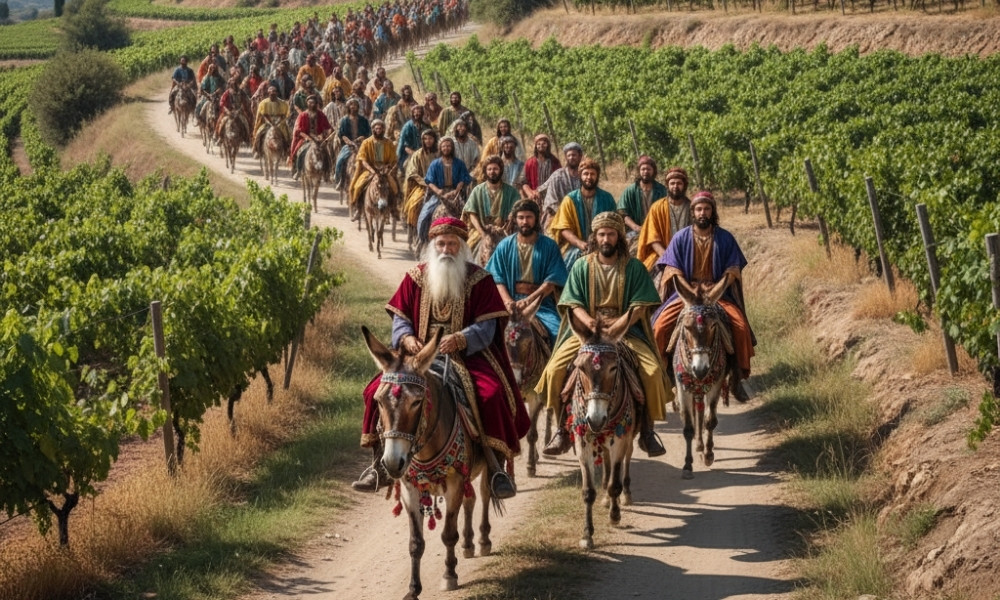
Abdon is the last of the “Minor Judges” and the final leader mentioned before the chaotic and heroic cycle of Samson begins. His judgeship represents the pinnacle of aristocratic wealth and established dynastic order in the era of the Judges. Like Jair before him, Abdon’s legacy is defined not by the sword, but by the sheer size of his family and their display of status. His rule marks the restoration of the tribe of Ephraim’s dignity after their humiliation in the civil war against Jephthah.
- Name: Abdon (Hebrew: Avdon)
- Meaning: “Servile” or “Service”
- Role: Judge, Aristocrat
- Tribe: Ephraim
- Father: Hillel the Pirathonite
- Home: Pirathon (in the hill country of Ephraim)
- Term: 8 Years
- Family: 40 Sons and 30 Grandsons
- Symbols of Status: 70 Donkeys
- Predecessor: Elon
- Successor: Samson
- Scripture: Judges 12:13–15
- Legacy: A wealthy dynasty and the restoration of Ephraimite pride
Name Meaning
“Service”: The name Avdon is derived from the root Ebed, meaning “servant” or “slave.” Irony: There is a distinct irony in his name. While his name implies servitude, his life displays the ultimate luxury and lordship. He did not serve in the fields; he was served by a massive, wealthy household.
Lineage / Family Background
The Pirathonite: He hailed from Pirathon in the land of Ephraim. Restoring Ephraim: His location is politically significant. In the previous generation (under Jephthah), the men of Ephraim were slaughtered (42,000 dead) for their arrogance. Abdon’s rise suggests that Ephraim had recovered sufficiently to once again provide a Judge for the nation, reclaiming their status as a premier tribe.
Biblical Era / Context
The Peak of Prosperity: Abdon’s rule represents the height of the social hierarchy in the Judges period. The ability to mount two generations of offspring on royal beasts suggests a time of established wealth, distinct from the desperate guerilla warfare of Gideon or Jephthah. The Shadow of Amalek: He was buried in Pirathon “in the hill country of the Amalekites.” This curious geographical note suggests that either a remnant of the Amalekites lived there, or the region was historically associated with them, hinting at the constant presence of foreign elements within Israel’s borders.
Major Roles / Identity
The Dynastic Patriarch: Abdon is unique because the text mentions his grandsons. This implies he lived long enough to see a third generation of leadership secure. The Civil Magistrate: Like the other minor judges, he appears to have been a ruler of internal affairs rather than a military general.
Key Character Traits
Opulence: In a time when most Israelites walked, owning 70 donkeys (the Mercedes-Benz of the Bronze Age) was a staggering display of resources. Stability: The mention of sons and grandsons riding together implies a secure succession plan and a lack of internal family feud.
Main Life Events
Succession: Succeeded Elon the Zebulunite. Family Expansion: He fathered 40 sons, who gave him 30 grandsons. The Procession: He provided donkeys for all 70 male descendants, creating a visible ruling class. Governance: He judged Israel for eight years. Death: Died and was buried in the hill country of Ephraim.
Notable Passages
Judges 12:14: “He had forty sons and thirty grandsons, who rode on seventy donkeys, and he judged Israel eight years.”
Legacy & Impact
The Calm Before the Storm: Abdon is the quiet end to a sequence of judges (Jephthah, Ibzan, Elon, Abdon). Immediately following his death, the text pivots to “And the people of Israel again did what was evil…” (Judges 13:1), introducing the 40-year Philistine oppression and the birth of Samson. Abdon represents the last moment of “normalcy” before the Philistine crisis.
The Number 70: The total number of his mounted descendants (40+30) is 70. This number echoes the 70 nations of the world (Genesis 10) and the 70 elders of Moses (Numbers 11), symbolizing a “perfect” or “complete” government.
Symbolism / Typology
Generational Blessing: Psalm 128:6 says, “May you see your children’s children! Peace be upon Israel!” Abdon literally embodied this blessing, seeing his grandsons ride in prosperity. The Donkey: Again, symbolizing peaceful rule. The contrast is sharp with the next judge, Samson, who never rides an animal but tears a lion apart with his bare hands.
Extra-Biblical References
Josephus: The historian notes that Abdon’s reign was peaceful and that “he had no occasion to perform glorious actions” in war, but was celebrated for his children and the splendor of his household.







Leave a Reply