
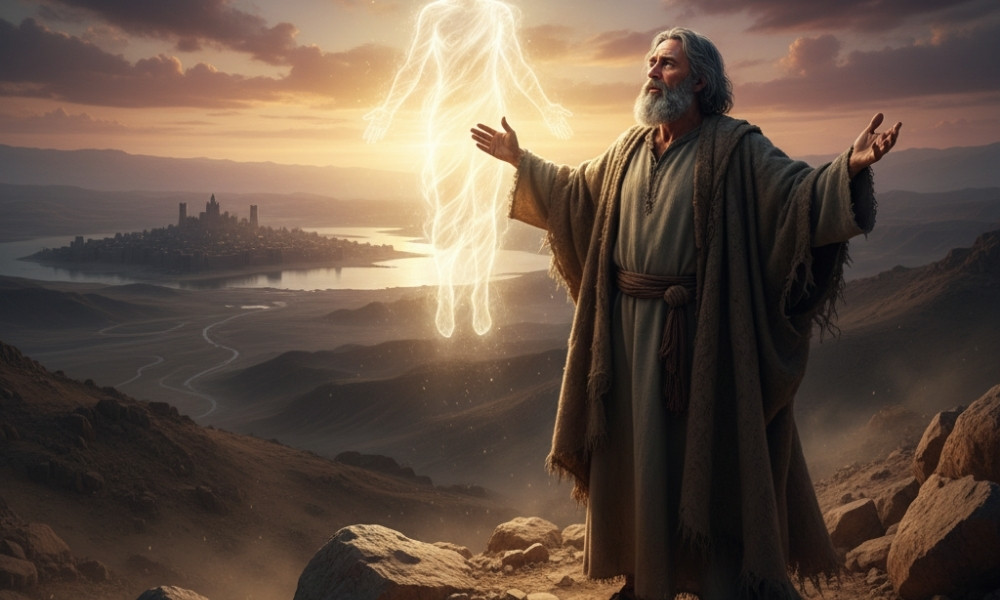
Abraham’s intercession for Sodom stands as one of the most profound dialogues between humanity and Divinity in Scripture. While Abraham is often celebrated as the “Father of Faith,” this specific event in Genesis 18 reveals him as the “Friend of God”—a man so intimate with the Creator that he could stand before Him and plead for the lives of others. It is the first great recorded prayer of intercession in the Bible, showcasing Abraham’s deep sense of justice, his compassion for the wicked, and his desperate love for his nephew, Lot. Here, Abraham is not just a patriarch; he is a mediator, testing the boundaries of God’s mercy.
- Name: Abraham (Hebrew: Avraham, meaning “Father of a Multitude”)
- Location: The Oaks of Mamre (near Hebron), overlooking the Jordan Valley
- Scripture: Genesis 18:16–33
- Opposing Parties: The Justice of God vs. The Mercy of God
- Beneficiary: Lot and his family (residents of Sodom)
- Key Virtues: Boldness, humility, persistence, compassion
- Outcome: God agreed to spare the city if ten righteous people were found; Lot was rescued
- Symbol: Hands raised in intercession or the scales of justice
Name Meaning
Abraham means “Father of a Multitude.” In the context of his prayer for Sodom, this name takes on a spiritual weight; he acts as a father figure not just to his biological line, but to the nations, pleading for their survival. He embodies the responsibility of a patriarch to protect and advocate for the vulnerable.
Lineage / Family Background
Origin: Son of Terah, originally from Ur of the Chaldeans.
Relationship to Sodom: His nephew, Lot, whom Abraham had raised like a son after the death of Lot’s father (Haran), was living in Sodom.
Divine Relationship: Identified in Scripture (Isaiah 41:8, James 2:23) as the “Friend of God.” This specific title is validated by the Sodom narrative, where God asks, “Shall I hide from Abraham what I am about to do?”
Biblical Era / Context
Time: Middle Bronze Age (Patriarchal Period).
Setting: The dialogue occurs immediately after the promise of Isaac’s birth. The three visitors (the Lord and two angels) rise to leave Mamre and look down toward Sodom.
Theological Context: This moment defines the standard for Divine Justice. It establishes that God does not destroy arbitrarily but acts based on careful investigation and moral necessity.
Major Roles / Identity
The Friend of God: The only human in the Old Testament invited into the divine council to discuss God’s plans before they happen.
The First Intercessor: Abraham sets the precedent for Moses, Samuel, and ultimately Jesus, standing between the wrath of God and sinful humanity.
Guardian of Justice: He challenges God to act according to His own nature, ensuring that the righteous are not swept away with the wicked.
Key Character Traits
Boldness: He dared to question God’s plan, asking, “Will you sweep away the righteous with the wicked?”
Humility: While bold, he remained reverent, referring to himself as “dust and ashes” (Genesis 18:27).
Persistence: He did not stop asking after the first agreement; he negotiated six separate times (from 50 down to 10).
Compassion: He prayed not only for his nephew Lot but for the entire city, hoping to save the wicked for the sake of the righteous.
Main Life Events (The Intercession Narrative)
The Revelation: God decides to reveal the outcry against Sodom to Abraham because Abraham has been chosen to teach his household righteousness and justice (Genesis 18:17–19).
The Approach: The two angels turn toward Sodom, but Abraham “remained standing before the Lord.” This physical stance symbolizes his spiritual readiness to intercede.
The Challenge: Abraham asks the theological question that underpins the passage: “Shall not the Judge of all the earth do what is just?”
The Countdown: Abraham negotiates the terms of judgment:
- Will you spare it for 50 righteous? (God says Yes)
- For 45? (Yes)
- For 40? (Yes)
- For 30? (Yes)
- For 20? (Yes)
- For 10? (Yes)
The Departure: The Lord departs, and Abraham returns to his place, having secured a promise that even a “minyan” (a small remnant) of righteousness could save a city.
Major Relationships
Yahweh: The dialogue is conversational, respectful, yet intense. It shows a relationship where God values human input.
Lot: Though Lot is not present, he is the silent motivation behind Abraham’s plea. Abraham’s love for Lot drives him to risk God’s displeasure.
The Righteous Remnant: Abraham establishes a relationship between the righteous few and the wicked many—that the presence of the godly serves as a preservative for the ungodly.
Notable Passages
Genesis 18:23: “Then Abraham drew near and said, ‘Will you indeed sweep away the righteous with the wicked?’”
Genesis 18:25: “Far be it from you to do such a thing, to put the righteous to death with the wicked, so that the righteous fare as the wicked! Far be that from you! Shall not the Judge of all the earth do what is just?”
Genesis 18:32: “Oh let not the Lord be angry, and I will speak again but this once. Suppose ten are found there?” He answered, “For the sake of ten I will not destroy it.”
Legacy & Impact
Theology of Intercession: This event teaches that prayer can influence God’s actions. It establishes the principle that God delights in mercy.
Jewish Tradition: The number ten (the final number Abraham reached) is significant in Judaism. It is the basis for the Minyan, the quorum of ten Jewish adults required for certain religious obligations and public prayer.
God’s Mercy: The story proves that God is willing to spare the many for the sake of the few. Though Sodom was eventually destroyed because not even ten were found, God honored the spirit of Abraham’s prayer by physically removing Lot and his daughters before the fire fell.
Symbolism / Typology
Abraham as a Type of Christ: Just as Abraham stood before God to plead for Sodom, Jesus stands at the right hand of the Father making intercession for believers (Hebrews 7:25).
The “Ten” vs. The “One”: Abraham stopped at ten righteous people. The Gospel reveals that eventually, not even ten could be found to save the world; it required the One truly righteous man, Jesus Christ, to save humanity.
Salt of the Earth: The story illustrates Jesus’ teaching that his followers are the “salt of the earth”—a preserving influence that prevents total decay and judgment.
Extra-Biblical References
Jewish Midrash: Tradition suggests Abraham stopped at ten because there were eight people in Noah’s family who were saved; Abraham reasoned that fewer than ten had not been enough to stop the Flood, but perhaps ten (the size of a large family) would suffice.
Islamic Tradition: In the Quran, Ibrahim (Abraham) also pleads for the people of Lut (Lot), demonstrating his merciful heart (Hud 11:74–76).







Leave a Reply