
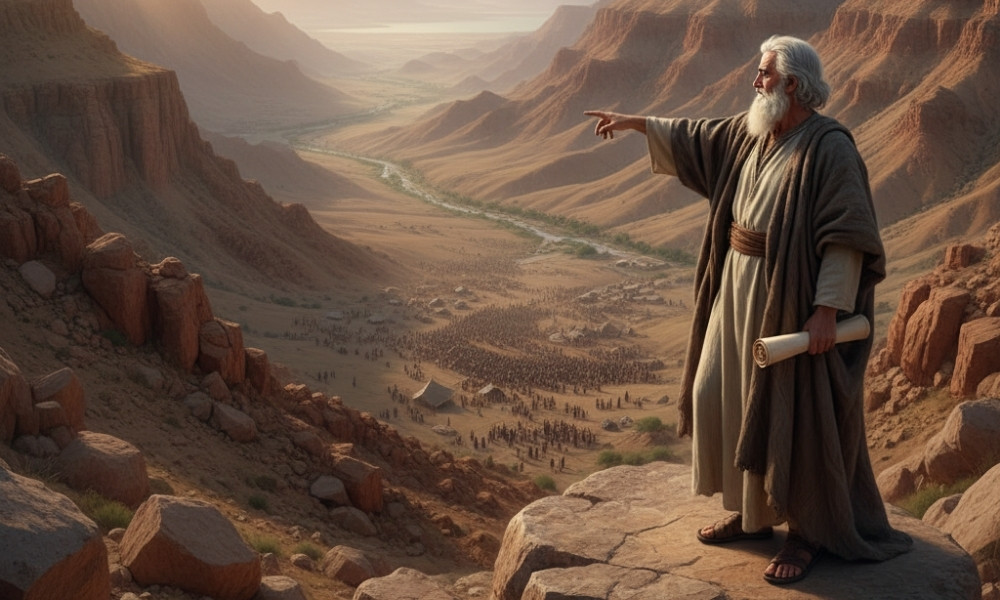
The Second Song of Moses, found in Deuteronomy 32, is the final public address of Moses before his death. Unlike the jubilant “Song of the Sea” (Exodus 15) which celebrated a past victory, this song is a somber, prophetic “Covenant Lawsuit” (Riv) concerning the future. God commanded Moses to teach this song to the Israelites as a “witness” against them. Its purpose was pedagogical and legal: God knew that Israel would eventually rebel and break the covenant, and this song was designed to survive through the generations as a testimony of God’s justice and Israel’s failure. It contrasts the stability of God (The Rock) with the fickleness of the people, serving as both a warning of judgment and a promise of ultimate restoration.
- Title: The Song of Moses (Ha’azinu – “Give Ear”)
- Scripture: Deuteronomy 32:1–43
- Speaker: Moses (at age 120)
- Setting: The Plains of Moab, just before entering the Promised Land
- Genre: Prophetic Lawsuit / Wisdom Literature
- Key Metaphor: “The Rock” (used 5 times to describe God)
- Purpose: To serve as a witness against Israel when they inevitably rebel
- Theme: Divine Faithfulness vs. Human Apostasy
Structure of the Song
The poem follows a chiastic (mirror-like) structure common in ancient Near Eastern treaty documents. It outlines the history of the relationship between Yahweh and Israel.
1. The Summons (vv. 1–4): Moses calls heaven and earth to act as a jury / witnesses to the lawsuit. He introduces God as “The Rock”—perfect and just.
2. The Indictment (vv. 5–18): Moses details God’s fatherly care for Israel in the wilderness, finding them in a “howling waste” and guarding them as the “apple of his eye.” This is contrasted with Israel’s response: they “grew fat and kicked” (rebelled), sacrificing to demons and forgetting the God who birthed them.
3. The Verdict / Judgment (vv. 19–25): Because of their idolatry, God promises to hide His face. He threatens to incite them to jealousy by using a “no-people” (Gentiles) to punish them.
4. The Mitigation (vv. 26–38): God refrains from total annihilation not because Israel deserves mercy, but to protect His own reputation so their enemies do not claim victory over Yahweh.
5. The Restoration (vv. 39–43): God asserts His absolute sovereignty (“I kill and I make alive”). He promises ultimately to take vengeance on His enemies and “cleanse his land” for His people.
Key Theological Themes
The Rock (Tzur): This is the central image of the song. In a shifting, desert landscape, a massive rock represents shade, defense, and immutability. While Israel is unstable and unfaithful, Yahweh remains The Rock—His nature does not change.
Jeshurun: In verse 15, Moses refers to Israel as “Jeshurun” (meaning “The Upright One”). This is used ironically. The “Upright One” grew fat and abandoned God. It highlights the gap between who they were called to be and who they became.
The Jealousy of God: The song introduces the dynamic of divine jealousy. Because Israel made God jealous with “what is no god” (idols), God will make Israel jealous with “those who are no people” (foreign nations). Paul cites this in Romans 10:19 to explain the inclusion of Gentiles in the New Covenant.
Monotheism: Verse 39 contains one of the strongest declarations of monotheism in the Torah: “See now that I, even I, am he, and there is no god beside me.”
Major Roles / Identity
Moses: The Dying Prophet. He is handing over the torch. He knows he will not cross the Jordan, and he knows the people will eventually fail. This song is his final effort to implant truth into their hearts.
Joshua: Identified in verse 44 (as Hoshea) alongside Moses. This indicates the transition of power; Joshua stood with Moses as this song was taught, showing his endorsement of the message.
The “No-People”: The foreign nations God uses as a tool of discipline.
Notable Passages
Deuteronomy 32:4: “The Rock, his work is perfect, for all his ways are justice. A God of faithfulness and without iniquity, just and upright is he.”
Deuteronomy 32:10: “He found him in a desert land, and in the howling waste of the wilderness; he encircled him, he cared for him, he kept him as the apple of his eye.”
Deuteronomy 32:35: “Vengeance is mine, and recompense, for the time when their foot shall slip.” (Quoted in Hebrews 10:30 and Romans 12:19).
Deuteronomy 32:39: “See now that I, even I, am he, and there is no god beside me; I kill and I make alive; I wound and I heal; and there is none that can deliver out of my hand.”
Legacy & Impact
The Liturgy of Warning: While the Exodus 15 song was sung during the Sabbath sacrifice, this song was often sung during the Sabbath of Ha’azinu (the reading of this portion), serving as a yearly reminder of the terms of the Covenant.
New Testament Usage:
- Romans 10: Paul uses the “foolish nation” prophecy to explain why the Gospel went to the Gentiles—to provoke Israel to jealousy.
- Revelation: The language of God avenging the blood of His servants (v. 43) appears in the adoration of the martyrs in Revelation 19:2.
The Psychology of Memory: God chose a song rather than a law code for this warning because, as Deuteronomy 31:21 states, “it will not be forgotten in the mouths of their offspring.” Melodies stick when laws are forgotten.







Leave a Reply