
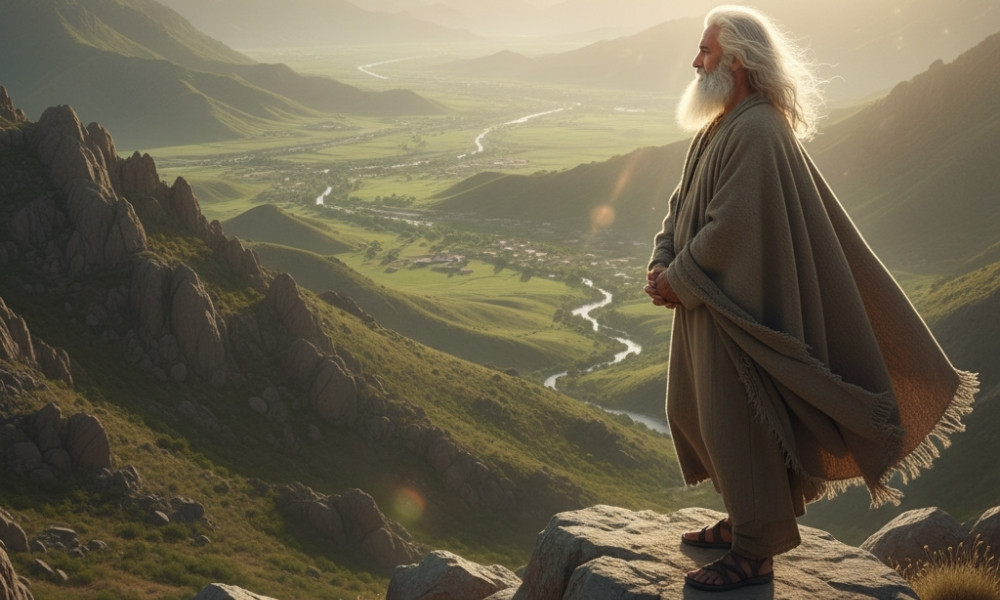
The death of Moses on Mount Nebo is one of the most poignant and majestic scenes in all of Scripture. After 120 years of life—40 as a prince in Egypt, 40 as a shepherd in Midian, and 40 as the leader of the Exodus—Moses’ journey concludes not in a palace or a battle, but in solitude with God. This moment represents the ultimate intersection of divine justice and divine intimacy. While he is barred from entering the land due to his error at Meribah, God honors him with a supernatural vision of the future and performs the funeral rites Himself. It is the quiet end of the era of the Law and the beginning of the era of Conquest.
- Event: The Death and Burial of Moses
- Scripture: Deuteronomy 34
- Location: Mount Nebo (Pisgah), overlooking Jericho
- Age: 120 Years
- Physical State: “His eye was not dim, nor his natural force abated”
- Buried By: Yahweh
- Successor: Joshua (Nun)
- Epitaph: “There has not arisen a prophet since in Israel like Moses, whom the LORD knew face to face.”
The Final Ascent
The Climb: Leaving the Plains of Moab, Moses climbs Mount Nebo to the peak of Pisgah. This was not a feeble old man crawling to his death; the text explicitly states his physical vigor was undiminished. He climbed to meet God one last time.
The Panoromic Vision:
God showed him the land in a sweeping panorama that likely exceeded natural human sight. The text lists the specific territories:
- From Gilead as far as Dan (North)
- Naphtali, Ephraim, and Manasseh (Central)
- Judah as far as the Western Sea/Mediterranean (West)
- The Negeb and the Valley of Jericho (South)
The Declaration: God reiterates the Covenant: “This is the land of which I swore to Abraham, to Isaac, and to Jacob… I have let you see it with your eyes, but you shall not go over there.” (Deuteronomy 34:4).
The Mystery of the Burial
The Divine Funeral: Verse 6 contains a detail unique in human history: “And [God] buried him in the valley in the land of Moab… but no one knows the place of his burial to this day.” Moses is the only person in the Bible buried by God. This signifies the intimacy of their relationship—God was his friend to the very end.
The Reason for Secrecy: Theologians agree that the grave was hidden to prevent it from becoming a shrine. Given Israel’s tendency toward idolatry (e.g., the Bronze Serpent), they likely would have worshipped Moses’ bones.
Spiritual Warfare (Jude 9): The New Testament book of Jude adds a fascinating layer to this event. It mentions a dispute between Michael the Archangel and the Devil over the body of Moses. This suggests that Satan perhaps wanted to claim the body (either to accuse Moses of his sin at Meribah or to set it up as an idol), but God protected His servant’s remains.
Theological Significance
The Law vs. The Promise: Moses represents the Law. He brought the people to the border, but he could not take them in.
- The Law reveals sin and guides us to the promise, but it cannot save us.
- Joshua (Hebrew Yeshua, the same name as Jesus) is the one who leads the people into the inheritance.
- Typologically, Moses had to die so that Joshua (Jesus) could lead the way.
Death as Satisfaction: Moses did not die of old age; he died by the “mouth of the Lord” (according to Jewish tradition, by a divine kiss). His death was an act of obedience, accepting God’s timing.
The Transfiguration: The Promise Fulfilled
It is crucial to note that Moses did eventually stand in the Promised Land. In Matthew 17, on the Mount of Transfiguration (likely Mt. Tabor or Hermon, inside Israel), Moses appears alongside Elijah to talk with Jesus.
- Significance: God’s ban was temporary (earthly). In the plan of redemption, Moses was eventually allowed to stand on the soil of Israel, witnessing the fulfillment of all he had written about in the person of Christ.
Major Roles / Legacy
The Prophet Par Excellence: Deuteronomy 34:10 closes the Pentateuch with the judgment that no prophet ever equaled Moses in signs, wonders, and face-to-face intimacy with Yahweh.
The Transfer of Wisdom: Before ascending the mountain, Moses laid his hands on Joshua. The “spirit of wisdom” passed to the new leader, ensuring the continuity of the mission.







Leave a Reply