
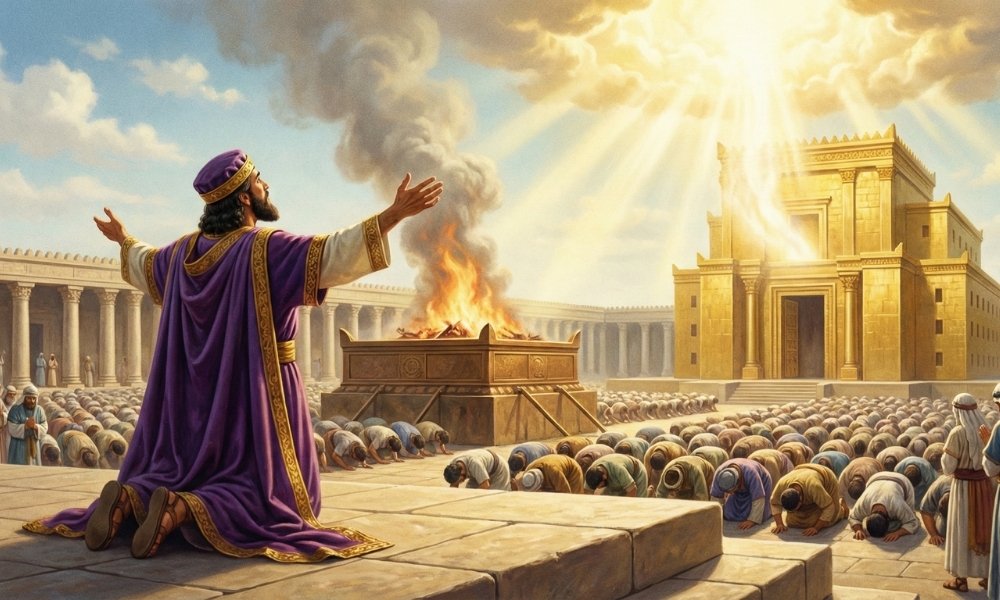
The Kings (Hebrew: Melachim) were the monarchical rulers of Israel and Judah, a system of government that replaced the loose confederation of the Judges. Initiated by the people’s demand to be “like all the nations,” the monarchy was a concession by God that eventually became the vessel for His eternal covenant with David. The era of the Kings is a dramatic saga of high peaks—the glory of Solomon’s Temple—and devastating valleys—the idolatry that led to exile. While most kings failed to live up to the divine standard, the office itself established the framework for the Messiah, the ultimate “Son of David” who would rule forever.
Quick Facts
- Hebrew Title: Melech (Plural: Melachim)
- First King: Saul (Tribe of Benjamin)
- Key Covenant: The Davidic Covenant (2 Samuel 7)
- Eras:
- Total Number: 42 (including Queen Athaliah)
- Key Duties: Military defense, enforcing justice, maintaining the cult (worship)
- The Standard: King David (the yardstick by which all others were measured)
- The Failure: Idolatry and reliance on foreign alliances
- End of Era: The Fall of Jerusalem to Babylon (586 BCE)
Definition & Title Meaning
Meaning: The Hebrew word Melech simply means “king” or “ruler.” However, in Israelite theology, the human king was not divine (unlike Pharaoh in Egypt). He was the Nagid (Prince/Leader) under the true King, Yahweh.
Theocratic Monarchy: The king was intended to be a vice-regent. He was subject to the Law of Moses (Torah) and was commanded to write his own copy of the law and read it daily (Deuteronomy 17:18–20) to prevent his heart from being lifted above his brothers.
Lineage / Family Background
The United Monarchy: Began with Saul (Benjamin), shifted to David (Judah), and passed to Solomon (Judah).
The Southern Kingdom (Judah): Remained loyal to the House of David. Despite wicked kings, God preserved this line for nearly 400 years to keep His promise that David would always have a “lamp” in Jerusalem.
The Northern Kingdom (Israel): Volatile and unstable. It experienced nine different dynastic changes (families wiping each other out) and did not have a single king described as “good” in Scripture.
Biblical Era / Context
Rise: The transition from tribal chaos (Judges) to a centralized state occurred under Samuel, Saul, and David. Jerusalem was conquered and established as the political and religious capital.
Golden Age: Under Solomon, Israel reached its zenith in territory, wealth, and international prestige, marked by the construction of the First Temple.
Schism: Due to Solomon’s idolatry and Rehoboam’s harsh taxation, the kingdom split in 930 BCE. Ten tribes formed the North (Israel), and two tribes remained in the South (Judah).
Decline and Fall:
- North: Destroyed by Assyria in 722 BCE due to systemic idolatry (sins of Jeroboam).
- South: Destroyed by Babylon in 586 BCE due to Manasseh’s bloodshed and general apostasy.
Major Roles / Identity
The Shepherd: The king was called to “shepherd” God’s people (2 Samuel 5:2)—providing protection, care, and guidance, rather than exploiting the flock.
The Warrior: He was expected to lead the army in battle to defend the land God gave them (1 Samuel 8:20).
The Supreme Judge: As seen in Solomon’s famous ruling (the two mothers), the king was the final court of appeal for justice in the land.
The Patron of Worship: The king was responsible for building/maintaining the Temple and ensuring the priests were supported. When kings (like Ahaz) corrupted worship, the nation suffered.
Key Character Traits
Dependence vs. Pride: The best kings (David, Hezekiah, Josiah) relied on God when outnumbered. The worst kings (Ahab, Manasseh) relied on their own cunning, foreign gods, or military alliances.
Obedience to Prophets: A key test of a king was how he responded to rebuke. David repented when confronted by Nathan; Jeroboam tried to arrest the prophet who rebuked him.
Heart Orientation: The biblical text constantly evaluates kings with the phrase: “He did what was right in the eyes of the LORD” or “He did evil in the eyes of the LORD.”
Main Historical Developments
The Request: The elders ask Samuel for a king to judge them “like all the nations.” God grants the request but warns them of the heavy cost (taxation, conscription, eminent domain).
The Davidic Covenant: God promises David an eternal dynasty. This transforms the monarchy from a conditional political office into a vehicle for Messianic redemption.
The Sins of Jeroboam: When the North split, King Jeroboam set up golden calves in Dan and Bethel to stop people from going to Jerusalem. This “original sin” of the North plagued every subsequent king.
The Reforms: A few kings in Judah (Hezekiah, Josiah) attempted to purge idolatry and rediscover the Law, delaying God’s judgment but not stopping it entirely.
Major Relationships
Prophets: The primary check on royal power. Prophets served as the “conscience of the King,” often delivering unpopular messages (e.g., Elijah vs. Ahab, Isaiah vs. Ahaz).
The High Priest: The King and Priest were separate offices (separation of church and state, in a sense). King Uzziah was struck with leprosy when he arrogantly tried to burn incense on the altar—a job reserved for priests.
The Queen Mother (Gebirah): In the Davidic dynasty, the king’s mother often held significant influence and a formal office, sometimes serving as a counselor (or a corrupter, in the case of Jezebel and Athaliah).
Notable Passages
1 Samuel 8: The warning against kingship — “These will be the ways of the king who will reign over you…”
2 Samuel 7: The promise — “Your house and your kingdom shall be made sure forever before me. Your throne shall be established forever.”
1 Kings 3: Solomon’s prayer — “Give your servant therefore an understanding mind to govern your people, that I may discern between good and evil.”
Psalm 2: The Royal Psalm — “I have set my King on Zion, my holy hill.”
Legacy & Impact
Messianic Theology: The failure of human kings fueled the hunger for the true King. The title “Messiah” (Anointed One) originally referred to the king, but eventually pointed to Jesus, the Son of David.
Wisdom Literature: Kings like Solomon and Hezekiah are associated with the collection and writing of Proverbs, Ecclesiastes, and Psalms, shaping the spiritual life of Israel.
Historical Record: The books of 1 & 2 Kings and 1 & 2 Chronicles provide the theological history of the nation, explaining why the Exile happened (it was not military weakness, but spiritual unfaithfulness).
Symbolism / Typology
The Anointing Oil: Symbolized the Holy Spirit empowering the king for service.
The Crown: Represented authority delegated by God.
The Shepherd: Foreshadows Jesus, the “Good Shepherd.”
The Throne of David: Symbolizes the eternal Kingdom of God, which Christ now occupies.
Extra-Biblical References
Tel Dan Stele: An ancient stone inscription discovered in 1993 that contains the first archaeological reference to the “House of David” outside the Bible.
Black Obelisk of Shalmaneser III: Depicts the Israelite King Jehu bowing down and paying tribute to the Assyrian king, confirming the biblical timeline.
Sennacherib’s Prism: The Assyrian king boasts of trapping Hezekiah in Jerusalem “like a bird in a cage,” corroborating the biblical account of the siege (though he does not claim to have conquered the city).







Leave a Reply