
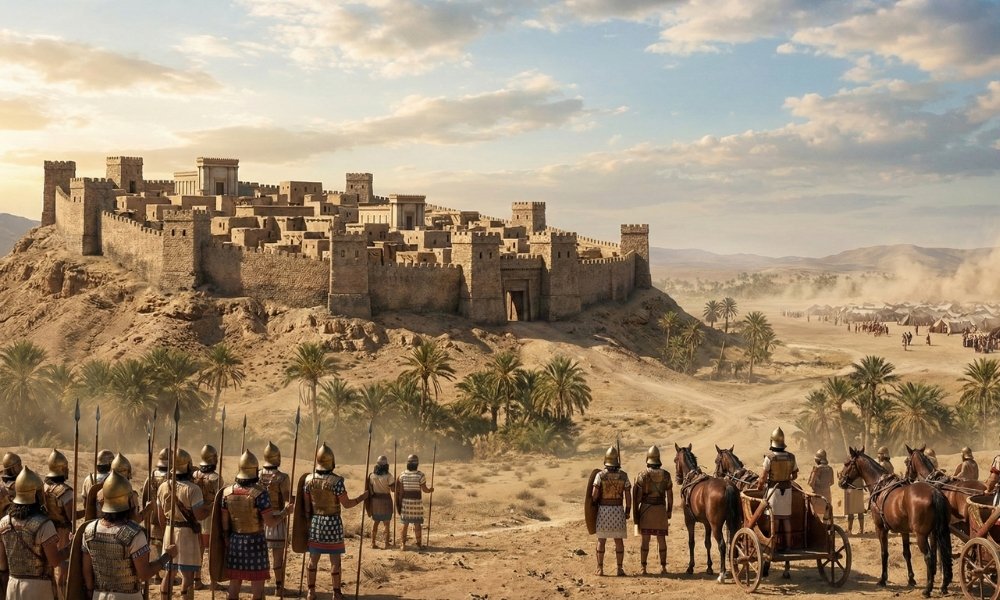
The Canaanites were the indigenous inhabitants of the land of Canaan (roughly modern-day Israel, Lebanon, Jordan, and Syria) prior to the Israelite conquest. In the biblical narrative, they are the descendants of Canaan, the son of Ham. They were not a single unified nation but rather a loose collection of city-states and various ethnic groups (such as the Amorites, Jebusites, and Hivites) sharing a common culture and language. The Canaanites are central to the Old Testament history as the primary adversaries of Israel—not just militarily, but spiritually. Their sophisticated polytheistic religion, which included the worship of Baal and Asherah, posed a constant temptation to the Israelites, leading to centuries of religious syncretism and conflict.
- Ancestry: Descendants of Canaan (son of Ham, son of Noah)
- Region: The Levant (West of the Jordan River)
- Social Structure: Independent City-States (e.g., Jericho, Hazor, Ugarit)
- Key Deities: Baal (Storm/Fertility), Asherah (Mother Goddess), Molech
- Biblical Role: The inhabitants of the Promised Land whom Israel was commanded to displace
- Key Cities: Jericho, Ai, Hazor, Megiddo, Jerusalem (Jebus)
- Fate: Conquered by Joshua, some assimilated, remnants became the Phoenicians
Name Meaning
The term “Canaanite” is derived from the ancestor Canaan (Hebrew: Kena’an). The etymology is debated, but it is often associated with the concept of “lowland” (referring to the coastal regions they inhabited) or, in later biblical usage, “merchant” or “trader” (as seen in Zechariah 14:21 and Proverbs 31:24), reflecting their reputation as fierce commercial traders (the Phoenicians).
Origin / Family Background
The Hamitic Line: According to the Table of Nations in Genesis 10, the Canaanites descended from Ham, one of Noah’s three sons.
The Curse of Canaan: Genesis 9 details a curse placed upon Canaan by Noah, predicting a future of servitude to his brothers (Shem and Japheth). This text served as a theological justification for Israel’s (descendants of Shem) later conquest of the land.
The “Seven Nations”: The Bible frequently lists specific subgroups that make up the Canaanite population, often referred to as the seven nations greater and mightier than Israel: the Hittites, Girgashites, Amorites, Canaanites, Perizzites, Hivites, and Jebusites.
Biblical Era / Context
Era: From the Patriarchal Age (approx. 2000 BCE) through the Conquest and Judges, fading during the Monarchy (approx. 1000 BCE).
Cultural Context: The Canaanites were an advanced civilization with fortified cities, iron chariots, and a developed alphabet (which influenced the Hebrew script). They were agriculturalists who relied heavily on rain, which fueled their worship of the storm god Baal.
Religion & Culture
Polytheism: Their religion was a major snare for Israel. The pantheon was led by El (the father god), but the active power was Baal (god of thunder and rain). Asherah and Astarte were goddesses of fertility and war.
Practices: Worship occurred at “High Places” (shrines on hills). Rituals included sympathetic magic to ensure harvest (fertility rites) and, in extreme cases, child sacrifice to gods like Molech (forbidden strictly in Leviticus).
Material Culture: They were renowned for their purple dye (later associated with the Phoenicians), extensive trade networks, and formidable walled architecture.
Major Roles / Identity
The Occupiers: They held the land God promised to Abraham. Their presence tested Israel’s faith and military reliance on God.
The Spiritual Adversary: They represented a worldview completely contrary to the holiness of Yahweh. Their culture emphasized fertility, sensuality, and appeasement of capricious gods, whereas Yahweh demanded moral righteousness and exclusive loyalty.
The Warning: Their expulsion was framed not just as a land grab by Israel, but as divine judgment on the Canaanites for centuries of wickedness (Genesis 15:16).
Key Interactions / Events
Abraham’s Sojourn: Abraham lived as a stranger among the Canaanites, buying the Cave of Machpelah from Ephron the Hittite to bury Sarah.
The Spies’ Report: Ten of the twelve Israelite spies were terrified of the Canaanites, describing them as giants and the Israelites as grasshoppers (Numbers 13).
The Conquest: Under Joshua, Israel destroyed major Canaanite strongholds like Jericho and Ai.
The Failure to Drive Them Out: Judges 1 records that many tribes failed to fully expel the Canaanites. Consequently, the remaining Canaanites became “thorns in their sides” and their gods a snare to Israel.
Major Relationships
Israel: A relationship defined by war, forbidden intermarriage, and religious tension.
Egypt: Historical records show Canaan was often a vassal state of the Egyptian Empire during the Late Bronze Age (time of the Exodus).
Phoenicians: The coastal Canaanites who were not conquered eventually evolved into the Phoenician civilization (centered in Tyre and Sidon), famous for maritime trade and interacting with Kings David and Solomon.
Notable Passages
Genesis 9:25: The curse — “Cursed be Canaan! The lowest of slaves will he be to his brothers.”
Deuteronomy 7:1-6: The command for destruction — “You must destroy them totally. Make no treaty with them, and show them no mercy… for you are a people holy to the Lord your God.”
Leviticus 18:24-25: The reason for judgment — “Do not defile yourselves in any of these ways… even the land was defiled; so I punished it for its sin, and the land vomited out its inhabitants.”
Judges 2:2-3: The consequence of disobedience — “I will not drive them out before you; they will become traps for you, and their gods will become snares to you.”
Legacy & Impact
Theological Symbol: In Christian thought, the Canaanites often symbolize the “flesh” or internal sin that the believer must ruthlessly drive out to possess the “Promised Land” of the Spirit-filled life.
Cultural Influence: ironically, the Canaanite language and alphabet are the direct ancestors of the Hebrew language and script.
Historical Remnant: The woman of Syro-Phoenicia in the New Testament (Mark 7:26) is identified as a “Canaanite” in Matthew 15:22, showing that the identity persisted into the Roman era.
Symbolism / Typology
The Giants (Anakim): Symbolize insurmountable obstacles in the life of faith.
Iron Chariots: Symbolize human military superiority which is nothing compared to God’s power.
High Places: Symbolize idolatry and the elevation of human desires over God’s law.
Extra-Biblical References
The Amarna Letters: A cache of clay tablets found in Egypt containing correspondence between Canaanite city-kings and the Pharaoh. They describe a chaotic land with “Habiru” (possibly Hebrews) attacking the cities, pleading for Egyptian help.
Ugaritic Texts (Ras Shamra): Discovered in 1929, these texts provided a wealth of information about Canaanite religion, including the mythology of Baal and Anat, shedding light on why the Bible so strongly condemns their practices.







Leave a Reply