
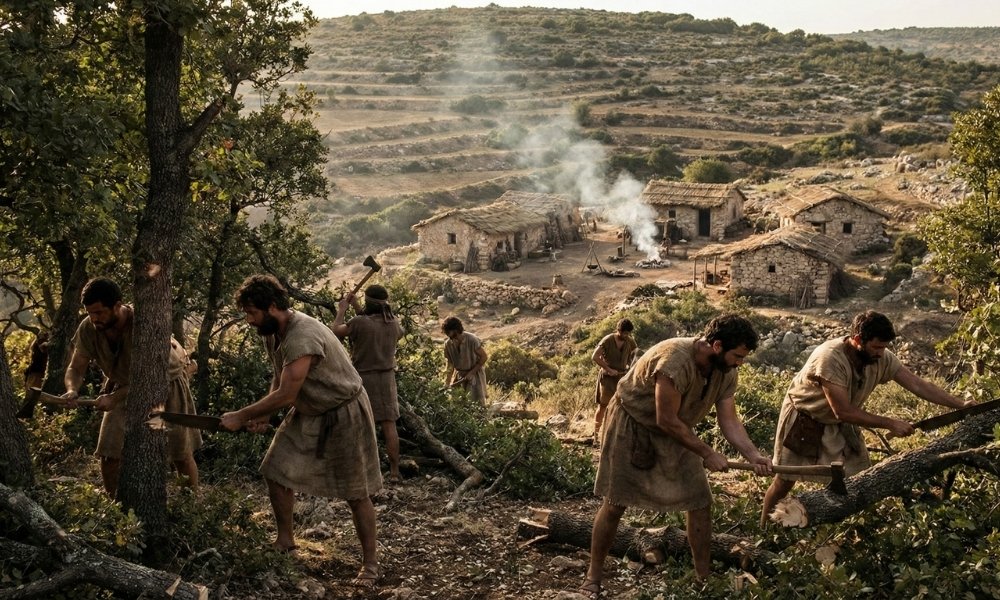
The Perizzites are perhaps the most elusive of the seven nations destined for destruction in the Promised Land. Unlike the Hittites or Amorites, they are not listed in the “Table of Nations” in Genesis 10, leading many scholars to believe their name describes a lifestyle rather than a specific genealogy. They are frequently mentioned in tandem with the Canaanites, appearing as the rural counterpart to the urbanized city-dwellers. They inhabited the forested hill country and the open, unwalled regions of Israel. Despite their rural nature, they were a formidable force, requiring significant military effort by the tribes of Judah, Simeon, and Ephraim to dislodge.
- Ancestry: Unknown (Not listed in Genesis 10); possibly a subset of Canaanites
- Region: The forested hill country (Ephraim/Manasseh) and Judah
- Meaning: “Villagers,” “Rural dwellers,” or “People of the open land”
- Biblical Role: The rural inhabitants of the land during the Patriarchal and Conquest eras
- Key Figures: Adoni-Bezek (associated King)
- Context: Often paired with the Canaanites (“The Canaanite and the Perizzite…”)
- Fate: Defeated by Judah/Simeon; remnant enslaved by Solomon
Name Meaning
The name “Perizzite” (Hebrew: Perizzi) is derived from the word prazot, meaning “open country” or “unwalled town.” This suggests that while other nations lived in fortified cities with gates and bars (like Jericho), the Perizzites dwelt in open villages, hamlets, or scattered agricultural settlements in the hills.
Origin / Family Background
The Missing Genealogy: Uniquely, the Perizzites are the only one of the seven “forbidden nations” not explicitly listed as a descendant of Canaan in the Table of Nations (Genesis 10).
Theories of Origin:
- Social Class: The term might not originally refer to an ethnic tribe but to a social class—the “peasants” or agrarian class of the Canaanite civilization.
- Hurrian/Indo-European: Some scholars link them to groups migrating from the north, distinct from the Semitic/Hamitic Canaanites, which would explain their separate mention.
- Assimilation: Over time, the Bible treats them as a distinct ethnic entity, listing them alongside the Hittites and Jebusites as enemies to be conquered.
Biblical Era / Context
The Patriarchs: They were already established in the land when Abraham arrived. Their presence was a source of tension regarding resources (land and water).
The Conquest: By the time of Joshua, they were entrenched in the “forest country” of the central hills.
The Judges: They remained a significant threat in the early Iron Age until the tribe of Judah broke their power.
Key Interactions / Events
Abraham and Lot’s Separation: The quarrel between Abraham’s herdsmen and Lot’s herdsmen over grazing land is punctuated by the ominous note: “The Canaanites and the Perizzites were also living in the land at that time” (Genesis 13:7). Their presence meant land was scarce, forcing the separation of the two patriarchs.
Jacob’s Fear: After Simeon and Levi massacred the city of Shechem, Jacob feared retaliation, specifically naming this group: “You have brought trouble on me by making me obnoxious to the Canaanites and Perizzites, the people of the land” (Genesis 34:30).
The Defeat of Adoni-Bezek: In Judges 1, the tribes of Judah and Simeon joined forces to attack the Canaanites and Perizzites. They killed 10,000 men at Bezek. They captured the king, Adoni-Bezek, and cut off his thumbs and big toes—a punishment he admitted he had inflicted on 70 other kings.
The Complaint of Ephraim: The tribe of Ephraim complained to Joshua that they needed more space. Joshua told them to clear the forest in the hill country “of the Perizzites and Rephaim” (Joshua 17:15), indicating they lived in the dense, uncleared woodlands.
Major Roles / Identity
The Occupiers of the Open Land: While the Canaanites held the valleys and the coast (where chariots could run), and the Jebusites held the fortress of Jerusalem, the Perizzites occupied the rugged, forested terrain that was difficult to clear and farm.
The Obstacle to Expansion: For the Israelites to transition from nomadic herders to settled farmers, they had to displace the Perizzites who controlled the prime agricultural “open country.”
Notable Passages
Genesis 13:7: “And quarreling arose between Abram’s herders and Lot’s. The Canaanites and Perizzites were also living in the land at that time.”
Exodus 33:2: God’s promise to Moses—”I will send an angel before you and drive out the Canaanites, Amorites, Hittites, Perizzites, Hivites and Jebusites.”
Joshua 17:15: “If you are so numerous… go up into the forest and clear land for yourselves there in the land of the Perizzites and Rephaim.”
Judges 1:4-5: “Judah attacked, and the Lord gave the Canaanites and Perizzites into their hands.”
Legacy & Impact
Intermarriage: Unfortunately, the Israelites did not fully drive them out. Ezra 9:1 records that even after the return from Babylonian exile, the people had not separated themselves from the “detestable practices” of the Perizzites and others, leading to a crisis of faith and national repentance.
Solomonic Slavery: 1 Kings 9:20-21 notes that Solomon conscripted the descendants of the Perizzites (who were not Israelites) into his forced labor force for his massive building projects.
Symbolism / Typology
The Hidden Enemy: Because they lived in forests and open villages rather than obvious walled fortresses, the Perizzites can symbolize the “unwalled” or subtle areas of sin in a believer’s life—complacency, lack of boundaries, or wild, uncleared “forests” of the heart that must be diligently worked and tamed.
Expansion: Joshua’s command to clear the Perizzite forest symbolizes the necessity of spiritual work and growth; God gives the land, but the believer must “clear the trees” to possess it fully.







Leave a Reply