
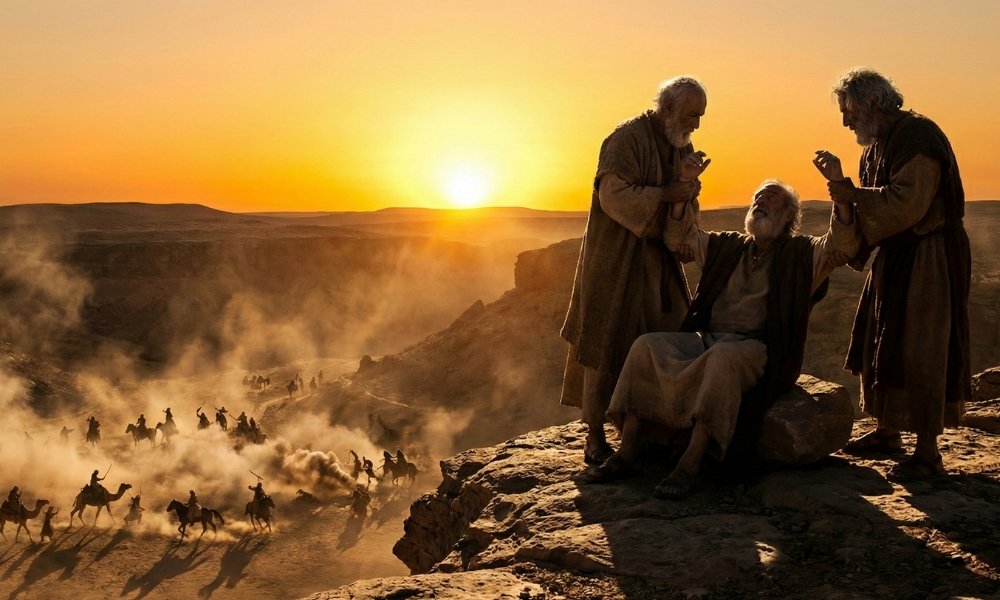
The Amalekites were a nomadic, marauding tribe that inhabited the desolate Negeb (Negev) desert south of Canaan. In biblical history, they hold the infamous title of being the first nation to attack the Israelites after their exodus from Egypt. Because of their unprovoked assault on the weak and weary stragglers of Israel, God declared a perpetual war against Amalek from generation to generation. They were known for their guerrilla warfare tactics, raiding settled communities for plunder and then retreating into the desert. They served as a constant scourge to Israel throughout the period of the Judges and the early Monarchy, until their power was effectively broken by Saul and David, and their final remnants destroyed in the time of Hezekiah.
- Ancestry: Descendants of Amalek (Grandson of Esau)
- Region: The Negev Desert and Sinai Peninsula
- Lifestyle: Nomadic raiders, bedouins
- Key Figures: King Agag, Haman (descendant)
- Biblical Role: The arch-enemy of Israel; the first to attack the Exodus
- Key Events: Battle of Rephidim, Saul’s disobedience, David’s raid at Ziklag
- Fate: Consumed by constant warfare; final remnants killed by Simeonites
- Symbol: The relentless predator
Name Meaning
The etymology of “Amalek” is debated. Some scholars suggest it means “dweller in a valley,” while others link it to “warlike” or “people who lick (blood).” In rabbinic tradition, the name is sometimes interpreted as am lak, meaning “a people who strike” (to sever heads), emphasizing their brutality.
Origin / Family Background
Genealogy: Genesis 36:12 identifies Amalek as the grandson of Esau. Eliphaz (Esau’s son) had a concubine named Timna, who bore Amalek. This makes the Amalekites distinct from the Canaanites (who were Hamitic); the Amalekites were Semitic and distant cousins to the Israelites, fueling a bitter “brotherly” rivalry similar to that with Edom.
The “First of Nations”: In the oracle of Balaam (Numbers 24:20), Amalek is called “the first among the nations,” likely referring to their status as the first prominent power to oppose God’s redeemed people in the wilderness.
Biblical Era / Context
The Wilderness: They controlled the trade routes and resources of the Sinai peninsula. They viewed the massive migration of Israelites as a threat to their dominance over the desert oases.
The Judges: They frequently allied with other enemies (like the Moabites or Midianites) to raid Israel during harvest times, destroying crops and starving the people.
The Monarchy: They were the primary target of King Saul’s first major campaign and a constant nuisance to David during his time in exile.
Key Interactions / Events
The Battle of Rephidim (Exodus 17): Shortly after crossing the Red Sea, Amalek attacked Israel at Rephidim. Joshua led the army in the valley, while Moses stood on a hill with the staff of God. As long as Moses held up his hands, Israel prevailed; when he lowered them, Amalek prevailed. Aaron and Hur famously held up Moses’ hands until sunset, securing the victory.
The Command to Obliterate (Deuteronomy 25): Moses commanded Israel to “blot out the name of Amalek from under heaven” because they had ruthlessly attacked the stragglers—the faint and weary at the rear of the column—showing no fear of God.
Saul and King Agag (1 Samuel 15): God commanded King Saul to completely destroy the Amalekites. Saul defeated them but disobeyed by sparing their King, Agag, and the best of the livestock. This disobedience cost Saul his kingship. The prophet Samuel had to execute Agag himself.
The Raid on Ziklag (1 Samuel 30): While David was away, Amalekites raided his city of Ziklag, burning it and kidnapping the wives and children of David and his men. David pursued them, slaughtered the raiders, and recovered everything.
Major Roles / Identity
The Opportunistic Predators: Amalekites rarely fought in open, pitched battles against superior forces. Their tactic was to ambush the weak, the tired, and the isolated.
The Hereditary Enemy: Yahweh declared, “The Lord will be at war against Amalek from generation to generation” (Exodus 17:16). They represent a specialized kind of evil that stands in direct opposition to God’s throne.
Notable Passages
Exodus 17:16: “Because hands were lifted up against the throne of the Lord, the Lord will be at war against Amalek from generation to generation.”
Deuteronomy 25:17-18: “Remember what the Amalekites did to you along the way… how they attacked the stragglers in your rear when you were faint and weary.”
1 Samuel 15:22: Samuel’s rebuke to Saul after the Amalekite war—”To obey is better than sacrifice, and to heed is better than the fat of rams.”
Legacy & Impact
Haman the Agagite: In the Book of Esther, the villain Haman is introduced as an “Agagite.” This links him directly to Agag, the Amalekite king from Saul’s time. The conflict in Esther is thus presented as the final showdown in the ancient war between Israel (Mordecai, a Benjaminite like Saul) and Amalek.
Hezekiah’s Extermination: 1 Chronicles 4:43 records that during the reign of Hezekiah, 500 men from the tribe of Simeon went to Mount Seir and killed “the remaining Amalekites who had escaped,” finally fulfilling the command of Moses.
Symbolism / Typology
The Flesh: In Christian typology, Amalek is widely viewed as a type of “the flesh” (the sinful nature).
- It attacks when the believer is weary.
- It is a grandson of Esau (the profane man).
- It cannot be reconciled with; it must be ruthlessly put to death (mortified).
- It continues to fight against the Spirit from generation to generation.







Leave a Reply