
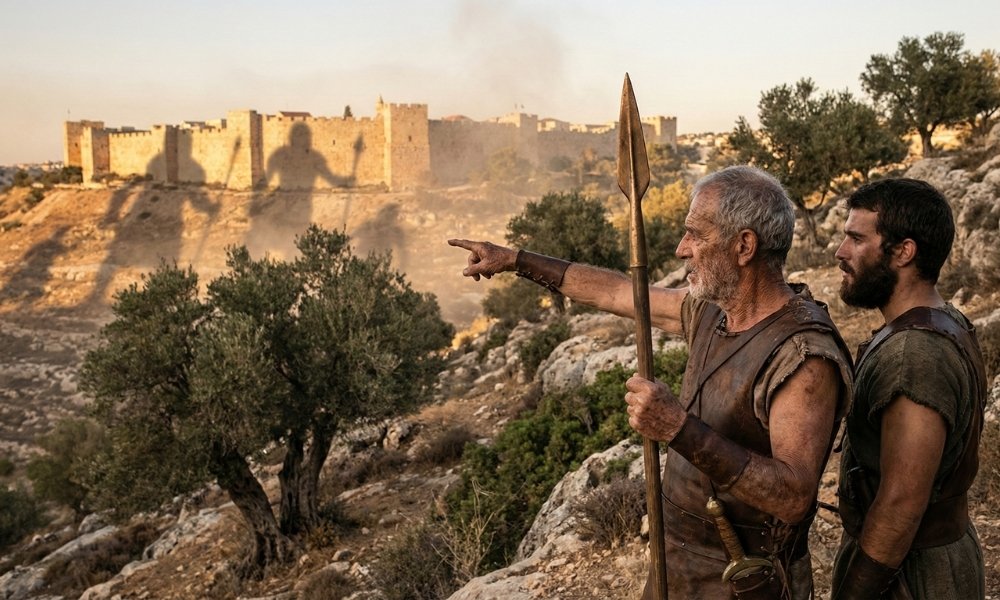
The Kenizzites are a minor but historically significant group mentioned in the Old Testament, primarily known for their unique assimilation into the tribe of Judah. They are first listed in Genesis 15 as one of the ten nations whose land God promised to Abraham. However, they are most famous because of Caleb, the faithful spy. Caleb is repeatedly called a “Kenizzite” or “son of Jephunneh the Kenizzite.” This indicates that one of Israel’s greatest heroes was likely of foreign extraction—possibly Edomite—whose clan fully integrated into Israel and inherited the hill country of Hebron due to their fierce loyalty to Yahweh.
- Ancestry: Descendants of Kenaz (likely related to Esau/Edom)
- Region: The Negev and Southern Hill Country (Hebron/Debir)
- Meaning: “Hunter” or “Side” / “Flank”
- Key Figures: Caleb, Othniel (First Judge of Israel)
- Biblical Role: Faithful converts; warriors of Judah
- Fate: Fully absorbed into the Tribe of Judah
- Symbol: The Hill Country / The Lion of Judah (by adoption)
Name Meaning
The name “Kenizzite” (Hebrew: Qenizzi) comes from the root Kenaz. The meaning is uncertain but is often associated with “Hunter.” It may also be related to an Arabic root meaning “to tuck in” or “side,” perhaps referring to their dwelling on the flanks of the mountains.
Origin / Family Background
The Edomite Connection: The genealogy is fascinatingly complex. Genesis 36:11 lists “Kenaz” as a grandson of Esau (Edom). This suggests that the Kenizzites were originally an Edomite clan.
The Pre-Israelite Tribe: Genesis 15:19 lists the “Kenizzites” alongside the Kenites and Kadmonites as people already inhabiting the land before Israel arrived.
The Fusion: Scholars generally believe that a clan of these Kenizzites (the house of Jephunneh) broke away from their Edomite or Canaanite roots and joined the Israelites during the Exodus, similar to the “mixed multitude” that left Egypt. By the time of the conquest, they were reckoned as part of the tribe of Judah, though their distinct lineage was remembered.
Biblical Era / Context
The Conquest: While the cowardly spies were terrified of the giants (Anakim) in Hebron, Caleb the Kenizzite was eager to attack them. His confidence in God allowed him to claim the most difficult territory in the land.
The Judges: The very first Judge raised up to deliver Israel was Othniel son of Kenaz, Caleb’s younger brother (or nephew). This means the first deliverer of Israel was a Kenizzite, highlighting how fully they had been grafted into the nation.
Key Interactions / Events
Caleb’s Request (Joshua 14): At age 85, Caleb approached Joshua and demanded his inheritance. He declared, “I am still as strong today as the day Moses sent me out… Now give me this hill country.” He drove out the three sons of Anak from Hebron, a feat no full-blooded Israelite had accomplished.
The Capture of Debir (Joshua 15): Caleb offered his daughter Aksah in marriage to whoever could conquer the city of Kiriath Sepher (Debir). Othniel, a Kenizzite, took the city and won the bride. This story underscores the Kenizzites’ role as the “shock troops” of Judah—taking the hardest targets.
Major Roles / Identity
The Adopted Sons: The Kenizzites represent the theological truth that covenant faithfulness supersedes bloodline. Caleb is technically a foreigner by descent, yet he is the representative leader of the tribe of Judah (Numbers 13:6) because he “followed the Lord wholeheartedly.”
The Giant Slayers: They are inextricably linked to Hebron and the defeat of the Anakim (giants). While others saw themselves as grasshoppers, the Kenizzites saw the giants as bread to be devoured.
Notable Passages
Genesis 15:19: “…the land of the Kenites, Kenizzites, Kadmonites…”
Numbers 32:12: “…except Caleb son of Jephunneh the Kenizzite and Joshua son of Nun, for they followed the Lord wholeheartedly.”
Joshua 14:14: “So Hebron has belonged to Caleb son of Jephunneh the Kenizzite ever since, because he followed the Lord, the God of Israel, wholeheartedly.”
Legacy & Impact
Hebron: Because of the Kenizzites, Hebron became a Levitical city of refuge and the first capital of King David. The stability established there by Caleb’s clan laid the foundation for the Davidic monarchy.
Othniel: As the first Judge (Judges 3:9), Othniel set the standard for leadership. The Spirit of the Lord came upon a man of Kenizzite blood to save the entire nation, proving that God can use anyone who is willing to fight for His people.
Symbolism / Typology
Wholeheartedness: Caleb the Kenizzite is the biblical type of “wholehearted” devotion. He symbolizes the believer who does not waver in old age but maintains the vigor of faith, claiming the promises of God even when they are defended by “giants.”
Spiritual Inheritance: The Kenizzites show that spiritual inheritance is not automatic (by birth) but is seized by faith.







Leave a Reply