
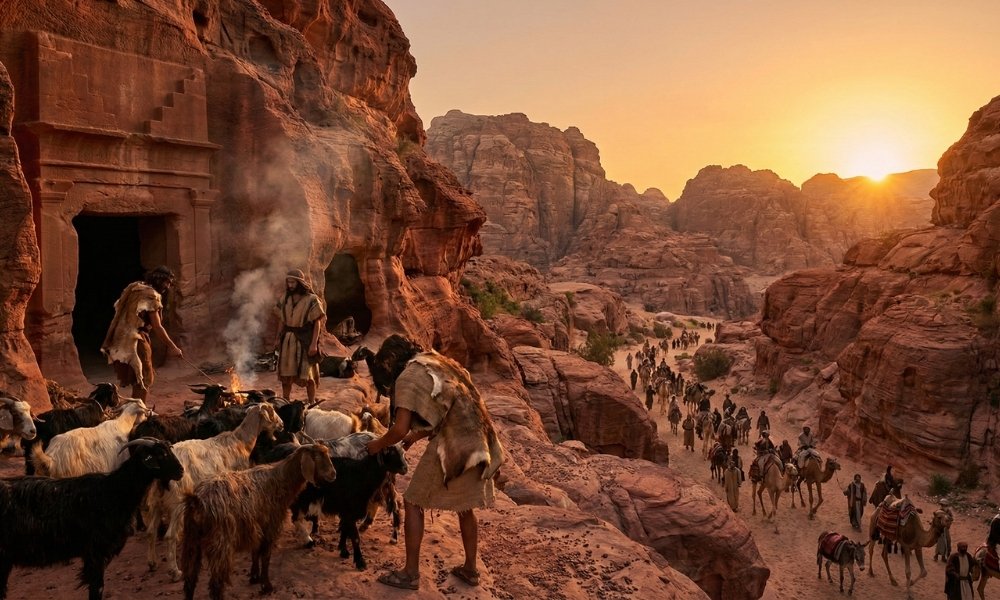
The Horites were the indigenous inhabitants of Mount Seir, the rugged mountainous region south of the Dead Sea, before they were conquered and dispossessed by the descendants of Esau (the Edomites). Often traditionally understood as “cave-dwellers” due to the geological nature of their homeland (which includes the area later known as Petra), they appear in the biblical narrative as a distinct clan-based society. While they were militarily defeated by the Edomites, they were not entirely wiped out; instead, they intermarried with Esau’s family, weaving their bloodline into the history of Edom and, notably, the ancestry of the Amalekites.
Quick Facts
- Name: Horites / Horim (Hebrew: Chori)
- Meaning: Traditionally “Cave Dwellers”; modern scholars also link them to the “Hurrians” or “Free Ones”
- Region: Mount Seir (territory later known as Edom)
- Era: Patriarchal Age (~2000 BCE) until absorbed by Edom
- Progenitor: Seir the Horite
- Successors: The Edomites (descendants of Esau)
- Key Event: Defeated by the coalition of Chedorlaomer; displaced by Esau
- Legacy: Ancestors of the Amalekites (through Timna)
Name Meaning
“Horite” (Hebrew: Chori) is most commonly derived from the Hebrew word chor, meaning “hole” or “cave.” This leads to the definition “Cave Dwellers” or “Troglodytes.” This fits the topography of Mount Seir and the later city of Petra, where dwellings were hewn directly into the sandstone cliffs.
Note: Many modern scholars also associate them with the Hurrians, a major non-Semitic civilization of the ancient Near East. However, the Bible presents the Horites specifically as a local clan in Seir rather than the broad Hurrian empire found in Mesopotamia.
Lineage / Family Background
Progenitor: They trace their descent to Seir the Horite, an individual whose genealogy is preserved in Genesis 36 separately from Esau’s, though they eventually merged.
The Seven Chiefs: Seir had seven sons who became the chiefs (sheikhs) of the Horites (Genesis 36:20-21):
- Lotan
- Shobal
- Zibeon
- Anah
- Dishon
- Ezer
- Dishan
The Esau Connection: The Bible records that Esau married Oholibamah, a Horite woman (the granddaughter of Zibeon). Furthermore, Timna (a Horite woman) became a concubine to Esau’s son Eliphaz, giving birth to Amalek.
Biblical Era / Context
Time: They appear early in the biblical narrative, existing as an established people group during the time of Abraham (Genesis 14) and Isaac.
Setting: They inhabited the “hill country of Seir,” a formidable landscape of red sandstone mountains and canyons stretching from the Dead Sea to the Gulf of Aqaba.
Cultural Context: They lived as a confederation of clans ruled by chieftains (alluphim), a political structure that the Edomites seemingly adopted after conquering them.
Major Roles / Identity
The Predecessors: They serve as the historical placeholder for the land of Edom. Just as the Canaanites were in the land before Israel, the Horites were in Seir before Esau.
The Conquered: Deuteronomy 2 uses the Horites as an object lesson for Israel. Moses explains that just as God gave Canaan to Israel, He gave Seir to Esau, who destroyed the Horites to take possession of it.
The Maternal Line of Amalek: Through the Horite woman Timna, the fierce tribe of Amalek was born. This means the arch-enemies of Israel were of mixed Edomite-Horite stock.
Key Character Traits
Resilient/Mountainous: Living in the arid, rocky terrain of Seir required toughness and adaptation to harsh environments.
Tribal/Clan-Focused: Their society was strictly organized by family heads (chiefs), a list meticulously preserved in Scripture.
Assimilated: Unlike the Rephaites who were largely exterminated, the Horites appear to have been partially absorbed, as Esau’s family intermarried with their nobility.
Main Life Events (Group History)
The War of the Kings: In Genesis 14:6, the Horites were attacked and defeated by the coalition of Eastern kings led by Chedorlaomer. They were chased as far as “El Paran” (near the desert).
The Edomite Conquest: Deuteronomy 2:12 states clearly: “The Horites used to live in Seir, but the descendants of Esau drove them out. They destroyed the Horites from before them and settled in their place.”
Integration into Edom: Genesis 36 lists the “Chiefs of the Horites” immediately following the genealogy of Esau, indicating that the surviving Horite clans became a subservient or integrated class within the Edomite kingdom.
Major Relationships
Esau: Their conqueror and kinsman by marriage. Esau effectively replaced Seir as the patriarch of the region.
Eliphaz (Son of Esau): He took a Horite concubine, uniting the bloodlines of Abraham and Seir.
The Israelites: The Horites had no direct conflict with Israel, as they had already been displaced by Edom by the time of the Exodus. However, their descendants (via Amalek) became Israel’s bitterest foes.
Notable Passages
Genesis 14:6: “…and the Horites in the hill country of Seir, as far as El Paran near the desert.” (First mention, showing them as victims of Chedorlaomer’s campaign).
Deuteronomy 2:12: “The Horites used to live in Seir, but the descendants of Esau drove them out… just as Israel did in the land the LORD gave them as their possession.”
Genesis 36:20: “These were the sons of Seir the Horite, who were living in the region…” (Followed by a detailed list of their chiefs).
Legacy & Impact
The Sovereignty of Borders: The history of the Horites is used by Moses to teach Israel that God appoints the times and boundaries of nations (Acts 17:26). The Horites lost their land because God assigned it to Esau.
The Amalekite Root: The bitterness of the Amalekites toward Israel may have roots in their Horite grandmother, Timna. Rabbinic tradition suggests Timna tried to convert to join Abraham’s family but was rejected, leading her to join Esau’s family and breed a son (Amalek) who would hate Israel.
Petra: The Horite legacy of living in rock clefts likely influenced the architectural and dwelling style of the region, perfected later by the Nabataeans in Petra.
Symbolism / Typology
The Old Nature: Just as the Horites (fleshly inhabitants) had to be dispossessed for the sons of Esau to inherit, they represent the previous occupants that must make way for God’s appointed order.
Hidden/Earthy: Their name (Cave/Hole) links them to the earth and darkness, contrasting with the “children of light.”
Extra-Biblical References
Nuzi Tablets: Thousands of tablets found in Nuzi (modern Iraq) detail the customs of the Hurrians. While the biblical “Horites” of Seir seem localized, many scholars believe they were a western branch of this massive Hurrian migration that occurred in the 2nd millennium BCE.
Egyptian Records: Ancient Egyptian topographical lists mention distinct groups in the Seir/Edom region, corroborating the existence of organized tribes in that area during the patriarchal period.







Leave a Reply