
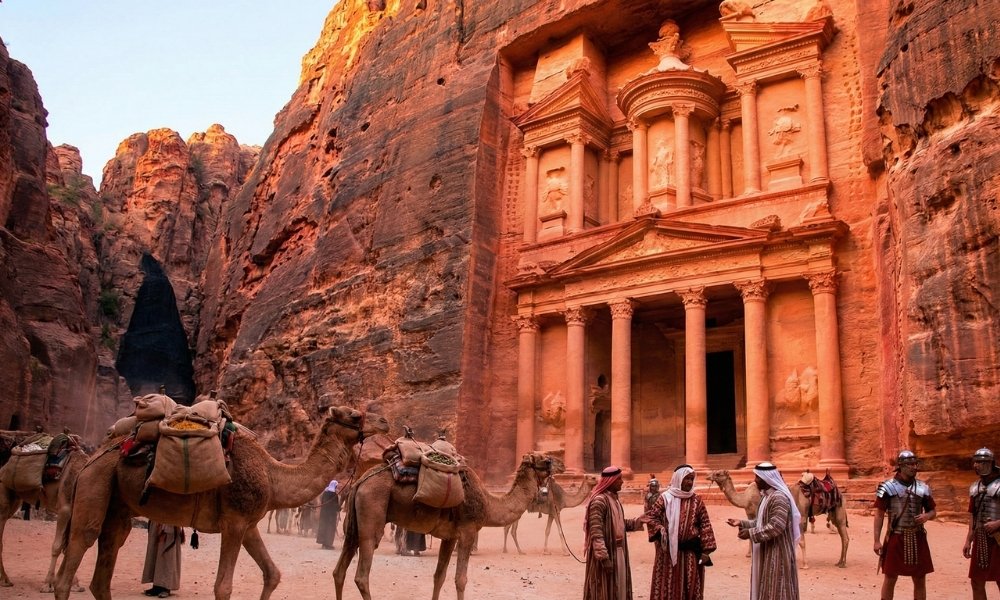
The Nabataeans were a remarkable Arab civilization that emerged from the desert mists to build one of the ancient world’s most spectacular kingdoms, centered around their rose-red capital, Petra. While they are not frequently mentioned by name in the Old Testament, they are crucial to biblical history as the successors to the Edomites in Mount Seir and powerful players during the New Testament era. They were masters of the desert—expert hydrologists who could find water where no one else could, and shrewd merchants who controlled the lucrative Incense Route. Their royal family intermarried and warred with the Herods, and it was a Nabataean ethnarch who guarded the gates of Damascus in an attempt to arrest the Apostle Paul.
Quick Facts
- Name: Nabataeans (Greek: Nabataioi; Aramaic: Nabatu)
- Meaning: Possibly derived from Nabat (“to flowing water” or “to bark/shout”) or connected to Nebaioth (son of Ishmael)
- Region: Edom, Moab, the Negev, and Northern Arabia
- Capital: Raqmu (Petra)
- Era: ~4th Century BCE to 106 CE (Roman Annexation)
- Language: A distinctive form of Aramaic (precursor to Arabic script)
- Key Monarch: King Aretas IV (“The Friend of His People”)
- Biblical Cameo: 2 Corinthians 11 (Paul’s escape); Galatians 1 (Arabia)
Name Meaning
“Nabataean” is linguistically complex.
- The Biblical Link: Many scholars historically linked them to Nebaioth, the firstborn son of Ishmael (Genesis 25:13), suggesting they are an Ishmaelite tribe.
- The Linguistic Link: The Arabic root nabat means for water to “well up” or “gush forth”—a fitting name for a people famous for finding hidden water sources in the arid desert.
Lineage / Family Background
Origin: They began as nomadic tribes from the Arabian Peninsula who migrated northward into the territory of Edom (Mount Seir) around the 6th or 5th century BCE.
Successors to Edom: As the Edomites were pushed westward into southern Judah (becoming the “Idumeans”), the Nabataeans took over their empty fortress-cities in the mountains.
The Herodian Connection: They were deeply entangled with the Herodian dynasty. King Herod Antipas (who killed John the Baptist) was originally married to the daughter of the Nabataean King Aretas IV. Herod’s divorce of her in favor of Herodias caused a war between the Nabataeans and the Jews.
Biblical Era / Context
Time: They bridge the gap between the Old and New Testaments (“Intertestamental Period”) and flourish during the time of Jesus and Paul.
Setting: They controlled the vast, arid expanse from the Red Sea to Damascus. Their capital, Petra (biblical Sela or Rekem), was a fortress city hidden within sandstone canyons, accessible only through a narrow gorge (the Siq).
Cultural Context: Unlike the warlike Assyrians or Babylonians, the Nabataeans were primarily merchant-diplomats. They amassed incredible wealth by taxing the frankincense and myrrh trade routes that ran through their territory, making Petra a cosmopolitan hub.
Major Roles / Identity
The Master Engineers: They survived in the desert by developing advanced hydraulic engineering—cisterns, dams, and aqueducts that harvested flash floods. This allowed them to practice agriculture in the desert and sustain a large population.
The Political Buffer: They served as a buffer state between the Roman Empire in the west and the Parthian Empire in the east.
The Persecutors (Briefly): In 2 Corinthians 11:32-33, Paul mentions that the “governor under King Aretas” was guarding the city of Damascus to seize him. This indicates the Nabataeans had political control or influence as far north as Damascus at that time.
Key Character Traits
Adaptable: They transitioned from tent-dwelling nomads who forbade agriculture (to remain mobile) to master builders of stone cities and settled farmers.
Wealthy: The monopoly on the incense trade made them one of the richest tribes in the region.
Artistic: Their architecture (seen in Petra) is a unique blend of Assyrian, Egyptian, Hellenistic, and Roman styles, carved directly into living rock.
Main Life Events (Group History)
Displacing the Edomites: By 312 BCE, they were established enough in Petra to successfully resist two invasions by the Greek Antigonid generals (successors of Alexander the Great).
The Height of Power (Aretas IV): Ruled from 9 BCE to 40 CE (covering the life of Jesus). Under Aretas IV, Petra reached its architectural peak, and the kingdom expanded.
War with Herod Antipas: After Herod Antipas divorced Aretas’s daughter, the Nabataean army defeated Herod’s forces in battle—a defeat the Jewish historian Josephus claimed was divine punishment on Herod for executing John the Baptist.
Paul in Arabia: After his conversion, Paul went away into “Arabia” (Galatians 1:17). This “Arabia” was the Nabataean Kingdom. It is likely he preached there, possibly stirring up the trouble that led King Aretas to hunt him down in Damascus later.
Roman Annexation: In 106 CE, the Roman Emperor Trajan peacefully annexed the kingdom, turning it into the Roman province of Arabia Petraea.
Major Relationships
The Edomites: The previous tenants of their land. The Nabataeans finished what Babylon started, effectively erasing Edom as a geographical power.
The Jews: A complicated relationship fluctuating between alliance (against the Greeks) and war (under the Hasmoneans and Herods).
The Romans: Initially allies/vassals, eventually absorbed by the Empire.
Notable Passages
2 Corinthians 11:32-33: “In Damascus the governor under King Aretas had the city of the Damascenes guarded in order to arrest me. But I was lowered in a basket from a window in the wall and slipped through his hands.”
Galatians 1:17: “I did not go up to Jerusalem… but I went into Arabia. Later I returned to Damascus.”
Isaiah 60:7 (Prophetic context): “All Kedar’s flocks will be gathered to you, the rams of Nebaioth will serve you; they will be accepted as offerings on my altar…” (Predicting the wealth of these Arab tribes eventually glorifying God).
Legacy & Impact
Petra: One of the New Seven Wonders of the World. Its ruins stand as a testament to their ingenuity.
The Arabic Script: The Nabataeans wrote in Aramaic, but their cursive style of writing eventually evolved into the Arabic alphabet used today.
The Magi? Because the Nabataeans controlled the frankincense and myrrh trade from the East, some scholars speculate that the “Magi from the East” would have likely passed through or had contact with the Nabataean trade network to acquire their gifts for the Christ child.
Symbolism / Typology
Water from the Rock: Their ability to bring life-sustaining water out of the dry rock of Petra serves as a physical echo of the spiritual truth of Christ (the Rock) providing living water in the wilderness.
Pride of the Rock: The prophecy of Obadiah against Edom (“You who live in the clefts of the rocks and make your home on the heights, who say to yourself, ‘Who can bring me down to the ground?’”) visually describes the Nabataean capital perfectly, illustrating the illusion of security provided by physical defenses.







Leave a Reply